At dawn, the ocean surface appears as a calm, infinite mirror—a vast blue expanse that has sustained life for billions of years. For centuries, humanity viewed the sea as an inexhaustible larder. However, modern marine biology and satellite data tell a far more alarming story. We are currently witnessing a systemic collapse of global fish stocks, a phenomenon scientifically termed as Overfishing.
This is not merely a seasonal decline in catch; it is a profound biological disruption that threatens the stability of the global biosphere, the livelihoods of millions, and the food security of the entire human race.
The Biological Threshold: Understanding MSY and Population Dynamics
To understand why overfishing is a crisis, we must first look at the Maximum Sustainable Yield (MSY). In fisheries science, MSY is the largest average catch that can be captured from a stock under existing environmental conditions without affecting the population’s ability to regenerate.
The violation of Biological Limits
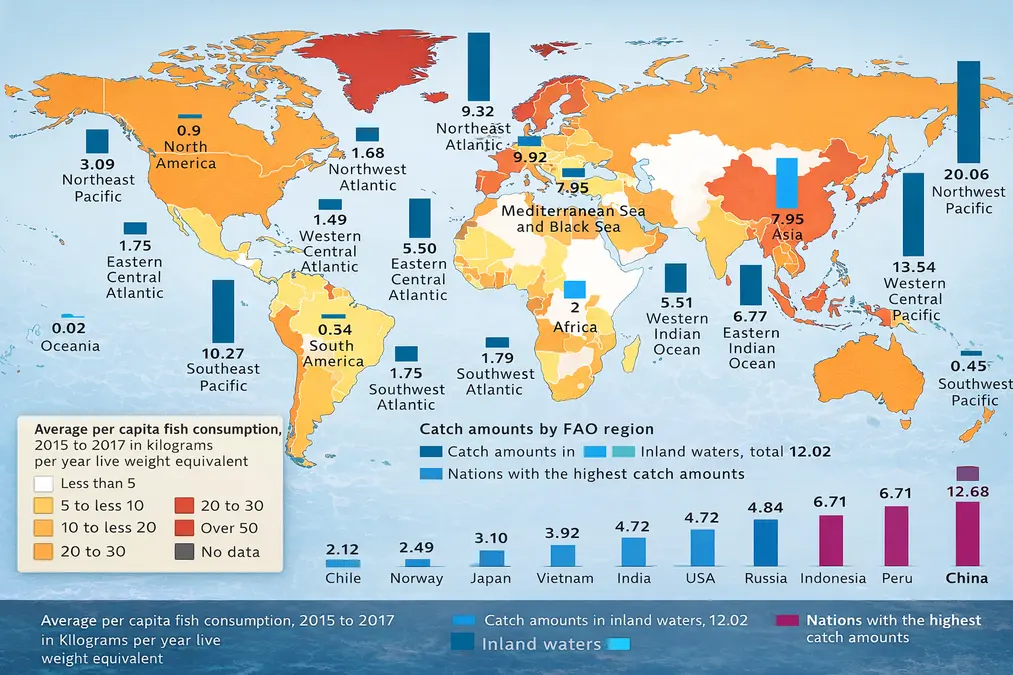
Currently, the FAO (Food and Agriculture Organization) reports that over 34.2% of global fisheries are classified as “overfished.” This means they are being harvested faster than the species can reproduce.
- Genetic Erosion: When industrial fishing consistently targets the largest individuals, it causes “Fisheries-Induced Evolution.” Only smaller, slower-growing fish survive to breed. Over decades, this permanently shrinks the average size of the species, making them less resilient and less nutritious.
- The Recruitment Failure: When “Juvenile” (young) fish are caught before they reach sexual maturity, the “recruitment” of the next generation fails, leading to a sudden and catastrophic population crash.
Trophic Cascades: The Domino Effect of Predator Removal
Marine ecosystems are built on a delicate balance of “Top-Down” control. Research into Trophic Cascades reveals that removing a single apex predator can destroy an entire habitat.
The “Shark-Ray-Scallop” Case Study
When large sharks are overfished, their prey—cownose rays—multiply uncontrollably. These rays then migrate to coastal bays and consume massive amounts of scallops and clams. This leads to the collapse of local shellfish industries and the loss of natural water filtration provided by these mollusks.
Coral Reef Suffocation
On coral reefs, “Grazers” like parrotfish act as the reef’s cleaning crew. When overfishing removes these grazers, algae grow unchecked, eventually smothering and killing the coral. This turns a vibrant “underwater city” into a biological desert, destroying the nurseries where 25% of all marine life begins.
Industrial Trawling: The Deforestation of the Sea
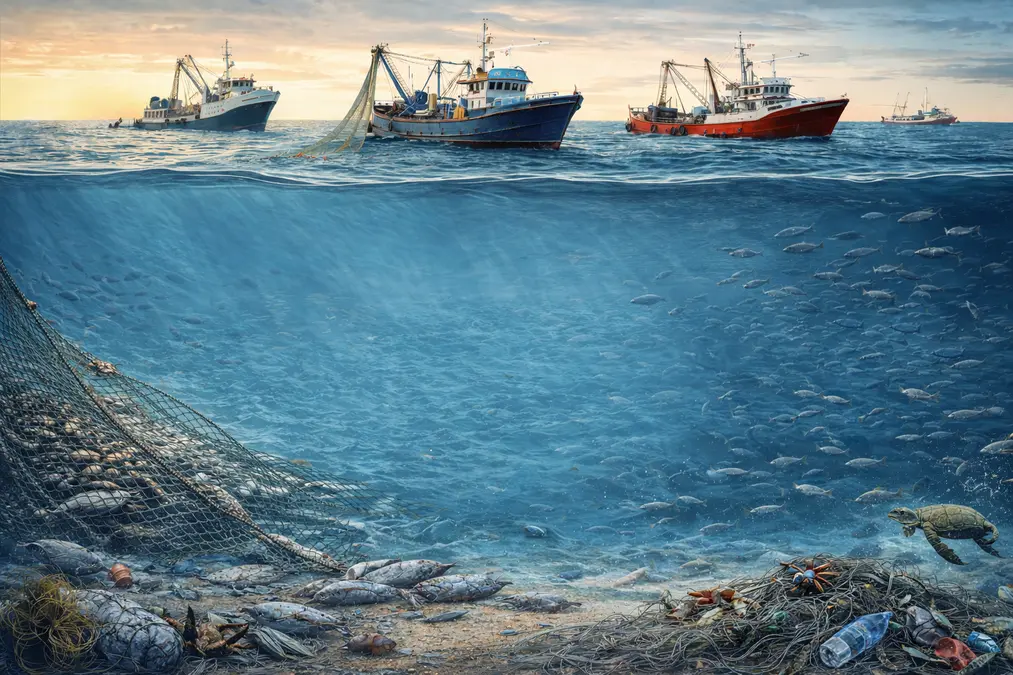
One of the most research-intensive topics in marine conservation is Bottom Trawling. This industrial method involves dragging heavy nets across the seafloor to catch shrimp and bottom-dwelling fish.
- Habitat Destruction: Bottom trawls act like underwater bulldozers, crushing ancient coral forests, sponges, and seagrass beds that have taken centuries to grow.
- The Carbon Release: Recent studies suggest that bottom trawling stirs up carbon stored in the seabed, releasing as much CO2 as the entire global aviation industry. This makes industrial fishing a significant, yet often ignored, driver of climate change.
The Silent Killer: Ghost Fishing and Plastic Pollution
Beyond active fishing, the “legacy” of discarded gear is devastating. Ghost Gear—abandoned, lost, or discarded fishing nets—accounts for nearly 10% of all marine litter.
- Entanglement: These plastic nets continue to “fish” on their own for decades. They trap whales, dolphins, and turtles, who die of exhaustion or starvation.
- Microplastic Bioaccumulation: As these nets slowly degrade, they break into microplastics. These toxic particles are eaten by plankton, then by fish, and eventually by humans, leading to serious health risks including hormonal disruption.
Global Fisheries Dashboard
| Scientific Indicator | Status in 1970 | Current Status (2024-26) | Long-term Impact |
| Global Fish Biomass | 100% (Baseline) | Reduced by ~60% | Systemic food chain collapse |
| Bycatch Ratio | 1:1.5 | 1:5 (in industrial shrimp) | Mass collateral biodiversity loss |
| Trawling Depth | 200m – 500m | Up to 2000m (Deep Sea) | Destruction of ancient ecosystems |
| Socio-Economic Value | Localized Wealth | Corporate Monopolization | Collapse of small-scale economies |
| Ocean Acidification | Low | High (pH dropping) | Loss of shell-forming species |
The Economic Paradox: Harmful Subsidies
A research-oriented analysis must address why overfishing continues despite its obvious risks. The answer lies in Economic Subsidies.
- The $35 Billion Problem: Governments worldwide provide massive subsidies to large industrial fleets. This money covers the cost of fuel and high-tech equipment, making it profitable to fish even when the stocks are almost empty.
- Unfair Competition: Without these subsidies, industrial “Super-Trawlers” would be financially unviable. Instead, they are enabled to travel to the distant waters of developing nations, stealing the protein sources of local communities who cannot compete with subsidized giants.
Humanitarian Crisis: Protein Poverty and Migration
The human cost of overfishing is a growing field of sociological research.
- The Protein Gap: In nations like Senegal, Ghana, and Sri Lanka, fish provides nearly 50% of the total animal protein intake. When industrial fleets deplete these waters, the result is mass malnutrition and stunted growth in children.
- Climate Refugees: As the sea “dies,” coastal villages that have survived for a thousand years are forced to abandon their homes. This triggers mass migration into overcrowded urban centers, leading to social unrest and economic instability.
Path to Recovery: Science-Based Solutions
The data is not all bleak. Marine research confirms that the ocean has a remarkable capacity for “Self-Healing” if managed with scientific integrity.
- Marine Protected Areas (MPAs): Studies show that “No-Take Zones” (where fishing is 100% banned) lead to a 400% increase in fish biomass within a decade. These zones act as “fish factories” that repopulate the surrounding oceans.
- Rights-Based Management: Empowering local coastal communities to manage their own waters ensures long-term stewardship over short-term profit.
- The Rise of Alternative Proteins: Investing in algae-based seafood and lab-grown fish “fillets” can take the pressure off wild stocks, allowing them to recover to 1970s levels.
Conclusion: Moving from Extraction to Stewardship
Overfishing is a loud warning from a silent ocean. It is the result of applying 21st-century technology to an ancient biological system without proper restraint. Our current “Hunter-Gatherer” approach to the ocean is no longer sustainable in a world of 8 billion people.
To save the oceans, we must move toward Ecosystem-Based Management. This means looking at the ocean not as a bucket of fish, but as a living, breathing system that regulates our climate and sustains all life. The data is clear: if the oceans fail, the terrestrial world will follow. The time for scientific intervention and global policy reform is now.