In a small village on the edge of a forest in Assam, a farmer named Dilip Hazarika had been sleeping lightly — the way everyone in his village sleeps between July and October, when the rice is in the field and the elephants are moving. He heard the sound first: a low rumble, the particular vibration that carries through ground and walls and sleeping bodies in a way that no other animal in the forest produces.
By the time he reached his window, there were seven of them. A matriarch-led herd, moving through what had been his standing rice crop. In forty minutes, they consumed and trampled more than he could earn in a month.
He did not call anyone. There was no one to call at 2am who could help. He watched until they left, then went back inside and sat in the dark until morning.
This is what human-elephant conflict looks like from the inside — not in the statistics, not in the policy documents, but in the lived experience of the hundreds of millions of people across India, Sri Lanka, Kenya, Tanzania, and Thailand who share landscapes with one of Earth’s most intelligent, most powerful, and most ecologically essential animals.
The numbers that describe this conflict are, by any measure, severe. India alone records nearly 500 human deaths and 100 elephant deaths annually from crop-raiding incidents and retaliation, according to the WII Status of Elephants in India Report released in October 2025. In Kerala, the last 15 years have seen 276 elephant-related human deaths out of a total 1,527 wildlife fatalities, with the case count steadily rising — between 2021 and 2025, human interaction with elephants claimed 103 lives in that state alone.
In Chhattisgarh, a 23-year study covering 2000–2023 recorded 828 conflict incidents — 737 human fatalities and 91 injuries across 19 forest divisions, with Jashpur, Dharamjaigarh, and Surajpur emerging as the highest-concentration hotspots.
These are not abstract statistics. Every number is a family. Every raid is a season’s food gone in an hour. And every retaliatory elephant death — electrocution, poisoning, spear trap — is an animal killed not out of malice but out of desperation by a community with no other tool left.
The question is not whether human-elephant conflict is a crisis. It is. The question is whether there are solutions that work — that protect farms, protect families, protect elephants, and do not require money, technology, or infrastructure that rural communities cannot access or maintain.
There are. And three of them — one proven in Assam’s rice fields, one documented in Sri Lanka’s orange groves, and one emerging from research on elephant sensory behavior — are increasingly recognized by conservation scientists as practical, scalable, and genuinely effective.
Why Elephants Come: Understanding the Raid Before You Stop It
Before any solution can work, it requires understanding why elephants enter farmland in the first place — because the answer is more complex than simple hunger, and solutions that ignore that complexity tend to fail.
India is home to over 60 percent of the world’s wild Asian elephants. Only 22 percent of elephant habitat falls within protected areas — the remaining elephant range lies in landscapes now shared with human settlements, agriculture, and infrastructure.
Developmental activities including infrastructure projects, agricultural expansion, and deforestation have caused substantial habitat loss for elephants, intensifying conflict. As elephants migrate into human-dominated areas, the likelihood of conflict increases, often resulting in agricultural damage and heightened risks for local communities.
An Asian elephant needs between 150 and 200 kilograms of food every day. In a healthy, intact forest, that need is met by grasses, bark, leaves, and fruit distributed across a home range that can span hundreds of square kilometres. When that forest is fragmented — when highways cut through corridors, when mining removes forest blocks, when agricultural expansion pushes the forest edge closer to the village — elephants face a choice between inadequate natural forage and the extraordinarily calorie-dense, easily accessible food available in farmland.
Rice. Sugarcane. Maize. Wheat. Bananas. These are not just crops — to an elephant, they are the nutritional equivalent of a buffet placed at the edge of their shrinking territory.
In a detailed one-year study in the Surguja circle in Chhattisgarh, 363 crop-raiding incidents were recorded, affecting 12.4 hectares of crops — mostly sugarcane, rice, maize, and wheat. Crop raids were more common in areas with dense forests or scattered forest patches, which elephants used as daytime refuges before entering fields at night.
The timing matters too. HEC incidents in Chhattisgarh show seasonal variations, often peaking during the monsoon season — the period when rice crops are at their most nutritionally attractive stage and when elephants are most actively moving.
Understanding this pattern — the refuge forests, the night raids, the seasonal peaks, the preference for specific crops — is the foundation on which every effective intervention is built.
Solution 1: The Citrus Lemon Biofence — A Living Wall That Feeds the Family It Protects
The Science Behind the Smell
Elephants possess what researchers describe as the most sophisticated olfactory system of any land animal — with more smell-receptor genes than any other mammal studied, including dogs. Their primary method of investigating their environment, assessing food safety, detecting danger, and navigating across large landscapes is through smell.
This is not a peripheral detail of elephant biology. It is central to understanding why Citrus limon — the common lemon tree — works as a deterrent when used correctly.
Orange trees mask the smell of crops stored in homes, and this prevents elephants from raiding farms. Farmers reported no problems with elephants ever since they planted these trees — and the trees provided a very good supplementary income at harvest.
Lemon and citrus species produce limonene, citral, linalool, and other volatile aromatic compounds at concentrations that are overwhelming to the elephant’s highly sensitive olfactory system. These compounds are not painful or harmful — they are simply intensely aversive. An elephant approaching a dense citrus planting encounters a smell wall that its instincts register as something to avoid, not challenge.
The practical effectiveness of this repellent property depends critically, however, on how the trees are planted. A single row of citrus trees with gaps between them is not a barrier — it is a perforated line that an elephant will simply walk through. The planting design is everything.
The Assam Model: Three Rows, Zigzag Pattern, No Gaps
The most well-documented and rigorously tested citrus biofencing programme in Asia comes from Assam, India — specifically from the work of the Guwahati-based NGO Aaranyak in the Brahmaputra river basin, one of the most intense human-elephant conflict zones in South Asia.
The plantation of lemon trees around farmlands as a community-based solution was proposed in 2019 when researchers from Aaranyak came across farmers in Sauraguri while mapping the distribution pattern and intensity of human-elephant conflicts in the Brahmaputra river basin. Project leader Bibhuti Lahkar said that 500 lemon saplings were supplied to five farmers. The saplings were planted in three rows, in a zigzag pattern, not to leave any space between them, such that they are tightly intertwined when they grow bigger.

Here is why each element matters
Three rows create depth — not a line but a zone. An elephant approaching the barrier encounters the citrus scent intensifying over several of planted distance. The olfactory deterrent builds rather than hitting as a single point, making it more difficult for the animal to locate a clean entry path.
Zigzag arrangement eliminates straight sightlines through the planting. When trees are planted in straight parallel rows, gaps between trees in adjacent rows align — creating visual and physical corridors that elephants can identify and push through. A zigzag pattern means that every gap in one row is blocked by a tree in the next row. There is no straight path through.
No gaps is the absolute requirement. A biofence with gaps is not a biofence — it is a suggestion. Elephants are intelligent enough to probe barriers and locate weaknesses. If there are gaps, they will find them. Dense, tightly intertwined planting is the difference between a fence and a decoration.
In four years, Hazarika’s lemon trees grew into powerful barriers against elephants. The trees that were saplings in 2019 had, by 2023, formed a dense aromatic hedge that elephants consistently avoided.
The Double Benefit: Barrier and Income
What makes the citrus biofence particularly significant from a community adoption perspective is that it produces income while it protects.
In addition to protecting the cultivated fields, the barrier of lemon and bamboo provided additional income and fuel wood to the villagers.
A mature lemon tree produces between 100 and 200 fruits per season. A three-row biofence around a one-hectare farm might contain 60 to 90 trees — producing thousands of lemons annually that can be sold at local markets, used domestically, or processed into lemon oil and juice products. The barrier pays for itself and continues generating income indefinitely.
This transforms the economics of conservation. Instead of asking farmers to sacrifice productive land for a buffer that costs money to maintain, the citrus biofence converts the buffer zone into a productive agricultural system. The farmer is not choosing between protection and income — they are getting both from the same planting.
Important Cautions: What the Science Also Says
Scientific honesty requires acknowledging limitations that field researchers have documented.
The biofence needs to be locally suitable to the climate, ecology, and soil. The species used as a biofence should be fairly fast-growing so that local communities are interested in adopting these fences.
Citrus lemons grow well in warm, humid conditions — Assam, Kerala, Karnataka, Sri Lanka, parts of East Africa. In drier regions or at high altitudes, different citrus varieties or companion aromatic species may be more appropriate. In regions with very high rainfall, bee fences may not work but citrus biofences generally perform better.
The barrier requires maintenance. Trees must be pruned to maintain density. Gaps that develop as trees age must be replanted. A biofence that is installed and forgotten will degrade. Community ownership — meaning the same farmers who benefit from the lemons maintain the fence — is the most reliable maintenance model.
And the biofence is most effective as part of a layered system, not as the only line of defence. Paired with early warning systems or the strip lighting approach described below, citrus biofencing becomes significantly more robust.
Solution 2: Strip Lighting at Elephant Eye Height — Discomfort Without Harm
How Elephants Process Light: The Biology Behind the Solution
The second solution draws on a different sensory vulnerability of elephants — not smell, but vision and sensitivity to light intensity.
Elephants have large eyes adapted for low-light conditions. Their retinas are rich in rod cells — the photoreceptors responsible for vision in dim conditions — which is an adaptation to their largely crepuscular and nocturnal activity patterns. They see extremely well in darkness and dim light.
This adaptation, which helps elephants navigate and forage after sunset, also creates a specific sensitivity: sudden, directed, high-intensity light in their direct line of vision causes significant discomfort and disorientation. It does not injure the animal. It does not cause pain in any lasting sense. But it does create a strong aversive stimulus — an unpleasant experience that elephants associate with the location where it occurred.
The practical application of this biology is the solar-powered LED strip light deterrent system, installed at a specific height corresponding to elephant eye level.
The Design Principle: Height, Direction, and Spacing
The critical design variable in strip lighting as an elephant deterrent is installation height. The system does not work if lights are installed too high (above the animal’s eye level, where they function as ambient illumination rather than directed aversion) or too low (below eye level, where they illuminate the ground but do not reach the animal’s visual field effectively).
Target height: 1.5 to 2 metres from the ground — the approximate eye height of an adult Asian elephant. At this height, a forward-facing LED strip light creates a direct visual stimulus in the elephant’s line of sight as it approaches the field boundary.
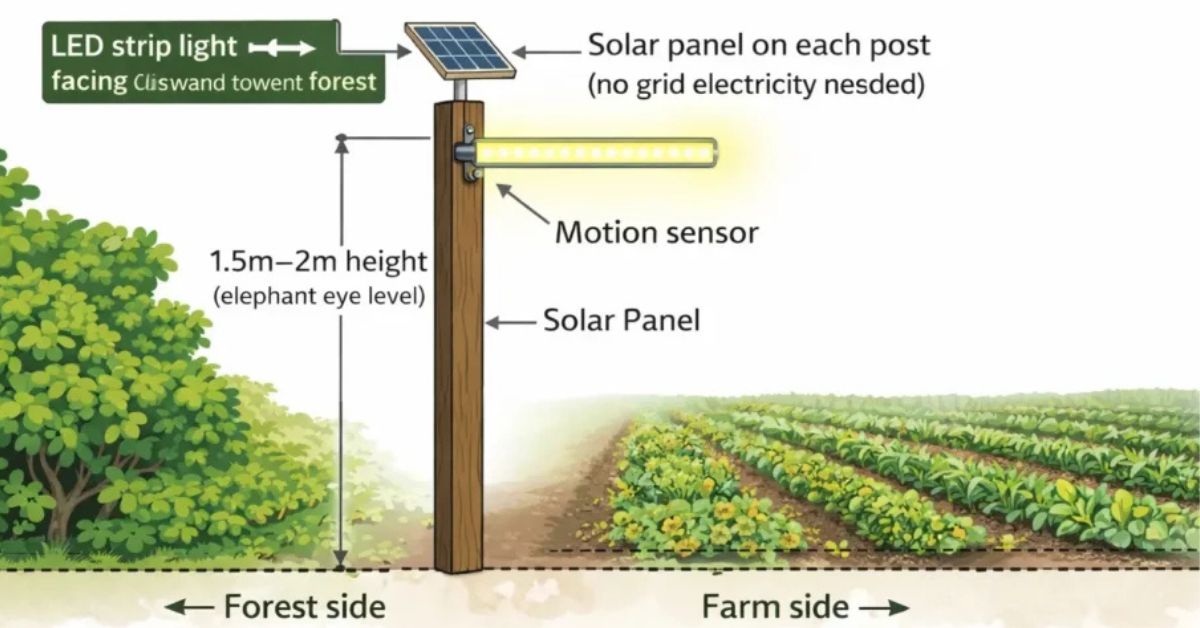
The recommended configuration combines this height parameter with specific spacing and directionality
Posts are installed every 10 to 15 metres along the farm boundary, each carrying a solar panel for power independence and an LED strip oriented toward the forest edge. Motion sensors can trigger illumination when large animals approach, or the system can run on a dusk-to-dawn timer during high-risk seasons.
The key engineering requirement is that the light faces outward — toward the forest, toward the direction of elephant approach — rather than illuminating the farm itself. The goal is to create a light barrier at the boundary, not to flood the farm with light.
Evidence from the Field
Research across multiple human-elephant conflict sites in India, Sri Lanka, and East Africa has documented that light-based deterrents — when correctly installed and maintained — reduce elephant incursion attempts significantly during the hours they are active.
Studies from North Bengal document that flash lights put up around crop fields, combined with farmers using torchlights and other deterrents, created effective combined barriers that reduced night raid success rates. The light component works best as part of a layered system — the strip light creates an aversive boundary, and if an elephant pushes past it, secondary deterrents (the citrus scent barrier, noise, human presence) provide additional deterrence.
The solar-powered design is critical for communities without reliable electricity access. A system that requires grid power will fail when power cuts occur — which in many conflict-zone villages is frequent. A self-contained solar unit with a battery backup can operate independently for the entire seven-month monsoon season that corresponds to peak conflict periods.
The Animal Welfare Dimension
One of the most important characteristics of the strip lighting approach — which distinguishes it from electric fencing, fire, firecrackers, and other deterrents still widely used — is that it causes no physical harm to the elephant.
Electric fences, when functional, are effective — but they deliver painful shocks that can injure calves, trap animals that panic, and generate the kind of aversive learning that produces increasingly desperate and aggressive attempts to breach the barrier. Firecrackers and noise deterrents cause significant stress. Fire at field boundaries creates real injury risk.
The strip light creates discomfort — a strong aversive visual stimulus — without injury. The elephant learns to associate that boundary with an unpleasant experience, turns away, and seeks another route. The learning is reinforced by the consistency of the stimulus. The animal is deterred, not damaged.
This is the standard that conservation scientists are increasingly applying to elephant deterrent systems: does it work without causing harm? The strip lighting system meets that standard.
Solution 3: The Community Early Warning Network — Technology Farmers Already Have
The third solution is less a barrier and more a system: a community-based early warning network that gives farmers the minutes of advance notice that can mean the difference between saving a crop and losing it.
The fundamental challenge of elephant raids is not just their frequency — it is their speed. A herd can consume and trample an entire field in under an hour. If farmers are asleep or working elsewhere, there is no intervention possible. By the time anyone knows an elephant is in the field, the damage is done.
Fields near roads experienced less damage, possibly due to human activity, patrolling, or early warning systems. The protective effect of human presence is well-documented — elephants avoid situations where they anticipate human confrontation. The question is how to extend that protective effect across an entire community without requiring individuals to stand guard in dark fields every night for months.
The answer that has emerged in multiple high-conflict zones is a WhatsApp-based community alert system, integrated with motion sensor technology at forest edges.
How It Works
Motion sensors or camera traps — increasingly available at costs of under ₹3,000 per unit — are installed at forest edges and known elephant entry points. When triggered, they send an alert via SMS or app notification to a designated community coordinator. The coordinator broadcasts the elephant’s location, direction of movement, and estimated time to village fields via a WhatsApp group that includes every farmer in the conflict zone.
Farmers who are closest to the projected entry point respond — not by confronting the elephants, but by activating deterrents: lights, noise at a safe distance, and by ensuring no one is in the fields. The coordinated response across multiple farms reduces the probability that elephants find an easy unguarded entry point.
Machans or huts at ground-level are used as look-outs and manned by individual farmers or groups guarding several fields cooperatively. Studies have shown that such tactics have helped reduce crop loss significantly. The modern version of this traditional practice replaces individual overnight vigils with a network that distributes the burden across the community — making it sustainable rather than exhausting.
The system costs almost nothing to operate after initial setup. The technology — smartphones, WhatsApp, inexpensive motion sensors — is already present in most Indian villages. What it requires is organization, a designated coordinator, and the establishment of community protocols for how alerts are shared and acted upon.
The Three Solutions Together: Why Layering Works
No single deterrent is 100 percent effective against elephants. This is one of the most consistently documented findings in 30 years of human-elephant conflict research. No single technique was deemed to be 100% effective at deterring crop-raiding elephants. However, chili pepper approaches were cited as being effective in 28% of studies across eight countries, and crop guarding coupled with deterrents was cited as most effective at 23% across 11 countries.
Elephants are intelligent, adaptable, and motivated by hunger and instinct. A single-barrier system — however well designed — will eventually be breached by a determined herd. The effectiveness of any deterrent increases dramatically when it is layered with complementary approaches.
The three solutions described in this article are designed to work together as a layered system:
Layer 1 — The Citrus Biofence creates a persistent olfactory barrier that requires no maintenance vigilance and produces income. It deters the casual approach — elephants that encounter the scent wall and turn away without any human intervention required.
Layer 2 — The Strip Lighting System activates when elephants push past or around the scent barrier at night. The directed light at eye height creates an aversive visual stimulus that reinforces the deterrence. A herd that finds the scent barrier unfamiliar on one side now encounters a light barrier on the other.
Layer 3 — The Community Warning Network activates when both barriers are tested. Farmers receive advance warning, deterrent responses are coordinated, and the protected perimeter is reinforced by coordinated human presence without anyone entering dangerous proximity to the animals.
This is not a theoretical model. It reflects the layered approach that the most successful conflict-mitigation projects in India and Sri Lanka have independently converged on.
The Animals Behind the Statistics: Why This Matters for Elephants Too
It is easy, in discussing human-elephant conflict, to focus on the human cost — and that cost is real and severe. But the elephant cost is equally significant and equally deserves attention.
Nearly 500 human deaths and 100 elephant deaths occur annually due to crop raiding and retaliation in conflict zones. Those 100 elephant deaths each year are not poached animals or animals killed for ivory. They are animals killed in direct retaliation — electrocuted on illegal live wires strung across fields, poisoned in crops, speared in the dark by terrified farmers with no other tool available.
40 to 50 elephants are killed annually while crop-raiding. Forests are destroyed by villagers in the belief that it will prevent the animals from using the area, leaving elephants caught in the pincer grip of habitat fragmentation and retaliation.
India holds over 60 percent of the world’s wild Asian elephants. The Asian elephant is classified as Endangered on the IUCN Red List. Every individual lost to retaliation is a genetic loss that the population cannot easily absorb.
The solutions described in this article — citrus biofencing, strip lighting, community early warning — are not charity toward wildlife at farmers’ expense. They are frameworks for coexistence that protect farmers’ livelihoods and protect elephants from the retaliation that habitat loss and crop competition otherwise make almost inevitable.
The war that begins at 2am in a rice field in Assam does not have to end the way it usually ends — with a farmer staring at flattened crops in the dark, and somewhere in the forest, an elephant moving toward the next village with a human community’s tolerance for its existence diminished by one more night.
It can end differently. The science says so. The farmers in Assam who planted lemon trees in zigzag rows say so. The evidence says so.
The question is only whether the solutions reach the people who need them.
How to Implement: Practical Starting Points for Farmers and Communities
For farmers or NGOs interested in implementing these solutions, here is what the field evidence recommends as starting points:
For the citrus biofence: Contact local agricultural extension offices or wildlife NGOs (Aaranyak in Assam, Wildlife Conservation Society India, Nature Conservation Foundation) for sapling supply and technical guidance. Minimum effective installation is three rows, zigzag spacing, no gaps, around the most frequently raided field boundary first. Allow two to four years for the barrier to reach full density.
For the strip lighting system: Solar-powered LED strip lights with motion activation are available from agricultural equipment suppliers and online platforms across India for ₹2,000 to ₹5,000 per installation point. Install at 1.5 to 2 metres height, oriented toward the forest edge, at 10 to 15 metre intervals along the most exposed boundary.
For the community warning network: A WhatsApp group costs nothing. Camera traps or motion sensors at known entry points cost ₹2,000 to ₹8,000 each. The coordination infrastructure — designated alert responders, agreed protocols, communication channels — requires community meetings and organization, not money.
The total cost of a layered system protecting one hectare of farmland — biofence saplings, lighting units at key points, and motion sensor early warning — can be as low as ₹15,000 to ₹30,000 with NGO support, amortized over many years of protection with ongoing income from lemon sales.
Against the cost of a single night’s crop raid — ₹20,000 to ₹50,000 for a medium-sized farm — the investment pays for itself within a single season.
Frequently Asked Questions
Q: Do lemon trees really stop elephants from entering farms?
Yes — when planted correctly. The Aaranyak NGO project in Assam documented that lemon trees planted in three rows in a zigzag pattern, with no gaps, created effective barriers that elephants consistently avoided after four years of growth. The mechanism is olfactory — the citrus volatile compounds (limonene, citral) are intensely aversive to elephants’ highly sensitive smell system. The critical requirement is planting density and the zigzag arrangement that eliminates straight paths through the barrier. Sparse or single-row planting is not effective.
Q: At what height should strip lights be installed for elephant deterrence?
The recommended installation height is 1.5 to 2 metres from ground level — corresponding to the approximate eye height of an adult Asian elephant. At this height, a forward-facing LED strip light creates a direct visual stimulus in the elephant’s line of sight as it approaches the farm boundary. Lights installed significantly above or below this height lose their directed aversive effect. Lights should face outward toward the forest edge, not inward toward the farm.
Q: Why are both biofencing and strip lighting needed? Why not just one solution? No single deterrent is 100 percent effective against elephants, which are highly intelligent and motivated animals that will probe barriers and find weaknesses. Research consistently shows that layered solutions — combining an olfactory barrier with a visual deterrent and an early warning system — produce significantly higher protection rates than any single technique alone. The citrus biofence deters casual approaches; the strip lighting catches animals that push through or around the scent barrier at night; the community warning network ensures coordinated human response when both barriers are tested.
Q: How long does it take for a citrus biofence to become effective?
Lemon trees planted as saplings typically reach effective barrier density in two to four years under good growing conditions. During this establishment period, supplementary deterrents — strip lighting, noise, community guarding — are important for maintaining protection. Once mature, the biofence requires only basic maintenance: pruning to maintain density, replanting gaps that develop, and periodic soil care. The trees will continue to produce both deterrence and income for 15 to 20 years or more.
Q: Does the strip lighting harm elephants?
No. The strip lighting system creates discomfort through a directed visual stimulus at eye level — a strong aversive experience that elephants learn to associate with the farm boundary. It does not cause pain, injury, or lasting harm. This distinguishes it from electric fencing (which delivers painful shocks), firecrackers (which cause significant stress), and fire (which creates real injury risk). The animal experiences the deterrent as unpleasant, turns away, and learns to avoid that boundary — without being harmed.