When we talk about the lungs of our planet, the Brazil Rainforest always comes first—and for a vital reason. Brazil is home to the majority of the Amazon Rainforest, the largest tropical forest on Earth. This ecosystem is not just a collection of trees; it is a powerful climate regulator that stores billions of tons of carbon and supports 10% of the world’s known biodiversity.
However, over the last few decades, this green giant has been under siege. The scale of forest loss in Brazil is no longer just a national issue; it is a global crisis that affects weather patterns from North America to Asia.
The Magnitude of the Crisis: A Data-Driven Reality
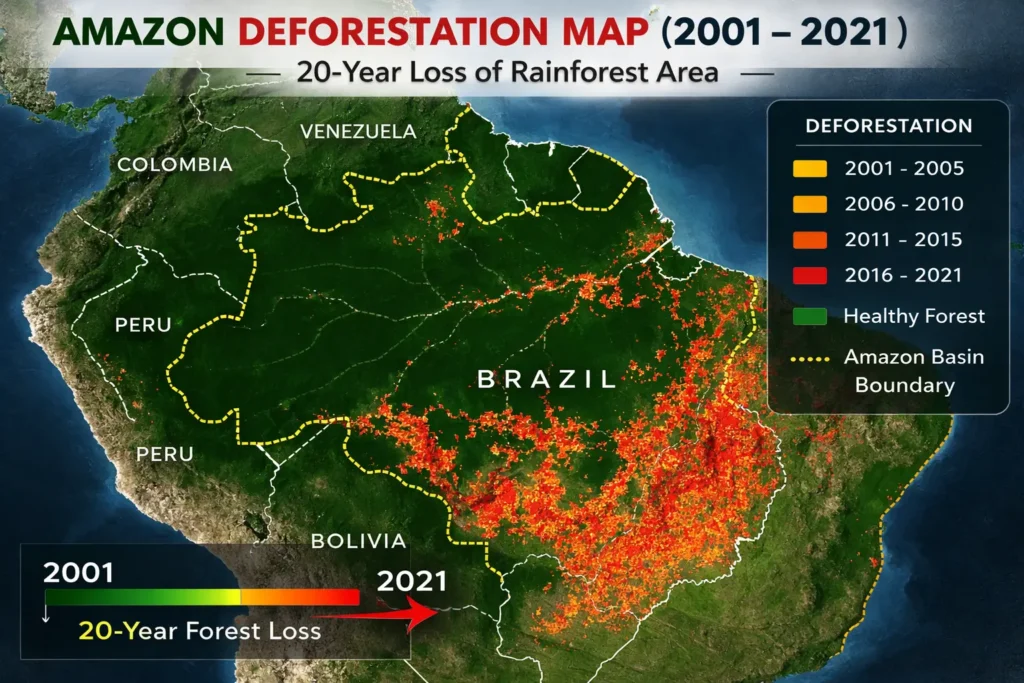
To understand the “Low Value” vs. “High Value” perspective, we must look at the hard data. Since 2001, Brazil has lost approximately 69 million hectares of tree cover. To put that in perspective, that is an area larger than many European nations combined.
- The 20% Threshold: Scientists estimate that nearly one-fifth of the Amazon is already gone.
- The Recent Shift: While deforestation rates saw a hopeful drop in 2023–2024 due to stricter enforcement, Brazil still loses thousands of square kilometers annually.
- Recovery Time: A tropical forest takes centuries to regain its full biodiversity. Once an old-growth tree is cut, the ecological gap it leaves cannot be filled by a sapling overnight.
| Factor | Status (Last 10 Years) | Environmental Consequence |
| Forest Cover Loss | Approx. 18-20% | Nearing the “Savanna” Tipping Point |
| Carbon Storage | Decreasing | Amazon shifting from Carbon Sink to Source |
| Water Recycling | 20% Reduction | Droughts in South America & North America |
| Species at Risk | 10,000+ Species | Loss of potential medical discoveries |
| Indigenous Land | Under Pressure | Threat to 400+ distinct tribal cultures |
Why the Amazon is Disappearing: The Drivers of Destruction
Deforestation in Brazil is rarely random. It is driven by global economic demands and systemic land-use changes.
- Cattle Ranching and Soy Production
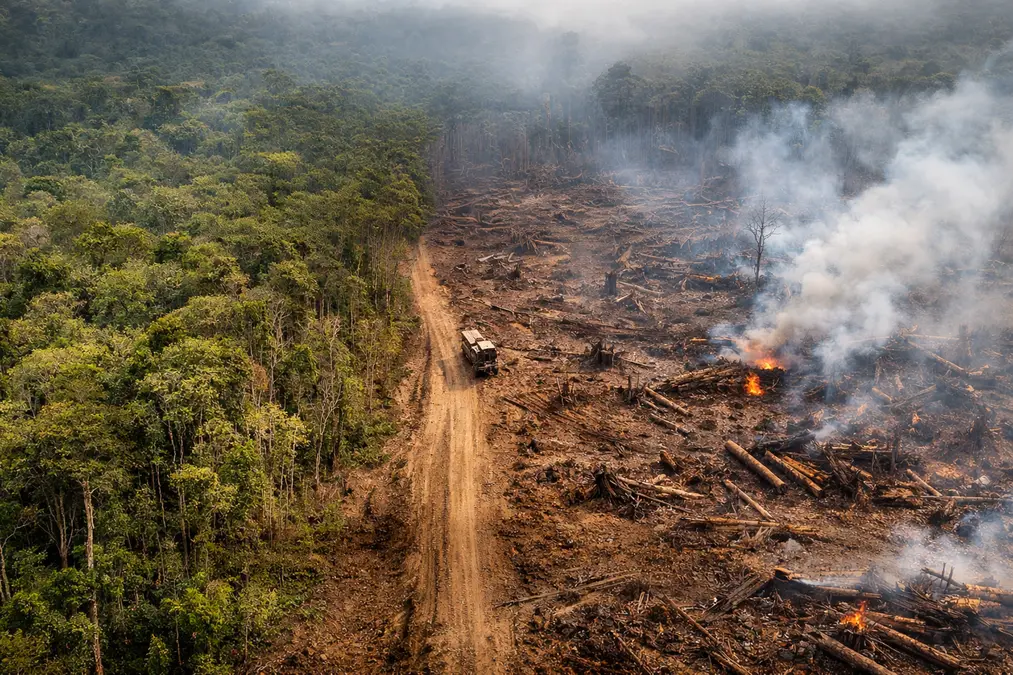
The single largest driver of deforestation is the conversion of forest into pasture for cattle. Brazil is one of the world’s largest exporters of beef. Additionally, large-scale soy farming—mostly used for animal feed globally—consumes vast stretches of previously forested land. - The Fire Cycle
Many fires in the Amazon are not natural; they are deliberately set by “land grabbers” to clear debris after logging. During the dry season, these fires often spiral out of control, leaping into healthy parts of the forest and creating a “feedback loop” of heat and dryness. - Infrastructure and Illegal Logging
Road construction into the heart of the jungle acts as a gateway. Once a road is built for timber or mining access, it becomes easier for illegal settlers to move deeper into protected zones, leading to a “fishbone” pattern of deforestation visible from space.
The Tipping Point: A Warning to Humanity
The most terrifying aspect of Amazon deforestation is the “Tipping Point.” Rainforests create their own rain by recycling moisture through their leaves.
If forest loss reaches 20–25%, the system may lose its ability to produce enough rain to sustain itself. At this point, the lush rainforest could permanently transform into a dry savanna.
- Carbon Bomb: If this happens, the Amazon will stop being a “Carbon Sink” (storing CO2) and become a “Carbon Source,” releasing billions of tons of stored carbon into the atmosphere, making global warming impossible to control.
The Human Cost: Protecting Indigenous Guardians
Millions of people, including hundreds of Indigenous communities, call the Amazon home. For them, the forest is not a commodity; it is their identity, pharmacy, and grocery store.
- Guardians of the Land: Data consistently shows that forests managed by Indigenous people are the best-preserved.
- Cultural Loss: When the forest falls, ancient knowledge of medicinal plants and sustainable living dies with it.
Why This Matters to You (Even Outside Brazil)
You might live thousands of miles away, but the Amazon affects your daily life:
- Weather Extremes: The Amazon influences the “Flying Rivers” (moisture corridors) that affect rainfall in the US and Europe.
- Food Security: Changes in global rainfall lead to crop failures and higher food prices worldwide.
- Medicine: Over 25% of modern medicines originate from rainforest plants. We are burning the “Global Pharmacy” before we’ve even read the prescriptions.
Is There Hope? The Path to 2030
The recent slowdown in deforestation proves that policy works. When governments use satellite tracking, protect Indigenous lands, and penalize illegal land grabbing, the forest can breathe.
What can be done?
Support Sustainable Supply Chains: Choosing products that are certified “Deforestation-Free.“
- Global Accountability: International trade agreements must include strict environmental clauses.
- Technological Monitoring: Using AI and real-time satellite data to stop illegal logging before it starts.
Conclusion: A Shared Future
Brazil’s forests are more than just trees; they are a vital organ of our planet. Saving the Amazon is not about borders or politics—it is about the survival of the climate system we all depend on. If the Amazon falls, the cost will be paid by every human on Earth. If we protect it, the benefits belong to all of us.