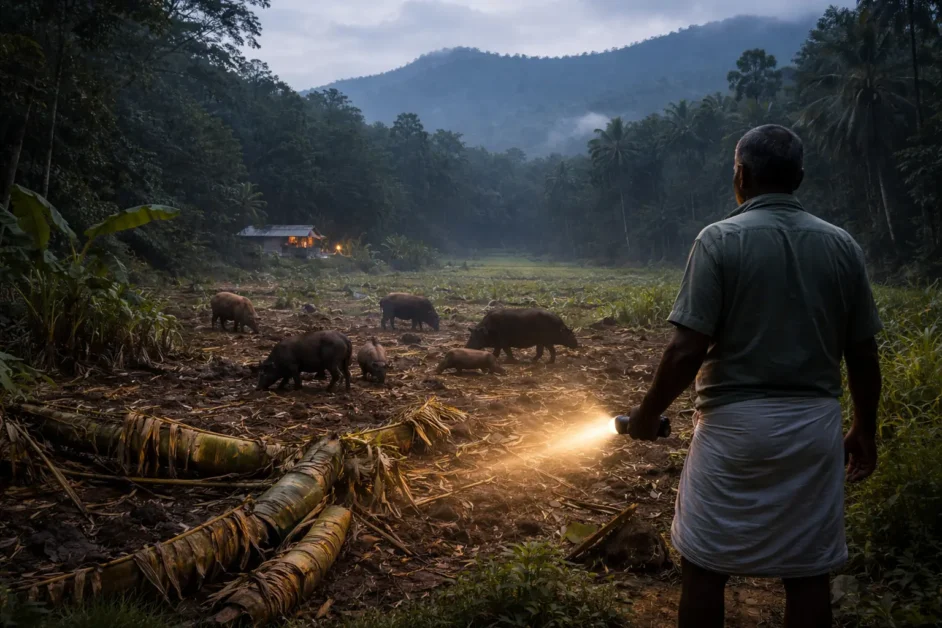
Victor Cherian farms coffee and pepper in Konni, Kerala. He has farmed the same land his grandfather farmed. He knows every inch of his estate — every tree, every trail, every shadow at the forest edge.
But he no longer sleeps well. Because the wild boars come at night.
They come in groups — five, eight, sometimes twenty. They tear up root crops in minutes. They destroy banana plants, jackfruit trees, paddy fields. They are fast, they are strong, and they are not afraid. By morning, a field that took months to grow can be stripped to bare earth.
Victor has called the forest department. He has filed complaints. He has waited. The shooters come eventually — sometimes. The boars return. Always.
“Election stunt or not,” Victor told The Federal newspaper in September 2025, when Kerala passed its historic Wildlife Amendment Bill, “this is a welcome step by the government. What matters now is putting pressure on the union government to give its assent.”
Victor Cherian is not alone. Across Kerala’s high ranges — in Wayanad, Idukki, Palakkad, Thrissur, and Pathanamthitta — farmers, tribal communities, and village residents are living with the same grinding, daily reality: their land is being destroyed by wildlife, their government has declared an emergency, and the law that should protect them is controlled by a central government in Delhi that has repeatedly said no.
This is the full story of Kerala’s wild boar war — the crisis, the law, the battle between state and centre, and the ecological danger hidden inside what looks like a simple question: can a farmer protect his crops?
The Scale of the Crisis in Numbers
- 919 deaths — from wildlife attacks in Kerala between 2016-17 and January 2025 (Kerala government official data)
- 8,967 injuries — from wildlife attacks in the same period — nearly 9,000 people hurt in nine years
- 273 panchayats — out of 941 total local bodies in Kerala designated as human-wildlife conflict hotspots
- 35 deaths — caused by wild pigs between 2021 and 2025 — the third-largest killer after snakes and elephants (Union Environment Ministry data)
- 87% — of all negative human-wildlife interactions in Kerala caused by elephants, wild boars, and monkeys (Wildlife Department study)
- 64% — of all Kerala conflicts concentrated in Wayanad district alone (Agriculture University study)
- 7,500+ — wild boars culled since 2020 — 2,500 by Forest Department, 5,000+ by local bodies — population keeps growing
- Rs 8.5 crore — paid in compensation for wildlife attacks in Kerala — against 10,095 applications filed (government data)
- 50-60% — of crops in Western Ghats Tamil Nadu damaged by wild boars, peafowl, and elephants — 90% of farmers call it their primary risk (2026 study)
Part 1: The Wild Boar — Kerala’s Most Destructive Conflict Animal
When people think of wildlife conflict in India, they think of tigers dragging people into jungles, or elephants crushing huts in the night. These are real. These are deadly. But in Kerala, the animal causing the greatest daily misery to the greatest number of farmers is not a charismatic megafauna. It is Sus scrofa — the wild boar.
What Wild Boars Are Doing to Kerala’s Farms
Wild boars are omnivores. They eat roots, tubers, fruits, crops, insects, small animals — whatever is accessible and nutritious. Their snouts are powerful rooting tools, capable of turning over soil to depths of 30 centimetres or more. A single boar can destroy a substantial area of paddy, tapioca, sweet potato, or root vegetables in a single night. A group of twenty can strip a small farm bare.
In Kerala’s high-range agricultural regions, virtually every commercially significant crop is vulnerable. A 2024 study of wildlife conflict in the state identified approximately 45 species of edible and commercial plants that are regularly targeted by wild animals — including paddy, coconut, areca nut, rubber, banana, plantain, tapioca, sweet potato, coffee, oil palm, pepper, cardamom, ginger, jackfruit, mulberry, mango, and pineapple. Wild boars are among the primary attackers of nearly all of them.
The economic consequences compound over years. A 2021 study by the University of British Columbia found that farmers in Karnataka lose one to three months of income every year to wild animal raids. In Kerala’s Wayanad district, research by the Agriculture University found that paddy farmers lost an average of 10 quintals from every 15 quintals produced per acre — losing 67 percent of their yield. For a subsistence farmer with no alternative income, this is not an inconvenience. It is the elimination of livelihood.
The 2025 study from Kodagu in Karnataka — geographically adjacent to Kerala’s conflict zones — found that nearly 50 percent of farmers surveyed incurred annual wildlife-related losses of Rs 90,000 or more, pushing many into debt. A 2026 study in Tamil Nadu’s Western Ghats found that 90 percent of farmers identified wildlife conflict as their primary production risk.
And so, an increasing number of Kerala’s farmers are making a rational economic decision: they stop farming. Abandoned fields — particularly in remote highland areas — are now documented across conflict-prone districts. The farming communities that have sustained Kerala’s agricultural heritage for generations are walking away, not because they want to, but because staying is financially ruinous.
The Boar Population Explosion
Why are wild boars so numerous in Kerala now? The answer involves several converging factors. First, successful wildlife protection under the Wildlife Protection Act 1972 reduced hunting pressure across all species, including wild boar. The boar, which was never a flagship conservation species but benefited from the general protection framework, thrived.
Second, changes in forest quality have worked in the boar’s favour. As natural forests in Kerala’s high ranges are degraded by encroachment, monoculture plantation expansion, and changed land use, the dense understorey — which supported natural predators — has thinned. Boars have fewer predators keeping their numbers in check.
Third, and most significantly, the boundary between forest and farm has become more porous. Farmers growing commercial crops near forest edges create abundant, predictable food sources for wildlife. Boars that learn to raid crops become habituated to human-modified landscapes and raise their offspring in these edge environments. The population grows fastest not in deep forest but in the agricultural fringes where food is plentiful and danger is low.
The result, reported consistently by farmers, forest officials, and researchers, is a population surge that appears to be accelerating.
Part 2: The Declaration of Emergency — Kerala Breaks New Ground
The Kerala government’s response to the escalating crisis has been, by the standards of Indian wildlife policy, genuinely unprecedented. In February 2025, Kerala became the first Indian state to classify human-wildlife conflict as a state-specific disaster under the Disaster Management Act, 2005. This was not a symbolic gesture. It was a structural change that shifted responsibility for conflict response to the State Disaster Management Authority, unlocked disaster management funds for faster compensation distribution, and changed the administrative framework for how the crisis was handled.
The disaster declaration was followed in September 2025 by an even more dramatic move: the Kerala Cabinet approved the Wildlife Protection (Kerala Amendment) Bill, 2025 — becoming the first Indian state to attempt to amend the central Wildlife (Protection) Act, 1972 for its application within the state.
What the Bill Actually Does — The Key Provisions
| Provision | What It Changes | Who Supports / Opposes |
| Wild boar declared ‘vermin’ | Wild boar loses all legal protection; can be killed without restriction; meat can be consumed | Farmers support; conservationists strongly oppose |
| State can declare Schedule II animals vermin | Power moves from Centre to state — huge constitutional shift; bypasses central authority | State government supports; Centre opposes; legal experts divided |
| Chief Wildlife Warden can order immediate action | Shooting, tranquilisation, capture, or translocation without lengthy bureaucratic delays | Forest department welcomes; conservationists cautious |
| Bonnet macaque downgraded from Schedule I to II | Macaque — moved to Schedule I only in 2022 — loses highest protection; can be more easily removed | Farmers support; wildlife scientists strongly oppose |
| Panchayats can call licensed shooters | Local self-government bodies can authorise culling; removes need for central clearance | Rural communities welcome; lawyers cite constitutional concerns |
Kerala Forest Minister A.K. Saseendran framed the bill as a necessary response to bureaucratic paralysis: the new provisions allow urgent action by bypassing the ‘impractical and time-consuming procedures’ mandated by central law. He stressed that species requiring legal protection would continue to be safeguarded.
The bill passed the Kerala Legislative Assembly. In February 2026, the Governor forwarded it to the President for clearance — required under Article 254(2) of the Constitution because a state law conflicting with a central law needs presidential assent.
The Political Dimension: Church, Farmers, and Elections
The Wildlife Amendment Bill did not emerge from a policy vacuum. It emerged from a specific political context — and understanding that context is essential to understanding why the bill took the form it did.
Kerala’s high-range districts — Wayanad, Idukki, and parts of Thrissur and Palakkad — have significant Christian agrarian communities. The Catholic Church and the Malankara Orthodox Syrian Church both have strong presences in these areas. Settler-farmer communities, many of them Catholic, have been at the forefront of protests about wildlife conflict for years. According to The South First, these communities wield considerable political influence, particularly for the Kerala Congress (Mani) party, which thrives on their support.
The bill, framed by the CPI(M)-led LDF government, was seen by political analysts as a calculated move to win back high-range voters. The Malankara Orthodox Syrian Church welcomed the government’s recognition of the hill people’s plight. Critics called it political populism disguised as policy. Proponents said that calling something political does not make it wrong.
What is undeniable is the numbers: 919 deaths, 8,967 injuries, 273 panchayats in crisis, and more than 1,000 lives lost since 2015 across Kerala’s forest fringe. Whatever the political calculation behind the bill, the underlying reality it was responding to was real.
Part 3: The Battle With Delhi — Why the Centre Keeps Saying No
Kerala’s Wildlife Amendment Bill faces a fundamental constitutional obstacle: wildlife is a Concurrent List subject. Both Parliament and state legislatures can pass laws. But when a state law conflicts with a central law — as Kerala’s amendment undeniably does with the Wildlife Protection Act — the state law requires the President’s assent under Article 254(2). And the President acts on the advice of the Union Cabinet.
The Union Cabinet’s position, stated publicly by the Union Environment Ministry in March 2025, is clear: no amendments to the Wildlife Protection Act to enhance state autonomy are currently under consideration.
This is not new. Kerala has been asking the Centre to declare wild boars vermin under Section 62 of the Wildlife Protection Act for years. The Centre has repeatedly refused. The bill is partly a consequence of this frustration — an attempt to create legal authority at the state level that the Centre has denied at the national level.
Why the Centre Refuses: Conservation vs. Federalism
The central government’s resistance is grounded in genuine conservation concern, constitutional principle, and institutional caution — even if it appears, from the perspective of a Kerala farmer watching his crop be destroyed, as indifference.
The conservation argument is the strongest. Wild boars are not simply pests. They are a critical prey species for tigers and leopards. Ecologists at Down to Earth have made the point with stark clarity: removing boars wholesale would destabilise local ecosystems. Tigers and leopards that lose boar as a prey base are more likely to switch to livestock — and from livestock, the pathway to human attacks becomes shorter. In Nainital’s forests, researchers have documented exactly this dynamic: prey scarcity is a driver of increased carnivore attacks on humans. Declaring wild boar vermin in Kerala could, paradoxically, increase tiger and leopard attacks in the same landscape.
The constitutional argument is also significant. If one state can unilaterally dilute protections for wildlife — removing species from schedules, declaring them vermin — the legal architecture that protects India’s biodiversity becomes vulnerable to political pressure in every state. A state where a specific crop interests group is politically powerful could seek vermin status for any species that competes with those crops. The Centre’s resistance to decentralising wildlife kill authority reflects an understanding that wildlife protection cannot be managed as a purely local issue.
The institutional argument is more mundane: the Centre’s wildlife bureaucracy is slow, underfunded, and resistant to change. But this too reflects real concerns about the consequences of fast, decentralised decisions about wildlife populations.
The Shooters’ Boycott: When Ground Reality Collapses Policy
While the legislative battle played out between Thiruvananthapuram and Delhi, an equally revealing crisis was unfolding on the ground. In February 2026, licensed shooters across Kerala announced a boycott of wild boar culling operations.
The Kerala government had been authorising culling since 2020 — first through the Forest Department alone, then from 2022 through local self-government bodies as well. Since 2020, the Forest Department culled around 2,500 wild boars. Local bodies culled over 5,000 between 2022 and December 2025. Total: more than 7,500 boars killed over five years.
The population kept growing.
In 2026, the government issued a new order restricting which firearm licences could be used for culling — barring sports and institutional licence holders from participating. Licensed shooters who had been participating as a social service — receiving only Rs 1,500 per animal, often after waiting more than a day — declared the new restriction legally unjustified and announced they would stop coming.
The boycott exposed the fragility of the entire culling system. The government was dependent on voluntary participation by licensed civilians to implement its wildlife management policy. When those civilians withdrew, the policy collapsed. Farmers in conflict-prone areas were left without even the inadequate protection the system had provided.
“Most shooters participate as a social service, receiving only ₹1,500 per animal, often after waiting for more than a day.” — Licensed shooter, Kerala, February 2026
Part 4: The Ecological Trap — Why Killing Boars Could Make Things Worse
The conservation community’s opposition to the Kerala Wildlife Amendment Bill is not simply institutional defensiveness. It is grounded in specific ecological science — and the concern is serious enough that it deserves a full examination.
Wild Boars as Tiger and Leopard Prey
In Kerala’s forest ecosystem, wild boars are a primary prey item for tigers and leopards. Studies of tiger diet in south Indian forests consistently show wild boar as a significant proportion of prey — typically 20 to 40 percent of a tiger’s annual prey base in landscapes where boars are abundant. Leopards are even more dependent on medium-sized prey including wild boar in areas where deer populations are reduced by hunting or habitat loss.
This predator-prey relationship has a direct bearing on human safety. When prey populations decline — whether through culling, disease, or habitat loss — large carnivores do not simply reduce their own populations proportionately. They switch to available alternatives. In landscapes where wild boar is abundant, tigers and leopards rarely target livestock. In landscapes where wild boar has been significantly reduced, livestock depredation typically rises. And in landscapes where livestock depredation rises, so do direct human-carnivore encounters.
Down to Earth’s ecologists made the point explicitly in their analysis of the Kerala bill: declaring wild boar vermin may seem like a farmer’s victory, but removing boars could push tigers and leopards towards livestock and humans. The consequence would be an exchange of one conflict — crop damage by boars — for another, potentially far more dangerous conflict: carnivore attacks on people.
The Bonnet Macaque: A Seed Disperser Being Downgraded to Pest
The proposed downgrading of the bonnet macaque from Schedule I to Schedule II is equally concerning to conservation scientists — for different reasons. Bonnet macaques are not simply agricultural pests. They are ecologically significant seed dispersers whose foraging behaviour spreads the seeds of dozens of tree species across forest and forest-edge habitats. Their contribution to forest regeneration is measurable and documented.
The macaque was moved to Schedule I only in 2022 — three years before Kerala proposed to downgrade it again. This rapid reversal reflects the pace at which agricultural interests can override conservation decisions when political pressure is sufficient. Conservationists note that downgrading species based on human irritation — rather than ecological assessment — sets a precedent that could be applied to any species that conflicts with agriculture, including species whose ecological role is poorly understood but significant.
The Ecosystem Services Kerala Would Lose
Wild boars, despite their destructive impact on crops, perform genuine ecological functions. They root up soil in patterns that create microhabitats for other species, expose insect larvae and tubers that smaller animals exploit, and disturb vegetation in ways that maintain biodiversity in forest understoreys. Their disappearance from a landscape would have cascading effects that are difficult to predict but likely significant.
This is not an argument for tolerating unlimited crop damage by boars. It is an argument for careful, evidence-based, locally appropriate management rather than blanket legal deprotection. The difference between targeted culling in specific hotspots and declaring a species vermin — removing all legal protection nationwide for a period — is the difference between management and elimination. Kerala’s bill was seeking the latter.
Part 5: What Is Actually Working — Evidence-Based Solutions
The debate between Kerala’s government and the conservation community has sometimes generated more heat than light. But underneath the political and legal battle, researchers and farmers in Kerala’s conflict zones have been experimenting with approaches that reduce damage without requiring the elimination of wildlife. Some of these have demonstrated real results.
1. Bio-Fencing with Indian Thorny Bamboo
Farmer and researcher Dileep Kumar, who has worked on wildlife conflict in Kerala for years, advocates Indian thorny bamboo as a practical, cost-effective barrier against both wild boars and elephants. Unlike solar electric fencing — which requires expensive maintenance, is vulnerable to weathering and sabotage, and has failed in multiple Kerala deployments — thorny bamboo, once established, can remain effective for up to 50 years with minimal maintenance. Kumar cites the crash guard fencing project in the Chedalath range of South Wayanad as a model, despite criticising its slow implementation.
2. Unpalatable Crops in Forest-Fringe Areas
Government advisories have recommended a shift to crops that wildlife finds unattractive in the most conflict-vulnerable fields adjacent to forests. Chilli, lemon grass, khus grass, and certain tree species are known to deter both wild boar and monkeys. Agroforestry models that incorporate these deterrents while maintaining commercial production have shown promise in pilot areas. The challenge is that these crops are not always as commercially valuable as the vulnerable crops they replace — farmers need support, including price guarantees or subsidies, to make the switch economically viable.
3. Early Warning and Rapid Response
Kerala’s 2025 45-day mission, launched by Chief Minister Pinarayi Vijayan, included deployment of early warning systems in 273 conflict hotspot panchayats. SMS alert systems for farmers, camera trap networks at forest boundaries, and rapid response teams with authority to act within hours — rather than the days or weeks that bureaucratic processes previously required — have reduced response time in pilot areas. The key finding from pilot deployments: speed matters. A response that arrives four hours after a boar raid is useless. A response that arrives before the raid can be deterrent. Predictive mapping of high-risk periods — monsoon onset, post-harvest dry season — allows pre-positioning of deterrence resources.
4. Targeted Culling With Ecological Guardrails
The most ecologically informed approach to boar management — recommended by several wildlife scientists — is targeted culling in specific, documented conflict hotspots during defined periods, with mandatory prey population monitoring to ensure carnivore prey base is maintained. This is different from declaring the species vermin. It requires coordination between forest officials, ecologists, and local communities. It is slower and more resource-intensive than blanket legal deprotection. But it reduces crop damage without triggering the carnivore prey collapse that blanket culling risks.
Kerala’s current system of licensed shooter culling, while imperfect, approximates this approach. The February 2026 boycott demonstrated its fragility — but also that the system’s fundamental concept, targeted culling by qualified individuals in specific locations, is more ecologically sound than open-season vermin status.
5. Crop Insurance Including Wildlife Damage
Perhaps the most significant policy shift announced in 2026 was the inclusion of animal-related crop losses in India’s national crop insurance scheme, the Pradhan Mantri Fasal Bima Yojana, effective from the June-July kharif season 2026. Farmers are given a 72-hour window to report losses, which will be verified by drone before compensation is paid. Whether this works in practice depends on the scheme’s existing implementation gaps — but structurally, integrating wildlife damage into mainstream crop insurance is more sustainable than relying on ad-hoc forest department compensation payments.
Conclusion: The Boar at the Centre of India’s Biggest Wildlife Policy Battle
Victor Cherian is still farming in Konni. He is still losing crops to wild boars. The Wildlife Amendment Bill he welcomed in September 2025 is still waiting for the President’s assent — which may never come, given the Union Cabinet’s stated opposition.
In the meantime, 273 Kerala panchayats remain designated conflict hotspots. The shooters who were culling boars have gone on boycott. The forest department is understaffed and underequipped. And somewhere in Wayanad’s forests, a wild boar with four piglets is teaching her offspring which fields are worth raiding and which are guarded.
Kerala’s wild boar war is not simply a story about a destructive animal and desperate farmers. It is a story about the collision between conservation law designed for a different era and a human reality that conservation law was never meant to ignore. It is a story about constitutional federalism — who decides what a state can do with its own wildlife. It is a story about ecological interconnectedness — how removing one species to solve one problem can create a worse problem elsewhere.