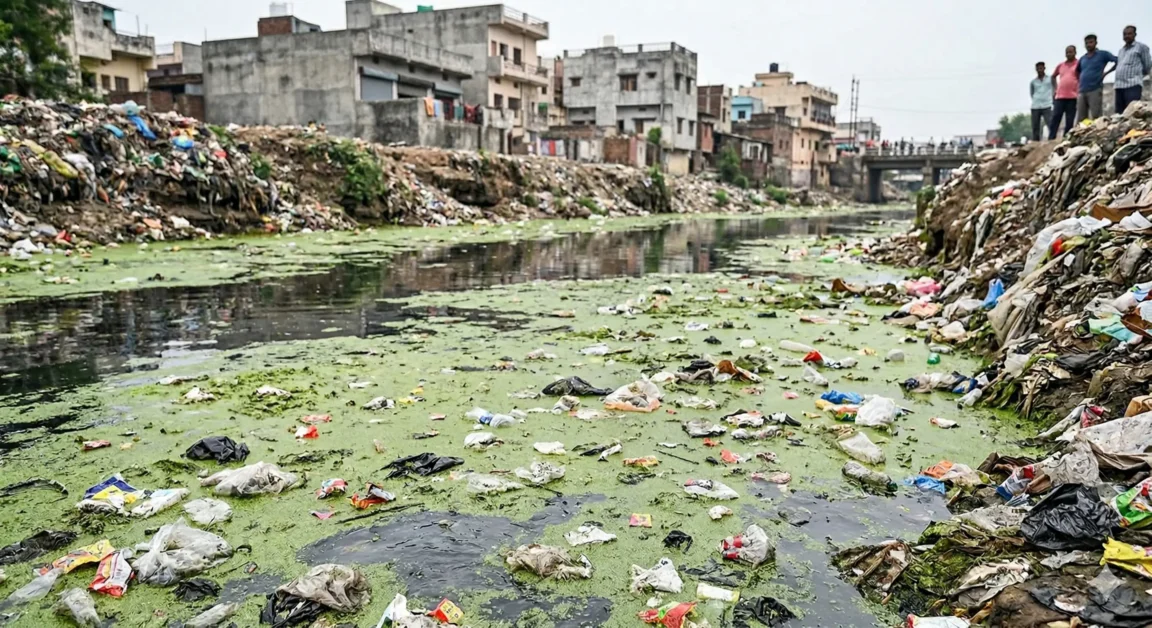
On January 26, 2026 — Republic Day — a 20-year-old young man named Bittu Singh walked into a heavily polluted river in Biaora, Madhya Pradesh. The water around him was black. Thick layers of plastic bags floated on the surface. Green algae had spread so densely that the river was barely visible beneath it. The smell was overpowering. On the banks, years of garbage had piled up like walls.
He had no government support. No NGO funding. No heavy machinery. Just his hands, basic tools, and one quiet decision: he was going to clean this river.
Nobody believed him at first. Some people laughed. His friends helped for a few days — then stopped coming. Bittu kept going. Every single day. Waist-deep in filth. Methodically pulling out plastic bottles, bags, algae, and debris. Documenting his progress on Instagram. Talking to no one in power, but speaking directly to millions through a screen.
By the time his video went viral across India in March 2026, he had transformed the Ajnar River. The before-and-after photographs were so dramatically different that thousands of people online refused to believe it was the same river.
This is the full story of Bittu Singh — a young man from a small town who reminded a nation of 1.4 billion people what one determined citizen can actually do.
Who Is Bittu Singh ?
Bittu Singh (soical name Bittu Tabahi) is a resident of Biaora, a town of approximately 40,000 people in Rajgarh district, Madhya Pradesh. Located 110 kilometres from Bhopal and 184 kilometres from Indore, Biaora sits on the northern edge of the Malwa plateau. The Ajnar River — the town’s historical lifeline — flows directly through the centre of the city. Bittu is around 19 to 20 years old. He is not a scientist, an activist from a famous organisation, or a government official. He is an ordinary young man from a small Indian town who looked at something broken in his community and decided not to look away.
His Instagram handle — bittu Singh — documents his cleanup journey in raw, unfiltered reels and posts. No professional video editing. No sponsored content. Just a young man, a river, and a camera phone showing the world what was happening and what was possible.
The River He Chose to Save: The Ajnar
The Ajnar River is not a famous river. It does not have the cultural prestige of the Ganga or the political attention of the Yamuna. But for the people of Biaora, it is everything. It is their historical water source, the backdrop to their temples and ghats, and the river that has defined the town’s geography and culture for centuries.
In recent decades, the Ajnar had become something else entirely. Years of neglect, unregulated dumping, open sewage discharge, and plastic waste had turned it into what one local reporter described as an open sewer. The Anjanilal Mandir Dham — an ancient temple built on the banks of the Ajnar — had become surrounded by garbage. The water, once used for religious rituals and daily life, had become toxic.
The pollution problem was not limited to household waste. A 2022 investigation by Mongabay India revealed that industrial units in the Pithampur Special Economic Zone — which has nearly 50 industrial facilities — were dumping chemical waste into open fields that drained into the Ajnar. Farmers reported black chemical froth floating on the water’s surface. A farmer named Brijesh Singh told Mongabay that his cow died after drinking from the Ajnar. His crop was destroyed. His land became infertile.
According to local activists, an estimated 45,000 to 50,000 people in surrounding villages are affected by the Ajnar’s pollution. Arsenic and heavy metals were found in water tests. Fish, crabs, and aquatic life had largely disappeared.
This was the river that Bittu Singh decided to clean. Alone.
January 26, 2026: The Day He Started
Bittu began his cleanup on January 26 — Republic Day of India. The choice of date was not accidental. Republic Day is when India celebrates its Constitution and its civic values. Starting on this day was a quiet, powerful statement: that a citizen taking responsibility for his community is one of the most patriotic acts imaginable.
In the early videos, the scale of the problem is shocking. The camera pans across the surface of the Ajnar and it is almost impossible to see water. Thick plastic waste, algae mats, garbage sacks, and unidentified debris form an almost continuous cover across the river’s width. On the banks, piles of rubbish have accumulated over years into small mountains.
Bittu walked into this. Literally. Into the water, pulling out whatever his hands could reach. Using basic tools — hooks, ropes, simple nets — to drag heavier material to the surface. Sorting the debris on the banks. Returning the next day. And the day after that.
At first, a few friends helped. Within days, they stopped coming. The task was too large, too slow, too overwhelming. The responses from people who saw the early footage were mixed. Some were inspired. Others were sceptical or dismissive — they said one person could never make a dent in pollution that had accumulated over decades.
“Numerous people apparently found the concept of a single individual effectively clearing such an extensive rubbish pile to be humorous. Bittu preferred not to challenge this perception and convinced himself he would continue with this venture.” — ScoopWhoop, March 2026
The Weeks of Work: What He Actually Did
The cleanup was not a single dramatic gesture. It was weeks of methodical, exhausting, unglamorous physical labour. Every day, Bittu returned to the river. Every day, the pile of removed waste on the bank grew larger. Every day, a slightly greater fraction of the water’s surface became visible.
He worked section by section, starting at the most visibly polluted stretches and clearing inward. The algae — which forms thick surface mats in heavily polluted water with excess nutrients from sewage and fertilizer runoff — had to be removed physically before the underlying plastic and debris could be reached. He used his hands more than any tool, because only hands can reach into the irregular crevices where decades of waste had compacted into the riverbed.
Throughout this process, he filmed and posted on Instagram. Not in a polished, edited way — but in real time. Muddy hands. Stinking water. Heaps of recovered plastic. And then — slowly, section by section — clear water beginning to appear.
The before-and-after contrast, when it finally arrived, was extraordinary. The same stretch of river that had been covered in floating garbage and black algae had become a clear, green-reflecting waterway. You could see the river bed. You could see fish returning. The sky was reflected in the surface. It looked, as one viral commenter said, like it was from another country.
“I can believe this is a river from another country. I can’t even believe it’s from the same place that Bittu cleaned.” — Viral commenter, Instagram, March 2026
How India Reacted: The Viral Moment
When the footage began circulating widely in March 2026, the response was unlike the usual cycle of viral content. People were not just sharing it for entertainment. They were sharing it because it made them feel something they did not expect to feel about an environmental story: hope.
The Better India — one of India’s leading positive news platforms — published a full feature on Bittu. The headline: ‘One 19-Year-Old Is Cleaning an Entire River Alone.’ ScoopWhoop, one of India’s most widely read youth-oriented media platforms, ran a detailed story. OdishaTV, national news channels, and hundreds of independent social media accounts picked up the story.
Writer and activist Divya Gandotra Tandon, with a large following on social media platform X, posted about Bittu with a message that resonated widely across India:
“Bittu Singh is unstoppable!! Single-handedly cleaning a river in Madhya Pradesh while the system watches. This is what real action looks like — not campaigns, not ads. People like him deserve to be the true face of Swachh Bharat.”
The post noted pointedly that celebrity brand ambassadors for environmental campaigns — who shoot advertisements, collect applause, and disappear — were being compared unfavourably to a 20-year-old from Biaora who simply showed up and did the work.
Another widely shared comment on the viral post read: ‘A boy from Biaora, Madhya Pradesh started cleaning an entire river alone and documented it on Instagram. He gained followers, engagement and respect. Meanwhile the municipal department is still asleep.’
The comment about the municipal department pointed to the uncomfortable truth at the heart of Bittu’s story: the river had been in this condition for years. The local civic authorities knew about it. The pollution was documented. And for years, nothing was done.
The System That Failed the Ajnar River
Bittu’s story is inspiring. But to understand its full significance, it is necessary to understand the failure that made it necessary.
India’s rivers are among the most threatened freshwater systems on earth. According to the Central Pollution Control Board (CPCB), over 350 river stretches across India are critically polluted. The Ajnar is one of hundreds of smaller rivers — the ones that do not have the political visibility of the Ganga or Yamuna — that have been systematically degraded by a combination of unregulated industrial dumping, insufficient sewage treatment infrastructure, and the simple habit of using rivers as garbage disposal sites.
The Namami Gange Mission, the government’s flagship river cleaning programme, has received over ₹42,000 crore in allocation for the Ganga and its tributaries. But the Ajnar — and thousands of rivers like it — fall outside its scope. They are local rivers, the responsibility of state governments and municipal corporations, and they receive a fraction of the attention and funding.
For the Ajnar specifically, the industrial pollution from the Pithampur SEZ represents a separate and more dangerous layer of contamination. Heavy metals and chemical waste are not solved by picking up plastic bags. They require regulatory enforcement — which, according to activists who have been fighting this issue since at least 2021, has been persistently absent.
Medha Patkar, one of India’s most well-known civil society leaders, joined protests about Ajnar river chemical pollution in 2021. Five years later, the situation remained bad enough that a 20-year-old felt he had to walk into the river with his bare hands to try to reverse it.
What Does One Person Cleaning a River Actually Achieve?
This is a fair question, and it deserves a serious answer.
The plastic and visible waste that Bittu removed from the Ajnar is a real, measurable improvement. Plastic pollution in rivers is not just an aesthetic problem. Plastic bags and bottles block water flow, trap sediment, leach chemicals into the water column, and kill fish and aquatic invertebrates. Their removal has direct ecological benefit. Fish populations, once plastic is removed, can begin to recover. The natural process of river oxygenation — which depends on water flow and surface exposure — improves when surface mats of algae and debris are cleared.
The return of clear water to a stretch of the Ajnar also changes the relationship that local communities have with the river. Rivers that look dead and smell bad are treated as waste dumps. Rivers that look alive are treated differently. Behavioural change around environmental protection often begins with visible change in the environment itself.
But there are limits. The chemical pollution from industrial dumping upstream — the heavy metals, the arsenic — cannot be removed by hand. The sewage that continues to flow into the river from inadequate treatment infrastructure will rebuild nutrient loads and algae mats unless it is intercepted. The structural causes of the Ajnar’s pollution require structural solutions: regulatory enforcement, investment in sewage treatment, and accountability for industrial polluters.
Bittu knows this. In his posts, he has called for government action alongside his own cleanup work. His message has never been that one person doing manual cleanup is the solution to river pollution. His message — demonstrated through action rather than words — is that individual responsibility and citizen action are necessary even when governments fail, and that one person starting can change what a community believes is possible.
The Deeper Meaning: What Bittu Singh Represents
India has a long tradition of citizen environmentalism. Sunderlal Bahuguna hugged trees in the Chipko movement. Medha Patkar stood in rising dam waters for the displaced people of the Narmada valley. Vandana Shiva has spent decades fighting for seed sovereignty and ecological farming. These names are famous. Bittu Singh is not famous — yet. But he belongs to the same tradition.
What makes his story resonate so powerfully with young Indians in 2026 is its simplicity. He did not write a report. He did not organize a rally. He did not file a petition. He walked into the river and started pulling out garbage. And he kept doing it. Every day. Alone.
In a social media environment saturated with performative activism — awareness posts, change.org petitions, hashtag campaigns — Bittu’s steady, unglamorous, daily physical labour stands out as something different. It is the opposite of performance. It is just work.
The Better India described him perfectly: ‘One polluted river. One 19-year-old who refused to look away. While others ignored the stench and waste, Bittu Singh showed up — every single day. Cleaning what an entire city had neglected.’
The River Pollution Crisis in India: The Bigger Picture
To understand why Bittu’s story matters beyond Biaora, it helps to understand the scale of India’s river pollution crisis.
India has 14 major rivers, 44 medium rivers, and hundreds of smaller rivers like the Ajnar. According to the CPCB’s most recent data, 351 river stretches across 28 states are critically or severely polluted. The total length of polluted river stretches exceeds 12,000 kilometres. The primary pollutants are untreated sewage — India treats less than 40 percent of the sewage it generates — and industrial effluents.
The ecological consequences are severe. India’s freshwater biodiversity is among the richest in the world — home to the Gangetic river dolphin, the gharial, over 900 species of freshwater fish, and thousands of invertebrate species. River pollution is the single largest driver of freshwater biodiversity loss in the country. The gharial’s wild population has collapsed from an estimated 5,000 to fewer than 182 breeding adults. The Gangetic dolphin has recovered somewhat under Project Dolphin, but remains critically threatened by water quality.
Smaller rivers like the Ajnar — which feed into larger systems, which feed into the Karam river, which eventually reaches the sea — are not isolated problems. They are nodes in a connected network. Pollution in the Ajnar contributes to pollution downstream. The 45,000 to 50,000 people affected by the Ajnar’s chemical contamination are not just a local statistic — they represent the human face of a systemic failure replicated across hundreds of Indian towns.
What You Can Do: The Bittu Singh Model
Bittu’s story is not a call for every reader to wade into their local river. Most river pollution problems require collective action, regulatory enforcement, and government investment that no individual can substitute. But his story does suggest a model for citizen environmental action that is worth taking seriously.
1. Document First
Bittu’s use of Instagram to document the river’s condition — before, during, and after — turned a local cleanup into a national conversation. Documentation is one of the most powerful tools a citizen has. Photographs and videos of pollution, shared publicly and tagged to relevant authorities and journalists, create accountability that quiet complaints never do.
2. Start Where You Are
Bittu did not wait for a perfect plan, a team, or official support. He started with what he had — his hands, basic tools, and a phone. The hardest part of any environmental action is starting. Once started, momentum builds. Communities notice. People who would never have joined an abstract campaign will join a visible effort they can see happening in front of them.
3. Keep Going When Others Stop
Bittu’s friends joined for a few days and then left. He kept going. This is perhaps the most important lesson of his story. Environmental problems did not appear overnight and will not be solved in a week. Consistent, sustained effort — even by a single person — accumulates into transformation over time.
4. Demand Systemic Change Alongside Personal Action
Bittu’s cleanup does not let the municipal corporation off the hook. It highlights their failure. Every person who cleans a stretch of beach, plants a tree, or removes plastic from a waterway is also demonstrating what their local government should be doing — and creating public pressure for them to do it.
5. Share Your Story
Bittu’s Instagram account turned his personal action into a national inspiration. Sharing environmental action — honestly, without exaggeration — multiplies its impact far beyond what any single person can physically accomplish. It changes what other people believe is possible.
Conclusion: The River Is Coming Back
The Ajnar River in Biaora, Madhya Pradesh is not fully clean. The industrial chemical pollution upstream has not been addressed. The sewage infrastructure that would prevent future contamination has not been built. The municipal corporation that should have been maintaining the river for years has not been held accountable.
But a stretch of the Ajnar that was covered in black water, floating garbage, and thick algae now reflects the sky. Fish are returning. Local people are walking along the banks again. And a 20-year-old named Bittu Singh — who started alone on Republic Day with his bare hands — is still going.
India has a Swachh Bharat mission. It has a Namami Gange programme. It has hundreds of crores in environmental budgets. But it also has Bittu Singh. And sometimes, the difference between a river dying and a river living is exactly that: one person who refuses to accept that nothing can be done.