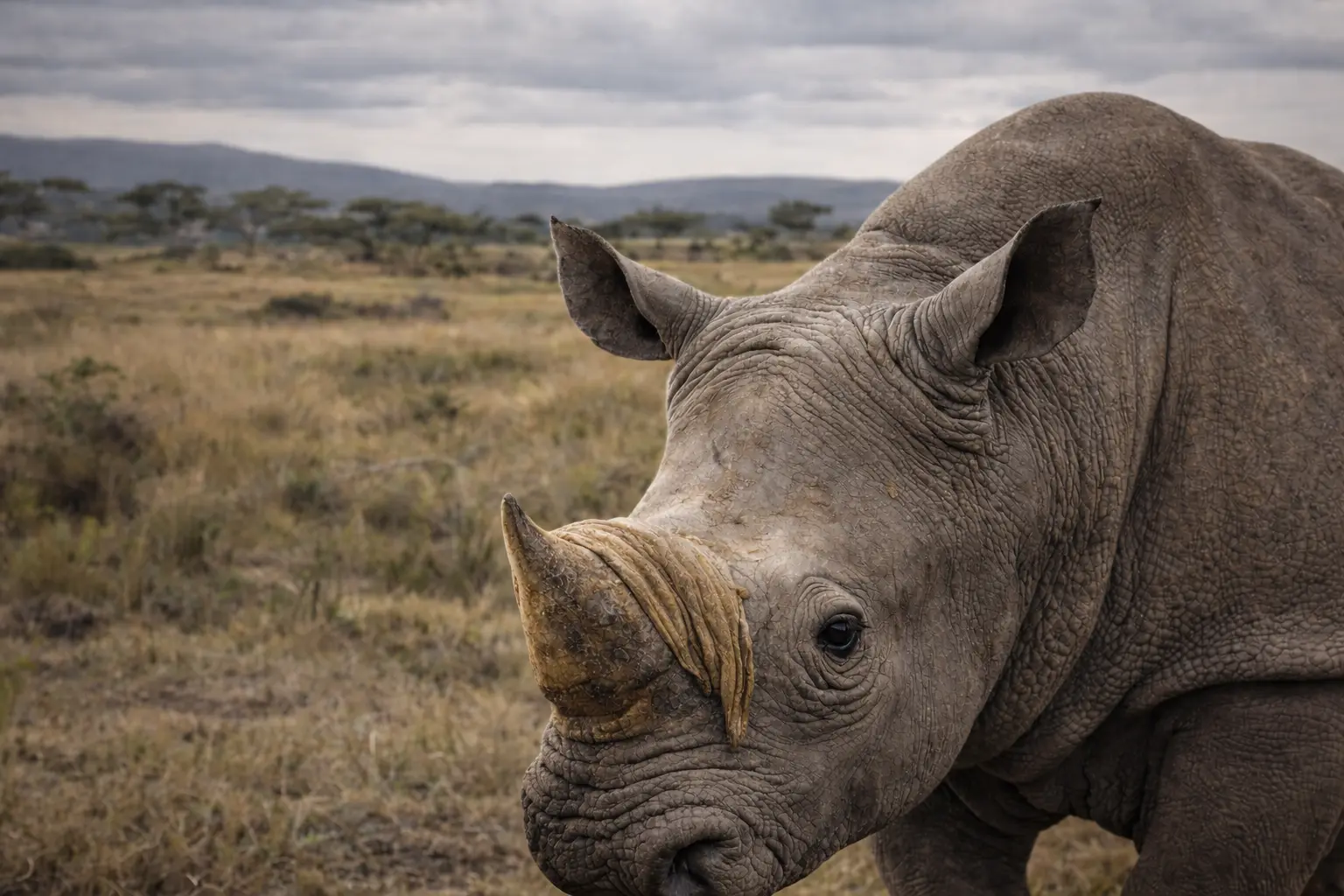
In the vast, sun-drenched grasslands of Africa, the rhinoceros has roamed for millions of years, acting as a “Mega-herbivore” that shapes entire ecosystems. However, in the 21st century, this ancient species faced a modern nightmare: a global criminal industry worth billions. As traditional conservation methods struggled to keep pace with organized crime, an unlikely savior emerged from the world of physics—Radioactive Isotopes.
The Rhisotope Project, a groundbreaking initiative in South Africa, is now turning the rhino’s greatest vulnerability—its horn—into its strongest defense. By injecting radioactive material into living rhinos, scientists are not just protecting animals; they are disrupting the global supply chain of wildlife trafficking.
The Economics of Extinction: Why Traditional Methods Failed
For decades, the fight against poaching was a literal war. Governments deployed armed patrols, helicopters, and drones. Some conservationists even turned to “Dehorning”—physically removing the horn to make the rhino “worthless” to poachers.
The Failure of Physical Barriers
Despite these efforts, the trade persisted. According to data from the World Wildlife Fund (WWF), rhino horn trafficking became an extension of organized crime, mirroring the logistics of drug and arms smuggling.
- The Valuation Gap: A horn that costs a few thousand dollars in Africa can fetch up to $60,000 per kilogram in Asian markets.
- The “Silent” Product: Once removed from the animal, a rhino horn is chemically inert and easy to hide. It can be powdered, disguised as wood, or hidden in heavy machinery, making it nearly invisible to traditional customs checks.
The Rhisotope Project: A Nuclear Solution
In 2021, researchers from the University of the Witwatersrand and the South African Nuclear Energy Corporation (NECSA) shifted the focus from “Protecting the Rhino” to “Exposing the Trade.”
The Methodology of Tagging
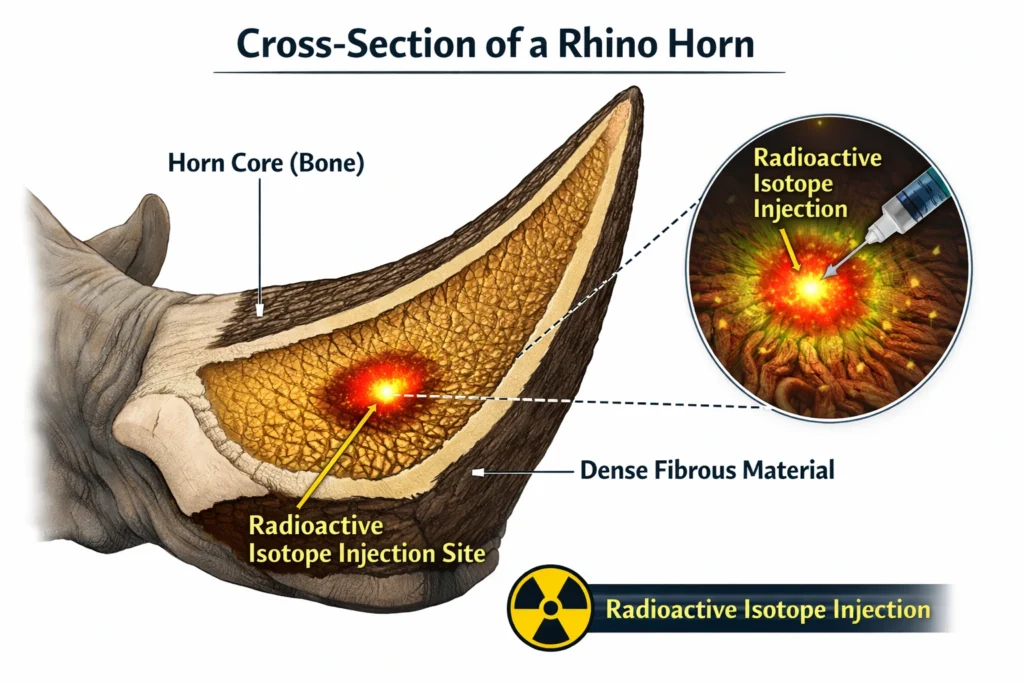
The process involves a highly precise veterinary and nuclear procedure:
- Sedation: The rhino is briefly sedated by a specialized veterinary team.
- Micro-Iniection: A tiny amount of specific, low-dose radioisotopes is injected into the horn’s keratin matrix.
- Biological Safety: Crucially, the horn is not living tissue. Because it is made of keratin (like human hair and nails), the radioactive material does not enter the rhino’s bloodstream or affect its health. The radiation dose is significantly lower than a routine human X-ray.
The Science of Detection: Triggering the Global Security Net
The real genius of this project lies in the existing global security infrastructure. After 9/11, most international airports, seaports, and border crossings were equipped with highly sensitive Radiation Portal Monitors (RPMs) to prevent nuclear terrorism.
Breaking the Silence of Smuggling
Once a rhino horn is “tagged,” it carries an invisible, permanent signature.
- Automatic Alarms: Even a small fragment of powdered horn will trigger the RPMs at international borders.
- Impossible to Mask: Unlike drugs or currency, radiation cannot be masked by lead linings without making the package so heavy and suspicious that it attracts immediate inspection.
- Global Monitoring: There are currently over 10,000 radiation scanners operational worldwide. By tagging the horn, scientists have effectively turned every major port in the world into a rhino-protection checkpoint.
Psychological Warfare: Changing Criminal Behavior
In research-oriented conservation, this is known as “Target Hardening.” The goal is not just to catch the criminal, but to make the crime too risky to attempt.
- Market Devaluation: As news of “Radioactive Horns” spreads, buyers in end-markets (primarily for traditional medicine or status symbols) become nervous. The fear of consuming radioactive material—even if the levels are harmless—severely devalues the product.
- Logistical Hesitation: Smugglers, who previously moved horns with high confidence, now face a high probability of detection and life imprisonment. When the risk outweighs the reward, the criminal supply chain begins to fracture.
Comparative Analysis: Nuclear Tagging vs. Traditional Conservation
| Feature | Armed Patrols & Fences | Nuclear Isotope Tagging |
| Primary Goal | Physical Prevention | Detection & Market Disruption |
| Scalability | Expensive & Resource-Heavy | Highly Scalable via Existing Tech |
| Global Reach | Local (Only inside the park) | Global (Across 100+ countries) |
| Criminal Risk | Risk of being shot by rangers | Risk of international arrest at ports |
| Cost Efficiency | High ongoing labor costs | Low-cost material with long-term effect |
Ecological Ripple Effects: Saving More Than Just Rhinos
The rhinoceros is an “Umbrella Species.” This means that by protecting the rhino, we protect the entire habitat.
- Grassland Management: Rhinos are “selective grazers.” Their feeding habits prevent certain grass species from dominating, which allows smaller herbivores and diverse plant life to thrive.
- Biodiversity Maintenance: The loss of the rhino would trigger a “Trophic Cascade,” where the disappearance of a large herbivore leads to the collapse of insect populations, birds, and eventually the soil health itself.
The Future of Nuclear Conservation
The success of the Rhisotope Project has opened a new frontier in Forensic Wildlife Science.
- Ivory & Pangolins: Researchers are now investigating if similar low-level isotopes can be used to tag elephant tusks and pangolin scales—the most trafficked mammal in the world.
- Customs Integration: There are ongoing discussions to integrate wildlife “signatures” into the international customs databases, allowing for real-time tracking of illegal shipments across the globe.
Conclusion: Innovation as a Second Chance
The story of radioactive rhino horns is a testament to human ingenuity. It demonstrates that the same technology used for energy and medicine can be repurposed to save a species from the brink of extinction. By making the illegal trade visible and risky, scientists have removed the cloak of silence that traffickers relied on for decades.
For the first time in the history of the poaching crisis, the rules of the game have changed. The rhino is no longer just a target; it is a high-tech deterrent, proving that when science and conservation unite, nature is given a powerful second chance to survive.