In early 2025, the most rigorous study of global glacier mass loss ever published appeared in the journal Nature. Coordinated by the World Glacier Monitoring Service (WGMS) at the University of Zurich, the Glacier Mass Balance Intercomparison Exercise (GlaMBIE) brought together 35 research teams and approximately 450 data contributors from around the world.
Their findings, combining satellite radar, laser altimetry, gravimetry data, and decades of ground measurements, paint the clearest and most alarming picture yet of what is happening to the world’s ice.
Glaciers worldwide lost 273 billion tonnes of ice per year between 2000 and 2023. Ice loss jumped by 36% in the second half of the study period compared to the first — meaning the problem is not just large, it is actively worsening.

About 41% of the total glacier mass loss recorded since 1976 occurred in just the last decade, from 2015 to 2024. Five of the last six years — 2019, 2020, 2022, 2023, and 2024 — recorded the strongest global glacier mass loss ever measured. In 2023 alone, glacier melt raised sea levels by 1.5 millimeters — more than any other single year on record.
In Switzerland, over 1,000 small glaciers have already disappeared entirely. Swiss glaciers as a whole have lost a quarter of their volume since 2015 alone.
Seven of the ten years with the most significant glacier mass loss have occurred since 2010.
These are not projections. They are measurements of what has already happened — recorded by satellites, confirmed by ground teams, and verified by independent methods that all reach the same conclusion.
Where Ice Is Being Lost: A Global Map of Retreat
Glacier loss is not uniform. Understanding where the most severe melting is occurring reveals the specific populations and ecosystems most immediately at risk.
The regions with the highest annual glacier mass loss between 2000 and 2023 are: Alaska (60.8 Gt/year), Greenland peripheral glaciers (35.1 Gt/year), Arctic Northern Canada (30.5 Gt/year), the Southern Andes (26.5 Gt/year), Southern Canadian Arctic (23.1 Gt/year), and Antarctica and sub-Antarctic islands (16.9 Gt/year).
| Region | Annual Ice Loss (Gt/year) | Key Risk |
|---|---|---|
| Alaska | 60.8 | Sea level rise, ecosystem disruption |
| Greenland Periphery | 35.1 | Coastal flooding, freshwater loss |
| Arctic N. Canada | 30.5 | Indigenous communities, permafrost |
| Southern Andes | 26.5 | Drinking water for millions |
| Central Europe | Highest % loss (39%) | Tourism, hydropower, water supply |
| Himalayas/Central Asia | 10.4 | 2 billion people downstream |
| East Africa | Near-complete loss | Iconic peaks, unique ecosystems |
Since 2000, glaciers have lost between 2% and 39% of their ice regionally, and about 5% globally. Regional losses range from 2% on the Antarctic and Subantarctic Islands to nearly 40% in Central Europe.
The European figure deserves special attention. Central Europe’s Alps — the glaciers that feed the Rhine, the Rhône, the Po, and dozens of smaller rivers that sustain some of the world’s most densely populated and economically productive regions — have lost nearly two-fifths of their ice in just over two decades. On some Swiss glaciers, ice thickness dropped by over two meters in a single summer season in 2025.
The Himalayan Emergency: Two Billion People Downstream
No glacier system on Earth puts more human lives at risk than the Hindu Kush-Himalaya — a mountain range stretching across Afghanistan, Pakistan, India, Nepal, Bhutan, and China that holds the largest concentration of glacial ice outside the polar regions.
These glaciers feed ten of Asia’s most important river systems: the Indus, Ganges, Brahmaputra, Yangtze, Yellow River, Mekong, Irrawaddy, Salween, Amu Darya, and Syr Darya. Together, these rivers provide water to approximately two billion people — roughly a quarter of the world’s population.
The Himalayan glacier system operates as a natural water storage mechanism. Snow and ice accumulate during winter and monsoon seasons, then melt gradually during dry seasons, providing a steady, reliable freshwater supply to downstream communities when rainfall is absent.
As glaciers shrink, this regulation mechanism breaks down in two distinct and opposite phases:
Phase 1 — Peak Water: As glaciers melt faster, river flows initially increase. This phase is already occurring across much of the Himalayas, causing downstream flooding, agricultural disruption, and infrastructure damage. More water sounds beneficial — but peak water is followed by collapse.
Phase 2 — Water Collapse: Once glaciers have lost sufficient mass, melt rates drop and river flows decline dramatically. In regions that have become dependent on the temporarily elevated flows of peak water, this decline represents a water security crisis with no natural solution.
Scientists estimate that several Himalayan glacier systems are approaching or have already passed their peak water threshold. The downstream consequences — for irrigation, drinking water, hydropower, and industrial use — will unfold over the coming decades and affect populations that have no alternative water source.
The Invisible Threat: Glacial Lake Outburst Floods
One of the most immediate and least-publicized dangers of glacier retreat is the formation of glacial lakes — bodies of water that accumulate behind natural dams of ice, rock, or debris as glaciers melt and retreat.
These lakes can grow rapidly and unpredictably. When their natural dams fail — through ice melt, seismic activity, or the weight of the water itself — the result is a Glacial Lake Outburst Flood (GLOF): a sudden, catastrophic release of millions of cubic meters of water and debris that can devastate everything in its path.
More than 15 million people globally are highly vulnerable to GLOF impacts. India, Pakistan, Peru, and China face the greatest risk. A GLOF from India’s South Lhonak Lake in October 2023, compounded by dam failure, caused 46 fatalities and displaced nearly 90,000 people across Sikkim, West Bengal, and northern Bangladesh, destroying bridges, highways, and leaving communities isolated for weeks.
The number and size of glacial lakes has grown dramatically over the past three decades — a direct consequence of accelerating glacier retreat. As more glaciers shrink, more lakes form. As lakes grow larger, the consequences of outburst events become more severe.
This is not a theoretical future risk. GLOFs are happening now, in populated mountain regions, with increasing frequency and scale.
Sea Level Rise: The Long Game
Annual rates of glacier thinning have nearly doubled — from 36 centimeters in 2000 to 69 centimeters in 2019.
Glacial meltwater accounts for 21% of total observed global sea level rise in recent decades.
At current rates of ice loss, glacier melt is expected to be the second largest contributor to sea level rise throughout the 21st century, after thermal expansion of ocean water.
The implications are not abstract. Cities from Mumbai to Miami, from Shanghai to Amsterdam, from Dhaka to Lagos are making infrastructure investments worth hundreds of billions of dollars based on sea level projections that glacier data is now suggesting may be conservative.
A one-meter rise in global sea levels — within the range of projections for 2100 under high-emissions scenarios — would threaten the homes of more than 300 million people living in coastal zones worldwide. Many of the world’s most densely populated river deltas — the Ganges-Brahmaputra, the Nile, the Mekong — would face regular inundation.
What happens to a glacier in Switzerland or Alaska does not stay there. It arrives, eventually, at the doorstep of every coastal city on Earth.
The Albedo Feedback Loop: How Melting Ice Accelerates Warming
One of the most consequential and least understood aspects of glacier loss is the ice-albedo feedback loop — a self-reinforcing mechanism that accelerates climate change as ice disappears.
Glaciers and ice sheets are among the most reflective surfaces on Earth. Fresh white snow and ice reflect approximately 80 to 90 percent of incoming solar radiation back into space — essentially acting as a planetary mirror that limits how much heat the Earth absorbs.
When ice melts and exposes the darker rock, soil, or ocean water beneath, these surfaces absorb 80 to 90 percent of incoming solar radiation rather than reflecting it. More heat is absorbed. Temperatures rise faster. More ice melts. More dark surface is exposed. The cycle accelerates.
This feedback loop means that glacier loss does not simply respond to warming — it amplifies warming. Every glacier that disappears makes the remaining glaciers melt faster. The process is self-compounding, which is why the acceleration in glacier loss documented in recent years is not linear — it is accelerating at an accelerating rate.
At 1.5°C of global heating — the minimum rise now considered likely — four of five identified climate tipping points move from being possible to likely, including the potential loss of almost all mountain glaciers.
Wildlife and Ecosystems: The Cold Chain Is Breaking
Glaciers do not only support human communities. They anchor entire ecosystems that have evolved over millennia around the specific conditions cold meltwater creates.
Cold-water river ecosystems: Many of the world’s most productive freshwater fisheries depend on glacially-fed rivers that maintain specific temperature ranges. As water temperatures rise with declining glacier input, cold-water species — including many salmon species, trout, and hundreds of invertebrate species — face range collapse or extinction.
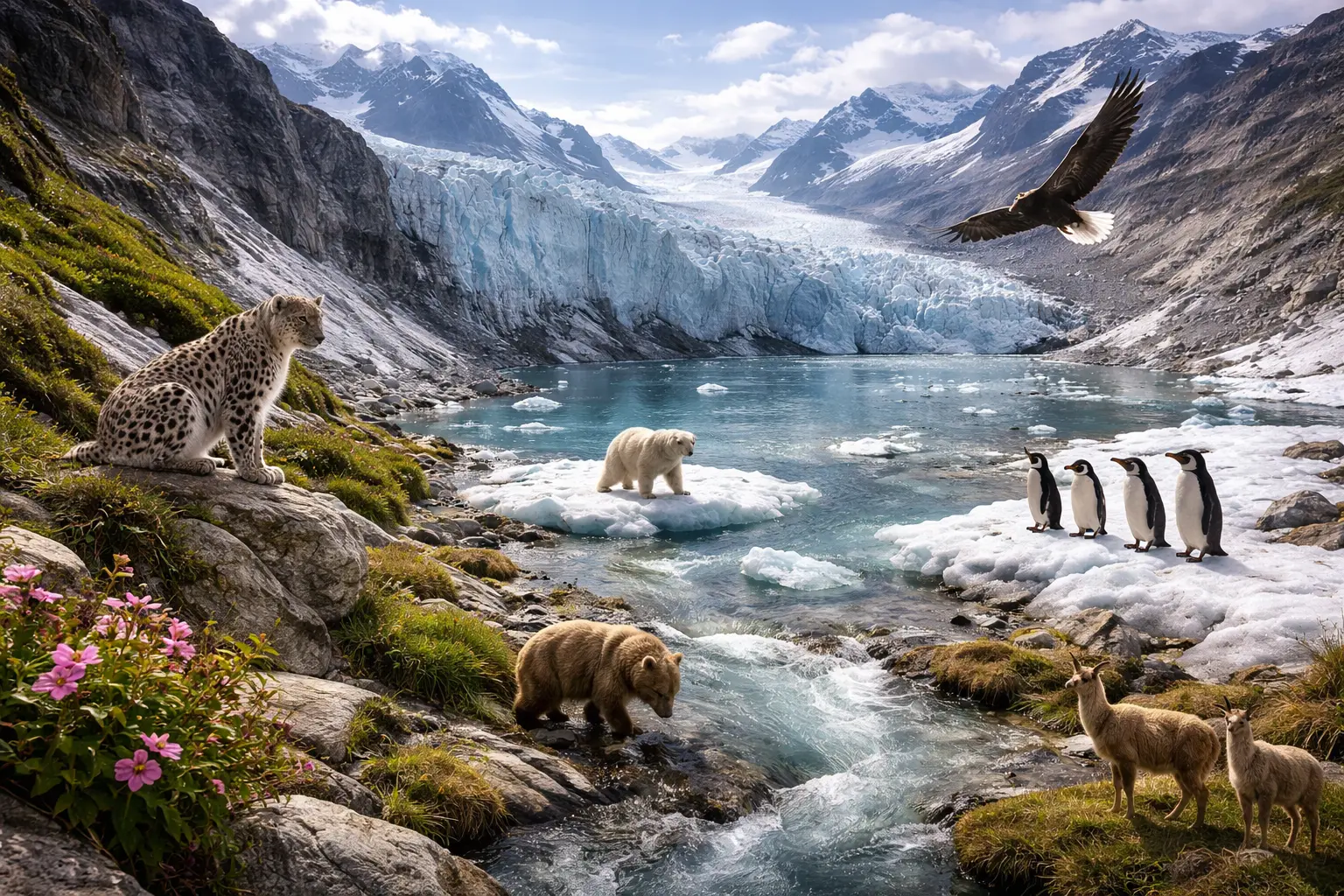
Alpine and polar species: Snow leopards, bar-headed geese, Himalayan tahr, polar bears, Arctic foxes, and dozens of other species have evolved behavioral and physiological adaptations to cold, ice-influenced environments. As those environments warm and shrink, species face habitat collapse with nowhere to relocate.
Microscopic biodiversity: Glacier surfaces support unique communities of cryophilic (cold-loving) microorganisms — algae, bacteria, and fungi that exist nowhere else on Earth. As glaciers disappear, these organisms disappear with them, and the ecological relationships they sustain dissolve.
Downstream vegetation: The seasonal pulse of glacial meltwater supports specific vegetation communities in mountain valleys and lowland floodplains. As meltwater patterns shift, vegetation changes — with cascading effects on the herbivores and predators that depend on those plants.
The loss of glaciers is not a single ecological event. It is the withdrawal of a foundational environmental condition that entire food webs have been built upon over thousands of years.
2025: The International Year of Glaciers’ Preservation
The scale of the crisis has prompted unprecedented international action. The United Nations General Assembly proclaimed 2025 as the International Year of Glaciers’ Preservation and established March 21 as the annual World Day for Glaciers. The initiative, spearheaded by UNESCO and the World Meteorological Organization with support from over 200 contributing organizations and 35 countries, seeks to raise awareness of the vital role glaciers play in the climate system and hydrological cycle.
This international recognition reflects growing scientific consensus that glaciers have moved from being a long-term climate indicator to an immediate humanitarian concern. The declaration of 2025 as the International Year of Glaciers’ Preservation is not symbolic — it is a policy mobilization mechanism designed to drive funding, data collection, and adaptation planning before the window for meaningful intervention closes.
What Can Still Be Saved — And What Cannot
Honesty requires acknowledging a difficult truth: some glacier loss is now inevitable, regardless of what actions humanity takes.
The IPCC’s Sixth Assessment Report states that continued glacier degradation is inevitable under all projected emissions scenarios. The ice that has already melted cannot be refrozen on any relevant human timeline. The sea level rise that meltwater has already contributed to is permanent on the scale of centuries.
But the difference between acting now and continuing on the current trajectory is the difference between losing some glaciers and losing most of them.
Almost 39% of glacial mass is threatened at current rates of warming. Each additional fraction of a degree of temperature increase accelerates the timeline and expands the losses.
The strong acceleration of global glacier mass loss is evident, with 5 of the last 6 years recording the strongest losses ever measured.
The science is clear about what determines outcomes: the speed and depth of greenhouse gas emissions reductions. Every year of delay in reducing emissions commits additional irreplaceable glacial mass to loss. Every fraction of a degree of warming avoided preserves ice that would otherwise be gone.
What This Means for You — Wherever You Live
The assumption that glacier loss is someone else’s problem — a concern for mountain communities, polar researchers, or distant coastal cities — misunderstands how deeply integrated glaciers are into global systems.
If you eat food: Agriculture in the Indus Basin, the Ganges Plain, coastal China, and South America’s Pacific coast depends on glacially-regulated river flows. Disruption of those flows affects global food supply and prices.
If you drink water: Hundreds of millions of people in mountain and downstream regions have no alternative to glacier-fed water sources. Water stress in those regions drives migration and conflict that affects stability globally.
If you live near a coast: The meltwater from every glacier on Earth eventually reaches the ocean and contributes to the sea level that determines flood risk for coastal cities worldwide.
If you care about biodiversity: Glacier-dependent species and ecosystems cannot be relocated or rebuilt. Once gone, they are gone permanently.
Understanding glacier loss as a distant environmental problem is a misreading of the evidence. It is a near-term humanitarian crisis in some regions and a long-term structural threat to the systems — food, water, climate stability — that underpin human civilization everywhere.
Frequently Asked Questions
Q: How fast are glaciers melting right now compared to historical rates?
The rate of glacier mass loss has nearly doubled since 2000. Annual glacier thinning rates went from 36 centimeters in 2000 to 69 centimeters in 2019 and have continued accelerating since. A 2025 analysis found that 41% of all glacier mass lost since 1976 occurred in the single decade from 2015 to 2024. The World Glacier Monitoring Service confirms that the last six years include five of the highest glacier mass loss years ever recorded.
Q: Which glaciers are disappearing fastest?
By total mass, Alaska leads glacier loss globally at approximately 60.8 billion tonnes per year, followed by Greenland’s peripheral glaciers and Arctic Canada. By percentage of total ice lost, Central Europe — primarily the Alps — has experienced the steepest relative losses, with some regions losing nearly 40% of their ice since 2000. Over 1,000 small glaciers in Switzerland have already disappeared entirely.
Q: What happens to freshwater supplies when glaciers disappear?
Glacier loss follows a two-phase pattern. In the short term, melting glaciers increase river flows — causing flooding and agricultural disruption. This is the “peak water” phase. Once glaciers have lost critical mass, river flows decline sharply during dry seasons, creating water scarcity for communities that have no alternative sources. This transition has already begun in parts of the Andes and Central Asia.
Q: Is there any way to stop glacier loss?
Some glacier loss is now unavoidable regardless of action taken — the IPCC confirms this under all emissions scenarios. However, the extent of future loss depends entirely on how quickly greenhouse gas emissions are reduced. Limiting warming to 1.5°C rather than 2°C would preserve significantly more glacial ice and delay or prevent critical tipping points. Every fraction of a degree of warming avoided translates directly into ice preserved.
Q: What are glacial lake outburst floods and how dangerous are they?
GLOFs occur when lakes formed by melting glaciers burst through their natural ice or rock dams, releasing massive volumes of water and debris catastrophically. More than 15 million people worldwide face high vulnerability to GLOFs. A 2023 event in India’s Sikkim state killed 46 people and displaced 90,000. As more glaciers retreat and form larger meltwater lakes, GLOF risk is increasing in mountain communities across the Himalayas, Andes, and Central Asia.