On February 1, 2026, Finance Minister Nirmala Sitharaman rose in the Lok Sabha to present her ninth consecutive India Budget.
The speech ran for nearly 90 minutes. It covered infrastructure, manufacturing, digital transformation, agriculture, and India’s ambition to become a fully developed nation by 2047. It referenced clean energy, green finance, and technology transitions. It celebrated India’s position as the world’s third-largest economy.
It did not mention the Ministry of Environment, Forests and Climate Change once.
Not once in a 90-minute speech to a nation that ranks among the world’s most climate-vulnerable countries — where 13 of the 20 most polluted cities on Earth are Indian, where Himalayan glaciers are retreating at documented rates, where extreme heat kills thousands annually, where wildlife corridors are vanishing under infrastructure projects — was the environment named as a policy priority.
This is the story of what India’s 2026 budget actually allocated, what it left out, what experts said about the gap, and why the distance between India’s environmental rhetoric and its environmental spending has consequences that will outlast any single fiscal year.
What the Budget Actually Allocated: The Real Numbers
Before analyzing what was missing, it is worth being precise about what was included — because the picture is more complicated than either critics or defenders of the budget typically acknowledge.
The Ministry of Environment, Forests and Climate Change (MoEFCC) received a gross allocation of ₹4,413.36 crore for 2026-27 — a net figure of ₹3,759.46 crore after recoveries and receipts. This represents approximately 8 to 10 percent increase over the revised estimates for 2025-26.
Within that allocation, several line items showed significant movement:
| Programme | 2025-26 RE | 2026-27 BE | Change |
|---|---|---|---|
| Project Tiger + Project Elephant | ₹153 crore | ₹290 crore | +90% (nearly doubled) |
| Green India Mission (Afforestation) | ₹95.7 crore | ₹212.5 crore | +122% |
| Control of Pollution | ₹853.90 crore | ₹1,091 crore | +28% |
| Biodiversity Conservation | ₹4 crore | ₹10 crore | +150% |
| Forest Fire Prevention | ₹33.25 crore | ₹40 crore | +20% |
| Air Quality Management | Higher | Lower | -10% |
| NTCA (Tiger Authority) | ₹36.75 crore (BE) | ₹32.18 crore | -12% |
These are not trivial numbers. The near-doubling of Project Tiger and Elephant funding was the most significant single wildlife conservation budget increase in several years. The Green India Mission increase was substantial. The pollution control allocation rose.
But context matters. And context reveals that the headline numbers, while positive in direction, are nowhere near adequate in scale — and that the budget’s silences are at least as important as its announcements.
The Speech That Said Nothing
The most striking feature of Budget 2026-27 from an environmental perspective is not what was funded. It is what was said — or rather, what was not.
Finance Minister Nirmala Sitharaman’s budget speech made no direct mention of the Ministry of Environment, Forests and Climate Change. While the speech referred to energy transition, clean technology and green finance, it did not frame climate change as an environmental, public-health or governance challenge. Forest protection, biodiversity, air pollution and climate adaptation were not identified as policy priorities.
This matters because of how Indian government policy works. Budget allocations exist in technical tables read by specialists. Budget speeches set national priorities, frame public discourse, and signal to states and ministries what the central government considers important. When the Finance Minister does not mention the environment in a 90-minute speech, she is communicating something specific: that environmental protection is not a central pillar of the government’s vision for India’s development.
The detailed budget documents tell a slightly different story — this funding appears only in technical budget tables. It is not highlighted or explained in the budget speech. There is no discussion of what the money is meant to achieve or how it links to climate risks, public health or environmental protection.
The distinction is not semantic. Funding without strategic framing is funding without accountability. When a programme is mentioned in the Finance Minister’s speech, it becomes subject to public scrutiny, parliamentary questioning, and media attention. When it exists only in technical appendices, it can be quietly underspent without political consequence — a pattern that India’s environmental spending has demonstrated repeatedly.
Wildlife Conservation: More Money, But Is It Enough?
The wildlife funding story in Budget 2026 is genuinely mixed — and the expert response illustrates why headline figures can be misleading.
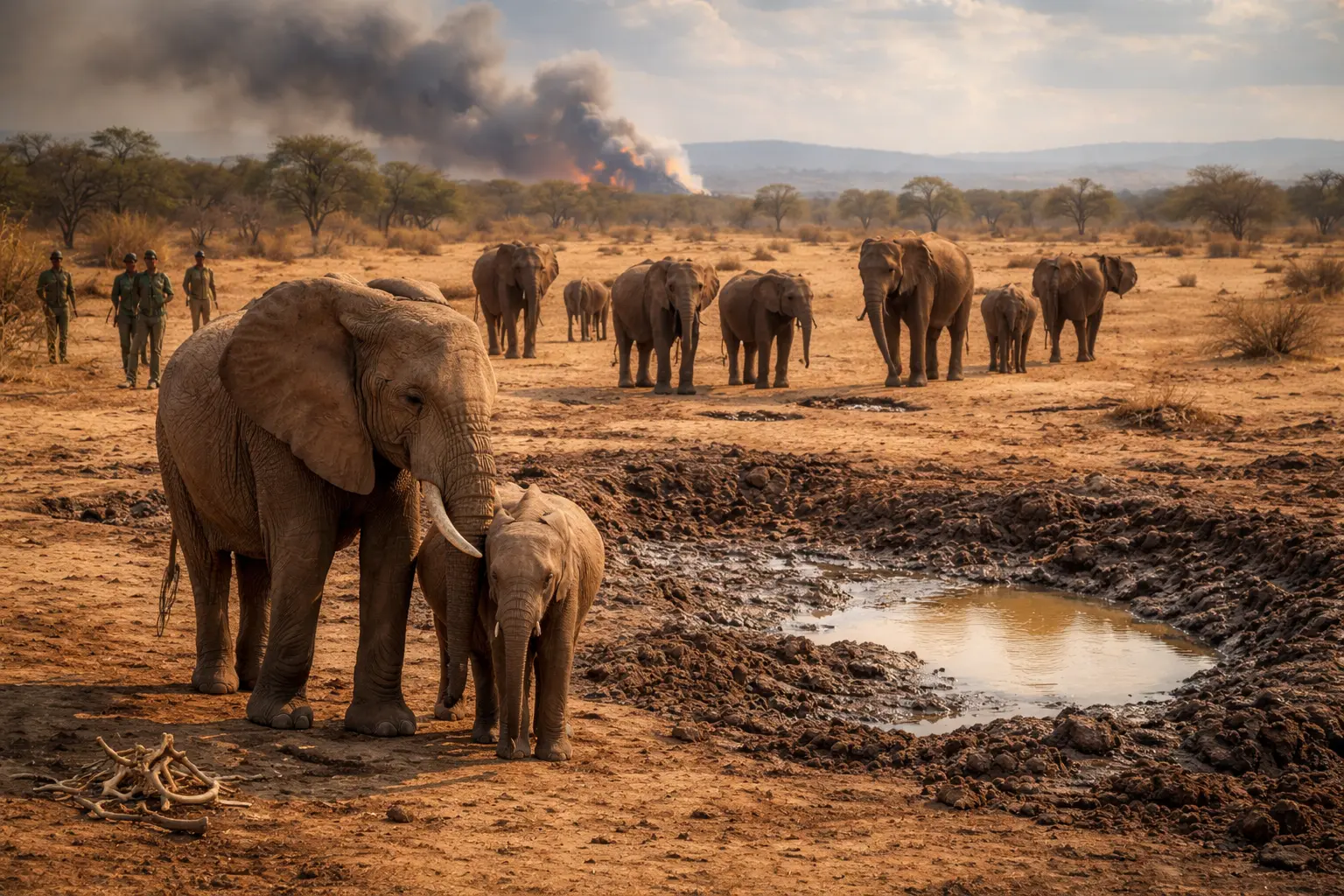
The budget allocated ₹290 crore for Project Tiger and Elephant, nearly double the ₹153.04 crore from last year. The National Mission for Green India got ₹212.5 crore, up from ₹95.7 crore. Wildlife conservationists welcomed the increase but warned it remains grossly insufficient for ground realities.
Dr. Anish Andheria, President of the Wildlife Conservation Trust, captured the ambivalence precisely. He said the funds should be viewed only as catalytic, emphasizing that managing human-elephant conflict requires substantially larger state investments, particularly in Madhya Pradesh, Chhattisgarh, and Maharashtra where elephant populations have surged.
The structural problem is deeper than the numbers suggest. India’s wildlife is constitutionally a concurrent subject — meaning both the central government and state governments have responsibility. He stressed that wildlife is a concurrent subject requiring joint action. “States must invest much greater funds and support long-term research to arrest ecosystem decline. Without well-funded, forward-looking state action, increases in central budget will have limited impact,” Andheria said.
The project merger issue deserves specific attention. The government merged Project Tiger and Project Elephant under a single budget head. One conservation expert noted that nearly ₹50-60 crore was previously diverted from Project Tiger for Project Cheetah. “They are not willing to spend more money. They don’t seem to have any desire to create separate new heads for different species. No such political willpower is visible in this budget,” he said.
The consolidation of multiple flagship conservation programmes into a single budget line — while superficially efficient — makes accountability nearly impossible. When a single allocation covers tigers, elephants, cheetahs, and general wildlife habitat development, it becomes impossible to determine whether any specific programme is adequately funded or chronically underspent.
One expert pointed to the broader gap: “We have the Great Indian Bustard, Lesser Florican, and even hyenas. The Western Ghats and Northeast India are biodiversity hotspots. These areas are affected by pollution, but the overall allocation to the Environment Ministry only increased by about seven or eight percent.”
India is one of 17 megadiverse countries in the world — home to approximately 7 to 8 percent of all recorded species while covering only 2.4 percent of Earth’s land area. The NTCA’s allocation actually fell from ₹36.75 crore (Budget Estimate 2025-26) to ₹32.18 crore (Budget Estimate 2026-27) — a 12 percent reduction for the authority responsible for overseeing Project Tiger, which manages the world’s largest tiger population.
Air Pollution: The Number That Should Alarm Every Indian
India’s air pollution crisis is not a seasonal inconvenience. It is a year-round public health emergency with documented mortality consequences.
Thirteen of the world’s 20 most polluted cities are in India. The Indo-Gangetic Plain — home to over 500 million people — experiences particulate matter concentrations that exceed WHO safe limits by factors of 10 to 20 for extended periods annually. Delhi, Lucknow, Patna, Kanpur, and dozens of other cities regularly record “severe” and “hazardous” AQI levels.
Against this backdrop, the budget’s treatment of air quality funding deserves scrutiny.
In the Budget 2026-27 documents, the ministry’s overall allocation stood at ₹3,759.46 crore, up 10 per cent from the Budget Estimates for 2025-26. However, the air quality management outlay was cut by 10 percent, and pollution control also saw a dip.
Noida experienced several “very poor” and “severe” air days in January 2026, worse than the previous winter. These conditions are not just seasonal problems. They point to long-standing failures in pollution control and environmental governance. While air pollution and climate change are distinct challenges, one should not forget how they are also related. Climate change is increasingly worsening pollution episodes by altering weather patterns, increasing heat stress, and intensifying stagnation events that trap pollutants close to the ground.
The National Clean Air Programme (NCAP) — India’s flagship initiative for reducing particulate pollution in 131 non-attainment cities — has consistently been underfunded and underutilized. Data presented in the PRS budget analysis shows that NCAP fund utilization has been well below allocation in multiple years, raising questions not just about the quantum of funding but about the government’s capacity to deploy it effectively.
Aarti Khosla, Founder and Director of Climate Trends, said the focus of government is rightly tilting towards building an energy transition ecosystem. “However, given the extent of air pollution, the focus on mitigating air pollution could have been stronger, including accelerating EV adoption, fast charging and such areas,” she said.
Climate Adaptation: The Critical Gap the Economic Survey Flagged
Perhaps the most significant environmental failure of Budget 2026 is not what it funded inadequately — it is what it effectively did not fund at all: climate adaptation.
The distinction between climate mitigation (reducing emissions) and climate adaptation (protecting communities from the climate impacts already locked in) is fundamental. India has made internationally recognized commitments to mitigation — a 500 GW non-fossil energy capacity target by 2030, a net-zero pledge for 2070. Budget 2026 continued to support these through renewable energy allocations.
But India is already experiencing the consequences of climate change that no amount of future emissions reduction can prevent. Extreme rainfall events are intensifying. Heatwaves are extending in duration and geographic reach. Himalayan glacier retreat is accelerating. Coastal erosion is claiming agricultural land in Odisha, Kerala, and West Bengal. The communities affected — overwhelmingly poor, rural, and marginal — need adaptation infrastructure now, not carbon reduction targets for 2047.
India’s per capita CO2 emissions stood at 2.1 tonnes in 2024 — less than half the global average and a fraction of emissions from developed economies. The climate impacts India is experiencing are largely the consequence of historical emissions from wealthier nations. Yet the adaptation burden falls almost entirely on Indian communities and the Indian government.
The Economic Survey released the day before Budget 2026 directly acknowledged this gap — making the budget’s silence on adaptation funding all the more conspicuous. Climate adaptation is not an option — it is an imperative, as multiple experts noted after the budget was presented.
Rivers: Decades of Cleanup Missions, Persistent Pollution
India’s rivers are both ecological lifelines and cultural symbols of extraordinary significance. They are also, in many stretches, severely polluted by a combination of untreated sewage, industrial discharge, agricultural runoff, and solid waste dumping.
The Ganga — India’s most sacred river — flows past 97 cities and thousands of industries. Despite the Namami Gange programme receiving significant allocations since its launch in 2014, independent assessments consistently find that water quality improvement has been limited, sewage treatment infrastructure remains incomplete, and real-time pollution monitoring is inadequate.
The 2026 budget did not present a new river restoration framework, additional accountability mechanisms for industrial polluters, or a timeline for achieving measurable water quality targets in priority river stretches.
This is not a new failure. It is a continuation of a pattern in which river restoration receives periodic political attention, generates significant budget announcements, and achieves limited on-ground change — partly due to coordination failures between states, partly due to implementation gaps, and partly because the industrial and agricultural discharge that drives most river pollution requires confronting powerful economic interests.
What the Budget Got Right: The Energy Transition Story
In the interest of accuracy, Budget 2026’s environmental record is not uniformly negative. The energy transition story is genuinely significant.
India’s renewable energy ambitions are among the most substantial of any major economy. The PM Surya Ghar Muft Bijli Yojana — targeting rooftop solar installation in one crore households — received continued strong support. Green hydrogen mission funding was maintained. The carbon market framework development continued.
India’s total CO2 emissions were 3,154 MT in 2024 — 7.96 percent of world total. Given India’s development imperatives and the historical emissions responsibility of wealthier nations, a budget that prioritizes clean energy access over carbon reduction at the expense of development is broadly defensible from a climate justice perspective.
The challenge is that energy transition and environmental protection are not the same thing. Renewable energy addresses emissions. It does not clean rivers. It does not protect wildlife corridors. It does not reduce particulate pollution in the short term. It does not fund the seawalls, drought-resilient agriculture, and heat action plans that climate adaptation requires.
A budget can make genuine progress on clean energy while simultaneously failing on biodiversity, pollution, adaptation, and ecosystem protection. Budget 2026 is an example of precisely this pattern.
The Scale Problem: ₹3,759 Crore in Context
The MoEFCC’s net allocation of ₹3,759.46 crore sounds substantial until it is placed in context.
India’s total Union Budget for 2026-27 is approximately ₹50 lakh crore. The MoEFCC allocation represents roughly 0.0075 percent of total government expenditure.
The Ministry of Roads and Highways — which constructs infrastructure that frequently fragments wildlife habitat and requires environmental clearances from the same MoEFCC — receives allocations orders of magnitude larger. The Ministry of Railways, whose tracks cross wildlife corridors and require mitigation structures that conservationists consistently note are underfunded, dwarfs the environment ministry’s budget.
One conservation expert pointed to the Railways and Transport Ministry’s refusal to allocate funds for wildlife mitigation structures. “Corridors and simple barriers for wild animals, where they should spend, they can’t even achieve that within a year,” he said. On enforcement, he noted systemic failures. “On the ground, the department always catches traffickers. But these people are released very quickly. Conviction rates are always very low. Without proper investigative cells and resources for evidence collection, this won’t change,” he said.
This budget architecture — in which the ministry responsible for environmental protection is allocated a fraction of a percent of government spending while ministries that generate environmental impact receive far larger allocations — reflects a fundamental political economy problem that no single budget cycle can resolve.
What Experts Are Saying: A Cross-Section of Responses
The expert response to Budget 2026’s environmental dimension has been consistent across organizations and disciplines.
Conservation specialists welcomed the wildlife funding increases while emphasizing their inadequacy relative to ground realities. Air quality experts expressed concern about the reduction in air quality management funding against a backdrop of worsening urban pollution. Climate economists pointed to the continued absence of a robust climate adaptation strategy as a critical governance failure.
The pattern that emerges from expert assessments is not that Budget 2026 was hostile to environmental concerns — it was not. It is that the budget treated environmental protection as a minor technical matter rather than a central development priority, at precisely the moment when the consequences of environmental degradation are becoming economically and humanly significant enough to threaten the development gains the budget was designed to celebrate.
India’s economic growth over the past decade has been genuine and substantial. But the environmental costs — in air pollution-related health expenditure, in climate-driven agricultural losses, in water scarcity affecting industrial production, in wildlife habitat loss that will affect biodiversity for generations — are also real, accumulating, and insufficiently accounted for in budget planning.
What a Genuinely Green Budget Would Require
Experts and analysts who have reviewed India’s environmental budget over multiple cycles broadly agree on what a budget that takes environmental governance seriously would need to include.
First, climate adaptation funding at scale — dedicated allocations for heat action plans, flood management infrastructure, drought-resilient agriculture, and coastal protection for communities facing immediate climate impacts, not as part of existing scheme budgets but as independent, ring-fenced allocations with measurable targets.
Second, wildlife corridor protection integrated into infrastructure budgets — a requirement that road, rail, and energy ministries allocate a defined percentage of project budgets to wildlife mitigation structures, with enforcement linked to environmental clearance.
Third, accountability mechanisms for pollution — real-time monitoring of industrial emissions linked to automatic penalties, public reporting of polluter performance, and funding for enforcement capacity that currently falls far short of what effective regulation requires.
Fourth, river restoration with measurable targets — specific water quality benchmarks for priority river stretches, with budget allocations linked to achieving those benchmarks rather than to constructing sewage treatment infrastructure that may or may not function at design capacity.
Fifth, environmental voice in the budget speech — a Finance Minister who frames climate resilience, biodiversity, and pollution control as central development priorities sends a political signal that cascades through state budgets, bureaucratic priorities, and private investment decisions in ways that formal allocations alone cannot.
Frequently Asked Questions
Q: How much did India’s Budget 2026 allocate to the environment ministry?
The Ministry of Environment, Forests and Climate Change received a gross allocation of ₹4,413.36 crore (net ₹3,759.46 crore) in Budget 2026-27 — an increase of approximately 8 to 10 percent over revised estimates for 2025-26. This represents roughly 0.0075 percent of India’s total budget expenditure.
Q: Did the wildlife conservation budget increase in 2026?
Yes, significantly in some areas. Project Tiger and Project Elephant received a combined ₹290 crore — nearly double the previous year’s revised estimate of ₹153 crore. The Green India Mission allocation more than doubled. However, conservation experts consistently noted that absolute amounts remain inadequate relative to the scale of wildlife protection challenges, and that the NTCA’s own allocation actually fell from its previous budget estimate.
Q: Why was the environment ministry not mentioned in the budget speech?
The Finance Minister’s 2026 budget speech made no direct reference to the Ministry of Environment, Forests and Climate Change, despite the ministry receiving an allocation in technical budget documents. Experts noted that the absence of environmental issues from the speech means they are not framed as national priorities — which affects political accountability, state government priorities, and public scrutiny of how funds are actually spent.
Q: What was the biggest environmental gap in Budget 2026?
Analysts and experts most consistently identified the absence of a climate adaptation strategy as the critical gap — specific funding to protect Indian communities from the floods, heatwaves, droughts, and coastal erosion that climate change is already causing. India’s renewable energy ambitions are genuine, but adaptation infrastructure for communities already experiencing climate impacts received no dedicated allocation or strategic framing.
Q: How does India’s environment budget compare to its development spending?
The comparison reveals a significant imbalance. The MoEFCC receives approximately ₹3,759 crore — a fraction of a percent of total government expenditure — while ministries that generate significant environmental impact (Roads, Railways, Heavy Industries) receive allocations tens to hundreds of times larger. This structural imbalance means that environmental costs of development are consistently under-accounted for in national economic planning.