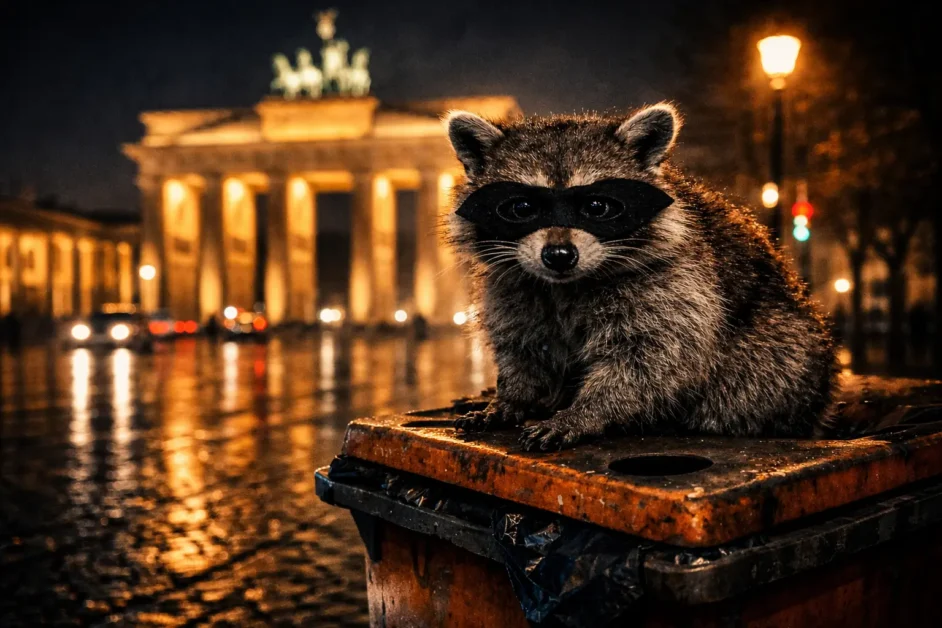
Germany is one of the most organised, efficient, rule-following nations on earth. It has laws for everything. It has agencies for everything. It has committees debating those agencies. And yet, right now, in the forests, parks, attics, subway stations, and Christmas markets of the German capital, a small masked animal from North America is winning.
Not winning a battle. Winning a war. Quietly, cleverly, one garbage bin at a time — the raccoon has conquered Berlin. And the German government, despite its laws, its hunters, its scientists, and its bureaucracy, has absolutely no idea what to do about it.
This is the story of the most unlikely invasion in European history. And the story of how Berliners — far from resisting the occupation — have welcomed it with open arms.
The Numbers That Tell the Story
- 2 million — raccoons now estimated in Germany — the largest non-native raccoon population on Earth (Goethe University / Senckenberg, 2025)
- 60x increase — in raccoon population in Germany over the past 25 years, b`ased on hunting records
- 200,000 — raccoons killed by hunters in Germany in 2022 alone — a record. Population still grew.
- 100+ per 100 hectares — raccoon density in Kassel — roughly one raccoon per football pitch, one of the highest predator densities in Europe
- 1,000 — raccoon families estimated in Berlin city alone, plus 30,000 in surrounding Brandenburg
- 50 calls per day — received by Berlin’s chief wildlife officer Derk Ehlert — all about raccoons
- €12 billion — annual cost to the EU economy from invasive species — raccoons are among the primary contributors
- 83 — raccoons killed in Berlin from 2020 to 2025 — the Senate’s entire response to the crisis (The Berliner, February 2026)
Part 1: How It All Started — A Gift That Became a Catastrophe
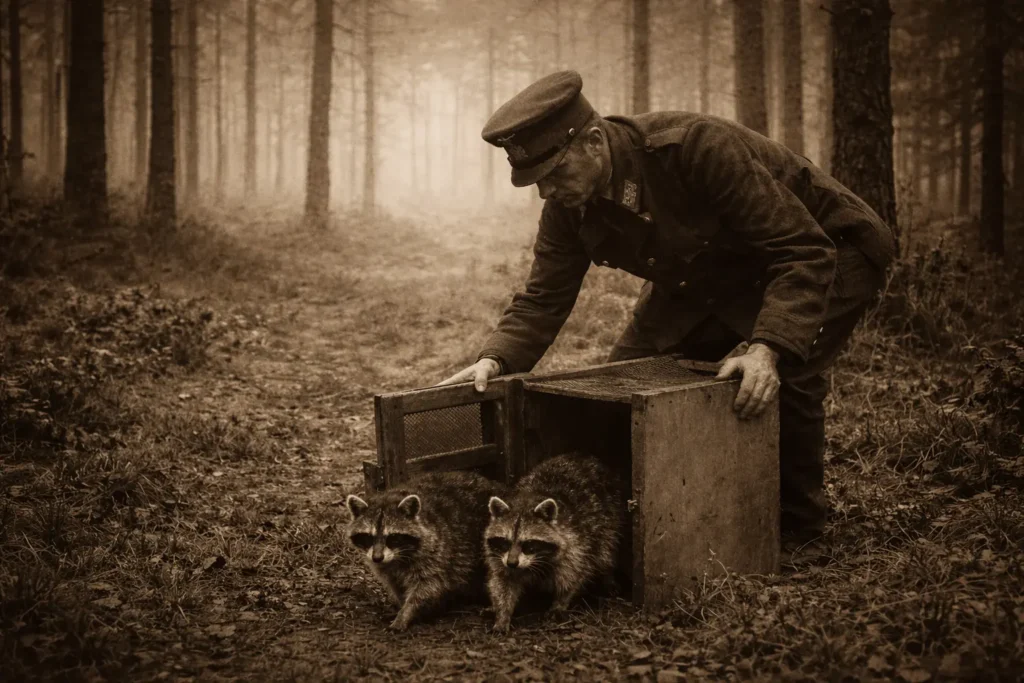
To understand Berlin’s raccoon problem, you have to go back to 1934. The year: Nazi Germany. The location: a forest near Lake Edersee in Hesse, central Germany. The decision: a forester and animal enthusiast named Rolf Haag applied to the Prussian Hunting Office to release two breeding pairs of North American raccoons into the German wild. His stated reason was to ‘enrich the local fauna.’ The application was approved.
Then, in 1945, as the Second World War ended and chaos consumed Germany, 25 more raccoons escaped from a fur farm in Wolfshagen, Brandenburg. Nobody chased them. Nobody had time. Europe was burning. And in the forests of north-eastern Germany, 25 raccoons began doing what raccoons do best: surviving, adapting, and reproducing.
Germany, it turned out, was an almost perfect environment for a North American raccoon. Mild climate. No natural predators — no bobcats, no coyotes, no large birds of prey that hunt raccoons in their native range. Dense forests. An abundance of human food waste in rapidly growing cities. Raccoons, which can eat almost anything and solve almost any physical puzzle placed in front of them, had found paradise.
By 1995, the raccoon was still rare enough in Germany that hunters considered it an unusual catch. By 2000, the population was growing. By 2010, it was accelerating. By 2022, hunters killed 200,000 raccoons in a single year — a figure that would have seemed science fiction in 1995 — and the population still grew. By 2025, scientists estimated 1.6 to 2 million raccoons in Germany, making it the country with the largest non-native raccoon population anywhere on the planet outside North America.
What began as two breeding pairs released by a Nazi-era forester had, in 90 years, produced two million animals occupying every corner of the country — including the attics, basements, and subway stations of the German capital.
Part 2: The Undercover Agent — How the Raccoon Conquered Berlin
If you were designing the perfect urban infiltrator, you would design something very close to a raccoon. Consider the specifications.
Specification 1: Intelligence
Raccoons are, by scientific consensus, among the most intelligent mammals in Europe — which is notable, because they are not European. Studies at the Goethe University Frankfurt have documented raccoons solving multi-step puzzles, remembering solutions for years, adapting immediately to new obstacles, and learning from watching other raccoons. The black mask around a raccoon’s eyes is not just cosmetic — it functions like a balaclava, reducing glare and improving the animal’s visual contrast sensitivity in low-light conditions. The perfect gear for a nocturnal operator.
Berlin’s chief wildlife officer Derk Ehlert put it plainly in an interview: ‘They are the most intelligent mammals in Europe. They are very quick.’
Specification 2: Hands
A raccoon has five fingers on each forepaw. These are not claws in the traditional sense — they are manipulative digits, capable of opening latches, unscrewing lids, pulling back bolts, and dismantling almost any human-designed container that was not specifically built to resist them. Reports from across Germany describe raccoons opening childproof medicine containers, unscrewing garden tap fixtures, pulling open refrigerator doors, and — in at least one documented Berlin case — chewing through electrical cables at a power plant in a way that suggested not random gnawing but targeted precision.
Berliners began reporting raccoons not just tipping over bins but actually opening them — distinguishing between locked and unlocked bins with apparent ease and moving on from locked ones without wasting time.
Specification 3: Diet
Raccoons will eat almost anything. Fruits, insects, fish, frogs, bird eggs, small mammals, carrion, fast food packaging, birthday cake, beer, compost — all documented. Biologist Frank-Uwe Michler summarised the raccoon’s eating strategy with elegant precision: ‘The raccoon is basically lazy, and eats what it can get with least effort.’ In a city like Berlin, which generates enormous quantities of accessible food waste daily, this strategy produces an animal that is never genuinely hungry and therefore never needs to leave.
This dietary flexibility is the foundation of the raccoon’s success. Species that depend on specific food sources collapse when those sources disappear. Raccoons do not depend on any specific food source. Berlin, with its thousands of restaurants, apartments, parks, and markets, offers a permanent, inexhaustible buffet.
Specification 4: Reproduction
A female raccoon gives birth to three to five kits per litter, typically once a year, with a gestation period of 63 days. Kits are independent within a year. In Germany, with no natural predators to reduce survival rates, the majority of kits born survive to adulthood and reproduce. The mathematical consequence of this reproductive rate — applied to a population that grew from 4 released animals to 2 million in 90 years — is not surprising. It is, however, alarming.
Scientists at Goethe University found that over 21 years of hunting data across 398 German districts, raccoon populations moved through predictable phases: introduction, slow growth, rapid expansion, and finally saturation — the point at which the environment reaches its carrying capacity and the population stabilises. In some parts of Germany, saturation has been reached. In others — including parts of Berlin — the expansion phase is still underway.
Specification 5: Fearlessness
The raccoon that boarded the BVG bus at Tempelhofer Damm did not appear frightened. The raccoon that passed out at the Christmas market was not attempting to hide. The raccoon filmed drinking beer at a lakeside café table in broad daylight — yes, this happened — was not startled by the camera. Raccoons in Berlin have been around humans long enough that they have largely lost their fear response to human presence. This is not domestication. It is something more unsettling: a wild animal that has calculated, correctly, that humans in Berlin are not a threat.
This fearlessness is a product of urban adaptation. Raccoons that were bold enough to approach humans survived and reproduced. Raccoons that fled every time a human appeared spent energy and missed food. Natural selection, operating over a few dozen generations in an urban environment with no predators, has produced a raccoon that looks at a Berliner and sees not a threat but an opportunity.
Part 3: The Government’s Dilemma — Every Solution Makes Things Worse
Germany is not a country that ignores problems. It is a country famous for its bureaucratic thoroughness, its comprehensive legislation, and its faith in evidence-based policy. And yet, when it comes to raccoons, Germany is — as The World from PRX described it with perfect accuracy — ‘passive in the face of invasion.’
This passivity is not negligence. It is the result of a genuinely impossible policy situation in which every available tool either does not work, is illegal, is politically unfeasible, or makes the problem worse.
Tool 1: Hunting — Tried, Failed, Repeated
Germany classifies raccoons as an unprotected game species, meaning they can be hunted year-round with no restrictions in most federal states. Hunters have pursued this option with extraordinary vigour. In 2022, Germany’s National Hunting Association reported killing a record 200,000 raccoons in a single year. Two decades earlier, the annual kill was around 10,000.
The population grew anyway.
There are two reasons for this failure. First, the sheer scale of the population — 2 million animals spread across the entire country — means that hunting, even at 200,000 per year, removes only around 10 percent of the total population. For a species with a reproductive rate that produces 3 to 5 offspring per surviving adult per year, a 10 percent annual cull has essentially no effect on overall population trajectory.
Second, and more importantly, a persistent myth — that hunting causes raccoons to reproduce faster in response to population pressure — has created significant public resistance to expanded culling. Researchers from Goethe University spent considerable space in their 2025 paper debunking this myth, tracing it to a misinterpretation of a 35-year-old American study. But the myth persists, and it makes politically unifying around a hunting-based solution nearly impossible.
Berlin’s specific response: From 2020 to 2025, the Berlin Senate authorised the killing of exactly 83 raccoons across the entire capital. In a city with an estimated 1,000 raccoon families, this is the equivalent of taking a teaspoon of water out of a full bathtub and declaring the problem addressed.
Tool 2: Neutering — Illegal and Impossible
If hunting cannot reduce the population, what about preventing reproduction? The idea of neutering raccoons — catching them, sterilising them, and releasing them — has been proposed repeatedly by animal welfare groups as a humane alternative to killing. The German government’s response is technically correct and practically devastating: it is both impossible and illegal.
With 2 million animals, the logistics of catching, anaesthetising, sterilising, and releasing even a meaningful fraction of the population would require resources that do not exist and a timeline measured in decades. More fundamentally, EU regulations on invasive alien species explicitly prohibit releasing invasive species back into the wild after capture. A raccoon caught and sterilised cannot be returned to the forest. It must be kept in captivity for life. There is no capacity in Germany to house 2 million raccoons in captivity.
The EU regulation, designed to prevent the spread of invasive species, has inadvertently created one of the strangest wildlife management situations in European history: it is illegal to remove a raccoon from your attic and take it back to the woods.
Tool 3: Relocation — Creates New Problems
Trapping raccoons and relocating them elsewhere has been tried in various German municipalities. It does not work for the same mathematical reason that hunting does not work: the population reproduces faster than relocation can remove individuals. Additionally, relocating raccoons from one area to another simply moves the problem geographically rather than solving it. Given that raccoons in Germany are already present in virtually every district, there is nowhere to relocate them to that does not already have raccoons.
Tool 4: The Berlin Hunting Ban — A Legal Trap
Berlin imposes a hunting ban from February to September — covering the raccoon’s primary breeding season. This ban exists for legitimate reasons: indiscriminate hunting during breeding season kills nursing mothers and orphans kits. But its practical effect is to reduce the window in which legal raccoon control is possible to the four months between October and January. During the other eight months, if a raccoon moves into your attic, your legal options are essentially: ask it to leave, or wait.
The EU’s invasive species designation adds a further layer of restriction. While raccoons can be hunted, they cannot be intentionally caught and knowingly released. This means that the most practical solution a Berlin resident might attempt — catching the raccoon in their attic in a live trap and driving it to a forest — is technically illegal. As The Berliner dryly observed, raccoons in Berlin have tenancy rights that many human renters would envy.
What the Government Actually Recommends
When confronted with this impasse, German authorities fall back on a set of recommendations that function as an implicit acknowledgment that they cannot solve the problem at a population level. They can only advise individuals on how to make themselves a slightly less attractive target.
| Official Recommendation | Why It Doesn’t Work at Scale |
| Lock your garbage bins properly | Raccoons can open many locks; bin manufacturers lag behind raccoon intelligence |
| Seal all entry points in your home | Raccoons find new entry points; average home has many unsealed gaps |
| Do not feed raccoons | Thousands of Berliners ignore this — intentionally or accidentally |
| Call wildlife authorities if injured raccoon found | Cannot release it — it goes into permanent captivity |
| Secure pet food and outdoor food sources | Effective individually; does nothing for population |
“Berlin’s Senate refused to sanction killing the raccoons. Instead, they encouraged residents to lock their bins properly.” — AllThatsInteresting, citing The Telegraph
Part 4: The Berliners — How a City Adopted Its Invaders
Here is where the Berlin raccoon story becomes something more than an ecological cautionary tale. Because while scientists warn about ecological damage, while hunters kill 200,000 animals per year, while the government debates policies it cannot implement — the people of Berlin have made a different choice entirely.
They have decided, with varying degrees of consciousness, to love the raccoons.
The Celebrity Treatment
In the past decade, German media has covered raccoons with the sustained, affectionate attention normally reserved for celebrities. The raccoon that passed out at the Christmas market was covered by multiple national outlets. The raccoon that boarded the BVG bus was photographed and shared thousands of times. The raccoon that short-circuited the power plant became a local legend. Each incident generated not outrage but delight — a city laughing at itself for having been outwitted by a masked mammal from Ohio.
Berliners have given their neighbourhood raccoons names. Social media accounts devoted to local raccoon families have thousands of followers. Instagram pages dedicated to ‘Waschbär Berlin’ — Waschbär being the German word for raccoon, meaning ‘wash-bear’, named for the animal’s habit of appearing to wash its food — have become minor institutions. Raccoon sightings are shared in neighbourhood WhatsApp groups not as warnings but as announcements, the way other neighbourhoods might share news of a visiting celebrity.
The Feeding Problem
Despite official government guidance explicitly advising against feeding raccoons, a significant number of Berliners feed them anyway. Some do it consciously — leaving food out at night, treating the local raccoon family as semi-pets, giving them names and photographing them. Others do it unconsciously, through improperly sealed bins, compost heaps, pet food left on balconies, and the general abundance of accessible food that characterises a European city.
Biologist Berthold Langenhorst of the nature organisation NABU — who has observed raccoons stealing and drinking beer at lakeside locations — captured the public mood perfectly: ‘Raccoons are funny and clever. And they like beer.’
This affection has a direct population consequence. Every person who feeds a raccoon is subsidising its reproduction. Every family that allows a raccoon to raise kits in their attic because they find it charming is adding 3 to 5 new animals to the Berlin population. The city’s love for its masked invaders is, in a precise ecological sense, making the problem worse. And most of the people doing it know this, and continue anyway.
The Emotional Bias That Blocks Science
Researchers at Goethe University identified this phenomenon — the way raccoons’ appearance creates an emotional response that overrides rational assessment of their ecological impact — as one of the primary obstacles to effective management. Their 2025 paper noted that raccoons’ photogenic faces and playful behaviour generate a ‘strong emotional bias among the public, one that can stifle science-based conservation efforts.’
Professor Sven Klimpel, lead author of the study, addressed both policymakers and the public with unusual directness: ‘We must implement the legal requirements for species protection consistently and not let them be overridden by sympathy for charismatic animals.’
The problem is that charisma works. When animal welfare groups post photographs of raccoon kits — tiny, wide-eyed, masked, impossibly cute — next to calls for expanded hunting programmes, the hunting programmes lose. When scientists explain that raccoons enter a ‘killing frenzy’ in bird nesting sites, destroying entire clutches far beyond what they can eat, the public nods politely and continues to find the raccoon in the Christmas market video adorable.
Germany’s raccoon problem is, at its core, a problem of human psychology as much as ecology. The animal has, without any apparent intentionality, made itself likeable enough that the species most capable of controlling it has chosen not to.
The Waschbär Identity: When Invaders Become Part of the City
Something interesting has happened in Berlin over the past decade. The raccoon has moved from being seen as a foreign invader to being seen as part of the city’s identity. Like Berlin’s famous wild boars, which roam the city’s parks and suburban streets and are regarded with a mixture of wariness and civic pride, the Waschbär has become a Berlin character.
Tour guides mention them. Children’s books feature them. A Berlin-based board game includes a raccoon as a city mascot. The raccoon that rode the bus became the subject of a short film. Merchandise featuring the Berlin Waschbär exists and sells. The animal that arrived uninvited has, through sheer persistence, charm, and intelligence, earned a place in the city’s self-image.
This cultural integration is the raccoon’s most impressive achievement. No government programme, no hunting initiative, no scientific paper will ever be able to remove an animal that a city has claimed as its own.
Part 5: The Side of the Story That Is Not Cute
The affection that Berliners feel for their raccoons is understandable. But there is another side to this story — and it deserves to be told with equal honesty.
What Raccoons Are Actually Doing to Native Species
Scientists at Goethe University and the Senckenberg Biodiversity and Climate Research Center have documented what they describe as ‘a dramatic decline in sensitive species in areas with high raccoon densities.’ The victims are not charismatic megafauna. They are the unglamorous, easily overlooked species that form the foundation of healthy ecosystems: amphibians, ground-nesting birds, reptiles, bats.
Raccoons specifically target the breeding sites of these species. They raid bird nests systematically, often entering a ‘hunting frenzy’ in which they destroy far more eggs and chicks than they can consume — a behaviour that has no evolutionary logic in North America, where predator pressure limits the time a raccoon can spend in one location, but which has no limiting factor in Germany. European pond turtles — already endangered — have been found ‘predator-devoured’ in Brandenburg near raccoon tracks. Native bat species, which roost in tree hollows that raccoons also target, are showing population declines in high-density raccoon areas.
NABU, Germany’s major nature conservation organisation, has documented raccoons hunting young lapwings and red kites — the latter a bird that Germany has spent decades and significant conservation resources trying to protect.
The Infrastructure Damage
Beyond ecology, raccoons cause substantial economic damage to human infrastructure. They enter attics through gaps as small as 10 centimetres, nesting and raising young in roof insulation that they shred for bedding material. Electrical cables chewed by raccoons have caused fires. The power plant incident in Berlin was not unique — it was simply the most dramatic of many such incidents. In German cities, raccoon damage to buildings costs millions of euros annually in repairs.
Agricultural damage is documented but contested in scale. Raccoons raid crops, particularly corn and fruit. In rural areas bordering Berlin, farmers have reported significant losses. The economic cost of invasive species to the EU as a whole is estimated at €12 billion per year — raccoons are among the primary contributors to this figure.
The Disease Risk
Raccoons carry several diseases that are transmissible to humans and pets, including rabies — though Germany has been rabies-free since 2008, the risk of reintroduction through wildlife contact exists — and Baylisascaris procyonis, a roundworm parasite whose larvae can cause severe neurological damage in humans if ingested. Children who play in areas where raccoons defecate are at risk. The parasite’s eggs can survive in soil for years. In cities where raccoons are actively fed by residents and regarded as semi-pets, the proximity between raccoon waste and human contact is a genuine public health concern that receives far less attention than the viral bus incident.
Conclusion: The Unstoppable Waschbär
Two breeding pairs. Released in 1934 by a man who wanted to enrich the local fauna. Ninety years later: 2 million animals, 50 calls per day to Berlin’s wildlife office, one raccoon on a city bus, one raccoon in a power plant, one raccoon passed out under a Christmas market stall.
Germany has tried hunting — 200,000 killed in one year, population still grew. It has tried relocation — mathematically futile. It has tried legislation — which accidentally made the problem harder to address by prohibiting releasing captured animals. It has tried public education — which runs directly into the wall of the raccoon’s irresistible face.
The raccoon has not won through strength. It has won through a combination of intelligence, adaptability, reproductive efficiency, and — most devastatingly for any government hoping to manage it — genuine likability. It is difficult to declare war on something that your citizens consider a local celebrity.
Scientist Dr. Carolin Weh, Berlin’s wildlife expert and biologist, says the population in some areas has already reached its natural carrying capacity and will stabilise on its own. That may be the most honest prognosis available. Not a solution. Not a defeat. A new equilibrium — one in which Berlin is a city of humans, wild boars, pigeons, and, now permanently, masked North American visitors who have decided that Germany is home.