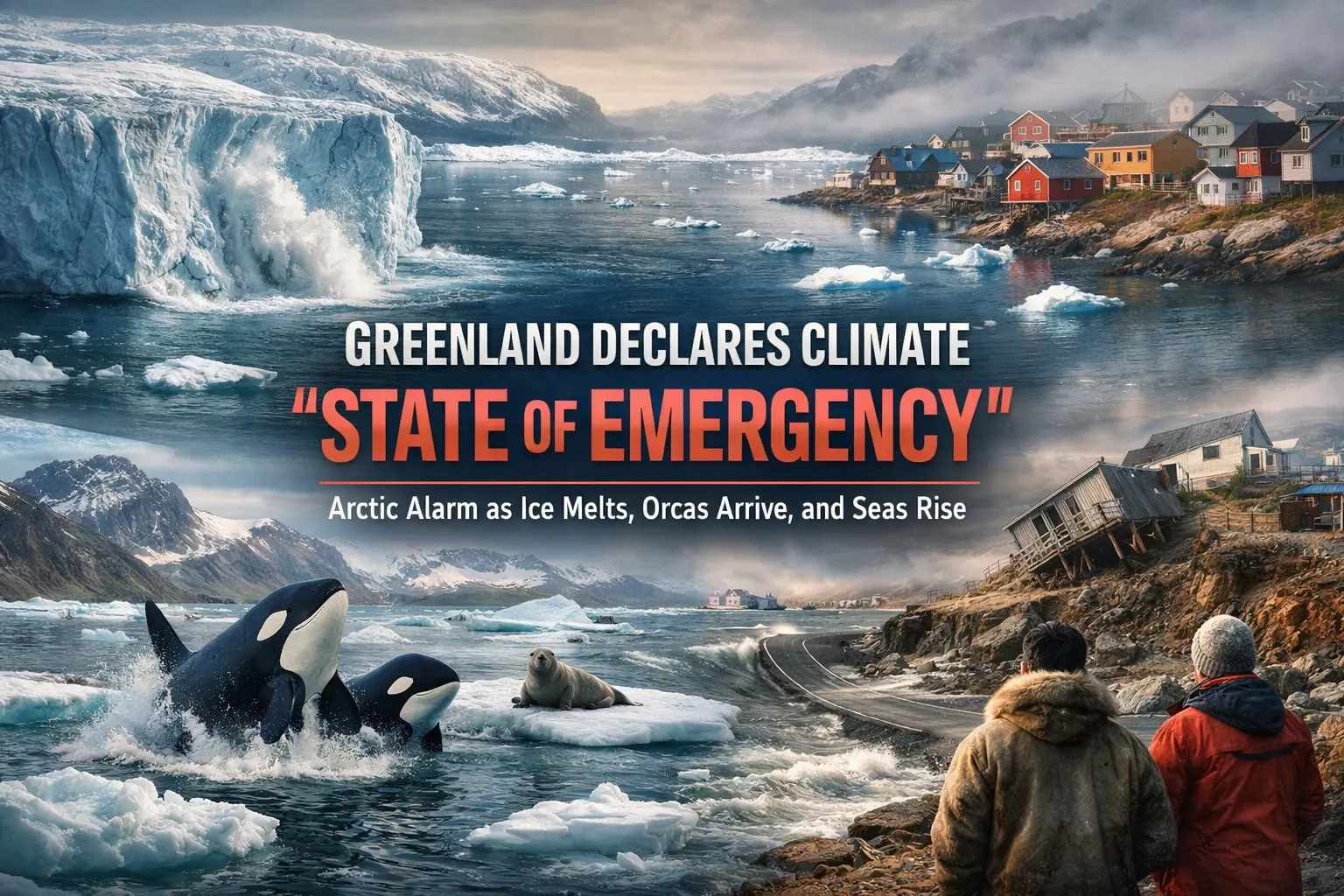
In early February 2026, the government of Greenland — the vast Arctic territory of the Kingdom of Denmark — declared a state of emergency as dramatic changes in its environmental and ecosystems started to reshape daily life along its coastlines.
This isn’t a weather alert or a political scare story — it’s an acknowledgment that the Arctic is changing faster than many scientists predicted, and one of the clearest signals yet lies in an unexpected place: pods of orcas (killer whales) moving into coastal fjords where thick ice once blocked their path.
Experts argue that climate justice must become central to global policy. This includes financial support for vulnerable nations, loss-and-damage funding, climate-resilient infrastructure, and legal recognition for climate-displaced people. Without shared responsibility and international cooperation, the burden of climate migration will fall unfairly on those already facing poverty and instability.
The Ice Is Disappearing Faster Than Expected
Greenland’s ice sheet — the second largest in the world — holds enough frozen water to raise global sea levels by more than 7 meters if it were to melt completely. Although that worst-case scenario would unfold over centuries, current trends are deeply troubling.
Recent observations show:
- Earlier seasonal melting
- Longer ice-free periods in coastal waters
- Accelerated glacier calving into the North Atlantic
- Increasing meltwater runoff
This isn’t just a scientific statistic. It affects fishing routes, traditional hunting grounds, infrastructure stability, and drinking water systems in Arctic settlements.
Ecosystem Disruption: Orcas and Changing Marine Life
One visible symbol of change has been the growing presence of orcas (killer whales) in Greenland’s fjords — waters that were once too ice-covered for them to navigate regularly.
With less sea ice:
- Orcas can enter deeper Arctic waters
- Seal populations face new predation pressure
- Fish migration routes are shifting
- Traditional subsistence patterns are being disrupted
For some communities, this represents opportunity — tourism and research expansion. For others, it signals ecological imbalance and cultural uncertainty.
Why Greenland State of Emergency Matters Globally
Greenland’s crisis is not isolated. What happens in the Arctic influences:
- Global sea levels affecting coastal cities from Asia to North America
- Weather systems across Europe and North America
- Ocean circulation patterns that regulate global temperatures
The melting of Greenland’s ice contributes significantly to worldwide sea-level rise. Even small increases intensify flooding, coastal erosion, and storm surges in vulnerable regions.
If Arctic ice continues to decline, the ripple effects could reach millions living far from the polar circle.
Life on the Ground: Community Impact
For Greenland’s residents, the emergency is deeply personal.
Transportation Challenges
Ice once served as natural highways for snowmobiles and sleds. Now thinner ice makes travel dangerous and unpredictable.
Infrastructure Strain
Thawing permafrost destabilizes buildings, roads, and airstrips.
Economic Pressure
Fishing patterns are shifting. Some species move northward, others decline.
Yet, Greenland is also exploring adaptation strategies:
- Expanded climate monitoring
- Coastal protection planning
- Renewable energy projects
- Sustainable tourism development
Climate Emergency or Climate Warning?
Declaring a state of emergency signals urgency — but it also reflects leadership. Greenland is positioning itself as both a victim of climate change and a voice in global climate negotiations.
The Arctic has often been described as Earth’s early warning system. If so, Greenland’s declaration may be one of the clearest alarms yet.
Key Facts at a Glance
- Greenland’s ice sheet is losing hundreds of billions of tons of ice annually.
- The Arctic is warming nearly four times faster than the global average.
- Sea-level rise from Greenland directly impacts global coastal populations.
- Wildlife migration patterns are shifting due to melting sea ice.
The Bigger Question
Greenland’s emergency forces a global reflection:
Are we prepared for a world where environmental shifts happen not over centuries — but within a single generation?
The Arctic’s silence is breaking. Ice is thinning. Oceans are rising. And Greenland’s message is clear: climate change is not future tense — it is present reality.