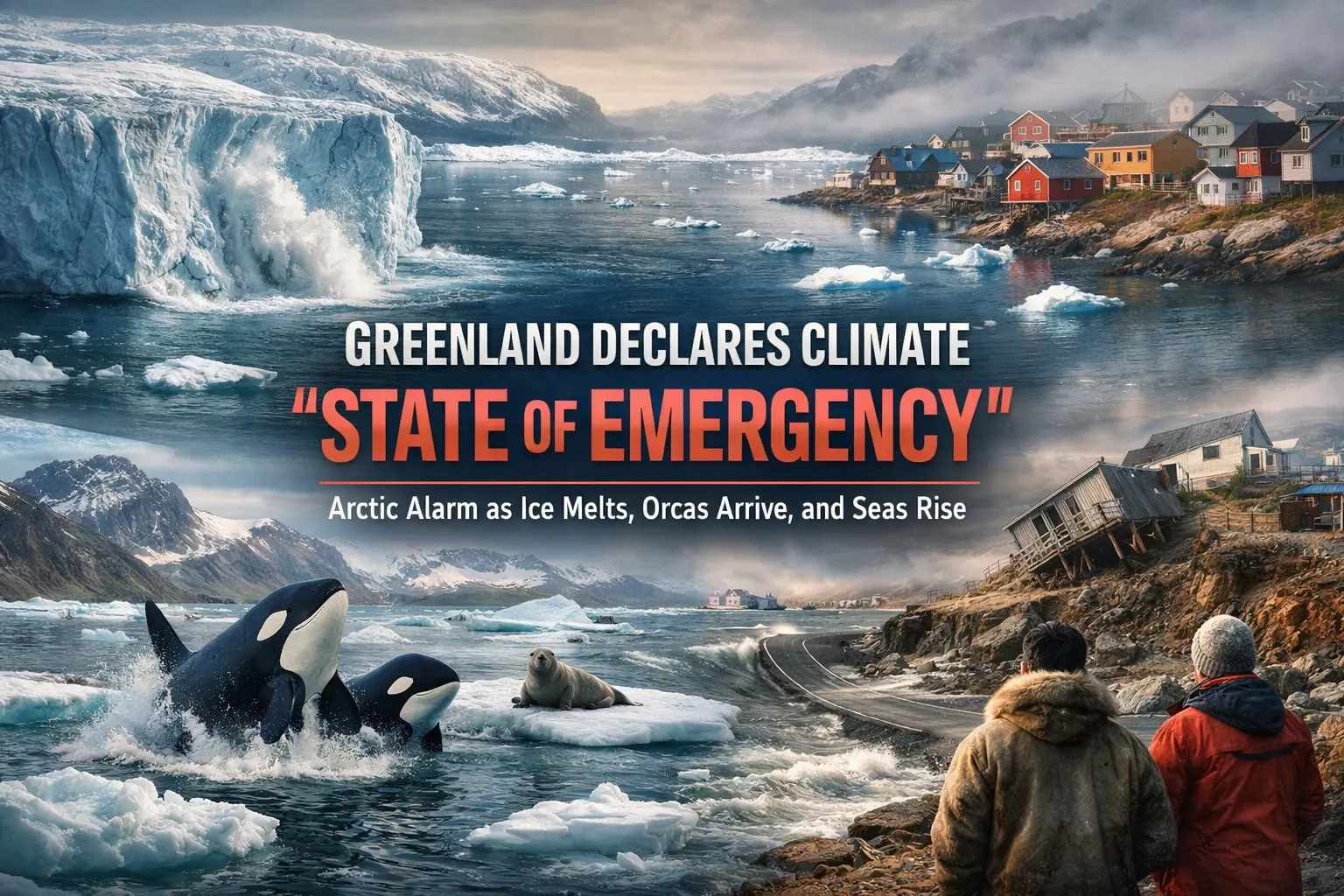
In early 2026, the government of Greenland — the vast Arctic territory of the Kingdom of Denmark — formally declared a regional climate emergency. The declaration was, in the words of officials in Nuuk, both a plea and a promise.
A plea to the world for urgent action on greenhouse gas emissions and support for adaptation. A promise to Greenlanders that their government would treat climate impacts as a crisis touching every ministry — health, infrastructure, education, fisheries — not just an environmental footnote buried in scientific reports.
The declaration did not come from a single dramatic event. It came from the accumulation of evidence that had been building for years, finally reaching a threshold that officials could no longer responsibly describe as normal variability.
Authorities were seeing record melt seasons, unstable glaciers, disrupted hunting routes, and a rapid shift in marine life. The surge in orca sightings was one visible sign of warmer, more open waters around the island — and the government wanted to treat this as a national safety, economic, and environmental crisis, not just a scientific concern.
What made the declaration internationally significant was its framing. For Greenland, declaring an emergency around orcas and melting ice was less about panic and more about permission: permission to say out loud that the old rules of the sea no longer hold.
That permission — the naming of a reality that local communities had been living with for years — is itself meaningful. Because in the Arctic, the crisis has not announced itself with a single catastrophic event. It has arrived season by season, incrementally, in ways that each year seem slightly wrong but never quite wrong enough to demand immediate global attention.
The Orcas: Beautiful, Magnificent, and a Flashing Red Light
To understand why orca sightings triggered a climate emergency declaration, you need to understand what orca presence in Greenland’s fjords actually means — ecologically, scientifically, and for the communities that depend on those waters.
Traditionally, killer whales kept to open ocean, steering clear of tight, ice-choked Arctic inlets. The sea ice barrier that once protected Greenland’s fjords is now more exposed than ever. Greenland’s emergency declaration did not come from one dramatic photo or a single viral clip. It came from the realization that orcas can only move into these fjords when the sea ice barrier has retreated far enough, long enough, for them to hunt, breathe and navigate safely. Their presence is a biological confirmation that the ice shelves guarding Greenland’s massive glaciers are more exposed than they used to be.
This is what scientists mean when they describe orcas as “climate fingerprints” — biological markers that confirm what satellite data is showing. You cannot fake an orca’s presence in a fjord. The animal is there because the conditions that kept it out are gone.
Satellite data over the last decade has shown a steep drop in summer sea-ice cover around Greenland. Local communities have noticed too, tracking the shift not with graphs, but with the arrival of species that simply did not belong here before. Orcas. Mackerel. Even humpbacks lingering longer than they used to. Scientists use the term “climate fingerprints” for these linked signals. In Greenland, the orca is becoming one of the clearest. As sea ice retreats earlier and returns later, open water stretches like highways along the coast. Orcas exploit these new routes, surging north into spaces that once were blocked by thick, multi-year ice.
In the town of Sisimiut, hunters reported that a fjord that used to be crowded with narwhals — following the drifting edge of the pack ice — was empty. The narwhals had been displaced by the orcas that followed the thinning ice north.
In Kullorsuaq — described by researchers as a frontline laboratory for Arctic climate change — a local councilor described a day when three generations of one family watched their main hunting area turn into what she called “a battlefield between predators,” with seals diving desperately through cracks in thin ice trying to escape orca pods. The family’s catch that week dropped by half. They leaned on supermarket imports flown in from thousands of kilometers away, at prices that strain already tight budgets.
This is what a climate emergency looks like when it arrives without fanfare: a freezer that never quite fills up, a grandfather who no longer recognizes the season, a generation learning to live with uncertainty that their parents never had to navigate.
The Ice: Why the Numbers Behind the Emergency Are Alarming
The orca sightings are striking. But the data behind them is what makes the emergency declaration scientifically justified.
The Arctic is warming about four times faster than the global average, and Greenland’s ice sheet is shedding billions of tons of ice each year into the ocean. Warmer waters nibble from below while hotter air attacks from above, breaking up sea ice earlier and thinning it year after year. As the ice retreats, new corridors of open water appear along the coasts, inviting orcas and other temperate species to push north.
Greenland’s ice sheet is the second largest on Earth. It holds enough frozen water to raise global sea levels by more than 7 meters if it were to melt completely. That worst-case scenario would unfold over centuries — but the trajectory of current ice loss is moving faster than many of the models used to project it.
Scientists from the Danish Meteorological Institute have recorded summer sea-ice loss around Greenland at rates that outpace earlier worst-case scenarios, with some fjords losing seasonal ice cover altogether.
The practical consequences for communities are immediate and specific. Hunters who used to travel by dogsled across reliable ice now find themselves stuck on land — or worse, stranded as floes crack unexpectedly beneath them. Rescue teams have been called out for incidents that simply did not exist a generation ago. Routes that elders trusted for their entire lives have been abandoned.
Elders remember winters when sea ice locked the fjord solid from November to May. Now it is closer to January to March, sometimes even shorter.
This compression of the ice season — from six months to two — is not a gradual transition that communities can adapt to incrementally. It is a structural transformation of the environment on which entire ways of life are built, happening within a single generation.
The Cascade Effect: When the Top of the Food Chain Moves
What makes Greenland’s crisis ecologically significant beyond its local impact is what happens when an apex predator enters a system that did not evolve to accommodate it.
The whales are not simply tourists. They are apex predators, and their arrival is sending shockwaves down through the food web — starting with some of Greenland’s most iconic Arctic animals. In a world of sea ice, narwhals and other ice-adapted whales enjoyed something of a sanctuary. Their narrow, winding leads in the ice were too difficult for orcas, which prefer open water. Now that sanctuary is eroding. With more open sea comes more predation. Narwhals, belugas, and seals are suddenly facing a threat in places that were once refuges.
The fear is a true chain reaction: orcas push prey species into stress and decline, which hits Indigenous communities that depend on those animals, which then scrambles local economies, food security, and culture. At the same time, changes in what and where orcas eat can ripple through fish populations and plankton cycles. When scientists say the top of the food chain is moving closer to the ice, they’re also quietly saying: the base of the food chain might be next.
The cascade does not stop at the water’s surface.
Marine mammals move nutrients vertically — from deep feeding grounds to the surface — and horizontally across fjords. Changes in their behavior and numbers can subtly alter plankton blooms, which influence how much sunlight the surface absorbs versus reflects.
And this connects directly to the albedo feedback loop that climate scientists have long identified as one of the most dangerous self-reinforcing mechanisms in Arctic warming.
As sea ice disappears and dark ocean replaces bright, reflective ice, more solar energy is absorbed instead of bounced back into space. This is the classic albedo effect feedback loop: less ice means more heat, which means even less ice. Orcas, by showing up in places that were once frozen over, are essentially swimming billboards for that feedback loop in action.
The Human Dimension: A Conflict Nobody Asked For
One of the most ethically complex dimensions of Greenland’s crisis is the tension it creates between global conservation priorities and local survival needs.
Greenland’s emergency declaration includes measures that sound contradictory to outside ears. Some coastal areas are considering time-limited orca hunts to scare pods away from key narwhal habitats, reviving older practices where orcas were never fully protected. At the same time, conservationists are sounding alarms about the vulnerability of Arctic orca populations themselves — reliant on fragile food webs and exposed to high loads of industrial pollutants carried north on ocean currents.
The tension this creates is real and not easily resolved. An elderly hunter named Poul, speaking to researchers in western Greenland, put it directly: “When the orcas come into our fjords, the narwhals disappear. Not just for a day — for the season. We go out, but there is nothing. The orcas are full, and we are empty.”
A young Greenlandic activist and law student named Ivalu asked the question that frames the entire dilemma: “How do you tell a community that watches its food source vanish that it must now sacrifice even more in the name of global conservation? How do you tell them that the whales feeding in their fjord are more important than their children eating in January? That their immediate reality must once again bend to the priorities of people far away?”
This is the ethical core of Greenland’s emergency — and it is a preview of the conflict that will play out in dozens of communities around the world as climate change forces ecosystems into new configurations that pit conservation values against human survival needs, with neither side having caused the problem they are now being asked to absorb.
What Greenland’s Crisis Means for the Rest of the World
The temptation, for anyone not living in an Arctic coastal community, is to receive Greenland’s emergency as a distant nature story — stunning footage of orcas in improbable places, filed mentally under “climate is changing” and moved on from.
That response misunderstands the physics of what is happening.
Greenland’s ice sheet is one of the main regulators of global sea level. The meltwater pouring from it flows into the same ocean that touches Miami, Mumbai, Rotterdam, Lagos. Every extra orca sliding through a newly ice-free fjord is a hint that those waters are quietly rising. That might sound abstract, until you remember that coastal insurance rates, flooded subway stations, and saltwater creeping into farmland are all part of the same chain.
The same heat allowing orcas into Greenland’s fjords also drives strange winter thaws in Europe, heatwaves in Asia, and shifting monsoons across the Global South. The Arctic is our planet’s early warning system. What happens there now plays out in extreme rainfalls, record-breaking heat, and unseasonal snowstorms across the globe.
The mechanism is direct. When ice shelves weaken, the entire glacier can slide more quickly into the sea. That is when localized melting becomes global risk. One scientist described ice shelves as glacial speed bumps. Once they are weakened, the entire glacier can slide more quickly into the sea.
And the speed bumps are cracking.
How Greenland Is Responding: Practical Adaptation on the Frontlines
Greenland’s emergency declaration was not purely symbolic. It triggered a set of practical responses that offer a model for how communities on climate frontlines can begin to adapt — imperfectly, incrementally, but concretely.
Municipal leaders are mapping areas where orcas are now most active and sharing that information directly with fishers via radio, WhatsApp groups, and simple paper notices at ports. The idea is to help boats avoid zones where traditional prey has been scared off, saving both time and fuel. Scientists are installing listening devices in the water to catch the distinct calls of orcas moving into new bays and fjords. Emergency, here, means adjusting hunting quotas on the fly, rerouting fishing zones, reallocating search-and-rescue teams, and getting ready for coastal communities that might need help fast.
Beyond immediate responses, Greenland is investing in expanded climate monitoring, coastal protection planning, renewable energy projects, and sustainable tourism development that can generate income independent of traditional hunting grounds that are becoming unreliable.
The emergency coordination room in Nuuk — described by one journalist as looking more like a start-up office than a war bunker, with coffee cups, charging cables, and a wall of screens showing satellite images and live sea-ice charts — has a corner dedicated to wildlife reports. Each new orca sighting from a village or fishing boat drops onto a digital map with a small black icon. People who once watched whales for luck have become, in a quiet and practical way, climate spotters.
The Bigger Question: An Early Warning Nobody Can Ignore
Greenland’s emergency declaration did not come with fireworks, or instant new laws, or a perfect plan. It landed more like a deep breath spoken out loud: this is not normal, and we will call it by its name.
The Arctic has long been described as Earth’s early warning system. If so, Greenland’s declaration is one of the clearest alarms it has yet produced — and the nature of the signal makes it unusually difficult to ignore.
You can dismiss a temperature graph. You can contextualize a satellite image. You can argue about the significance of a melting ice shelf. But you cannot easily explain away coordinated pods of orca whales hunting in fjords that elders remember as sealed in winter silence. The abstraction of climate data has become, in Greenland’s waters, a living, breathing, highly visible reality.
The chain reaction has started. What spreads from here is not only measured in degrees, but in attention, pressure, and what we are willing to change while the ice is still melting — not gone.
Frequently Asked Questions
Q: Why did Greenland declare a climate emergency specifically over orca sightings?
The orca sightings were the most visible and dramatic indicator of a broader crisis already confirmed by scientific data. Orcas can only enter Greenland’s fjords when sea ice has retreated sufficiently — making their presence a biological confirmation of ice loss that satellite data was already documenting. The emergency declaration was triggered by the convergence of record melt seasons, disrupted hunting routes, unstable glaciers, and rapidly shifting marine life. Orcas gave the crisis a face that data alone could not provide.
Q: Are the orcas causing the climate emergency, or are they a symptom?
They are entirely a symptom. Orcas are apex predators that follow prey into newly accessible waters opened by melting ice. The root cause of the emergency is greenhouse gas emissions driving Arctic warming at four times the global average rate. Orcas are not villains — they are opportunists responding to conditions created by human industrial activity. Their arrival in Greenland’s fjords is a consequence of climate change, not a cause of it.
Q: How does Greenland’s ice loss affect people who don’t live in the Arctic?
Directly and significantly. Greenland’s ice sheet holds enough water to raise global sea levels by more than 7 meters if it melted completely. Current melt rates are already contributing measurably to sea level rise affecting coastal cities worldwide, from Miami to Mumbai. The same atmospheric changes warming Greenland also amplify heatwaves, disrupt monsoon patterns, and intensify storm systems in regions far from the Arctic Circle.
Q: What is the impact on Indigenous Greenlandic communities specifically?
Greenlandic communities that depend on traditional hunting face cascading losses. Sea ice that once served as natural highways for sleds is now dangerously thin or absent. Narwhals — a primary food source — are being displaced from traditional feeding grounds by orca predation. Rescue teams are responding to ice-related accidents that did not exist a generation ago. Cultural practices built over centuries around predictable seasonal ice patterns are being disrupted faster than communities can adapt.
Q: Is Greenland’s crisis connected to other global climate events happening right now?
Yes. The atmospheric and oceanic systems affected by Arctic ice loss are the same systems that regulate weather patterns globally. Reduced Arctic ice weakens the polar vortex, contributing to the kinds of sudden cold outbreaks and weather instability experienced in Europe and North America. Meltwater from Greenland affects ocean circulation patterns that regulate temperatures across the Atlantic. The Arctic is not a sealed system — it is physically connected to the climate experienced by billions of people who will never see a fjord.