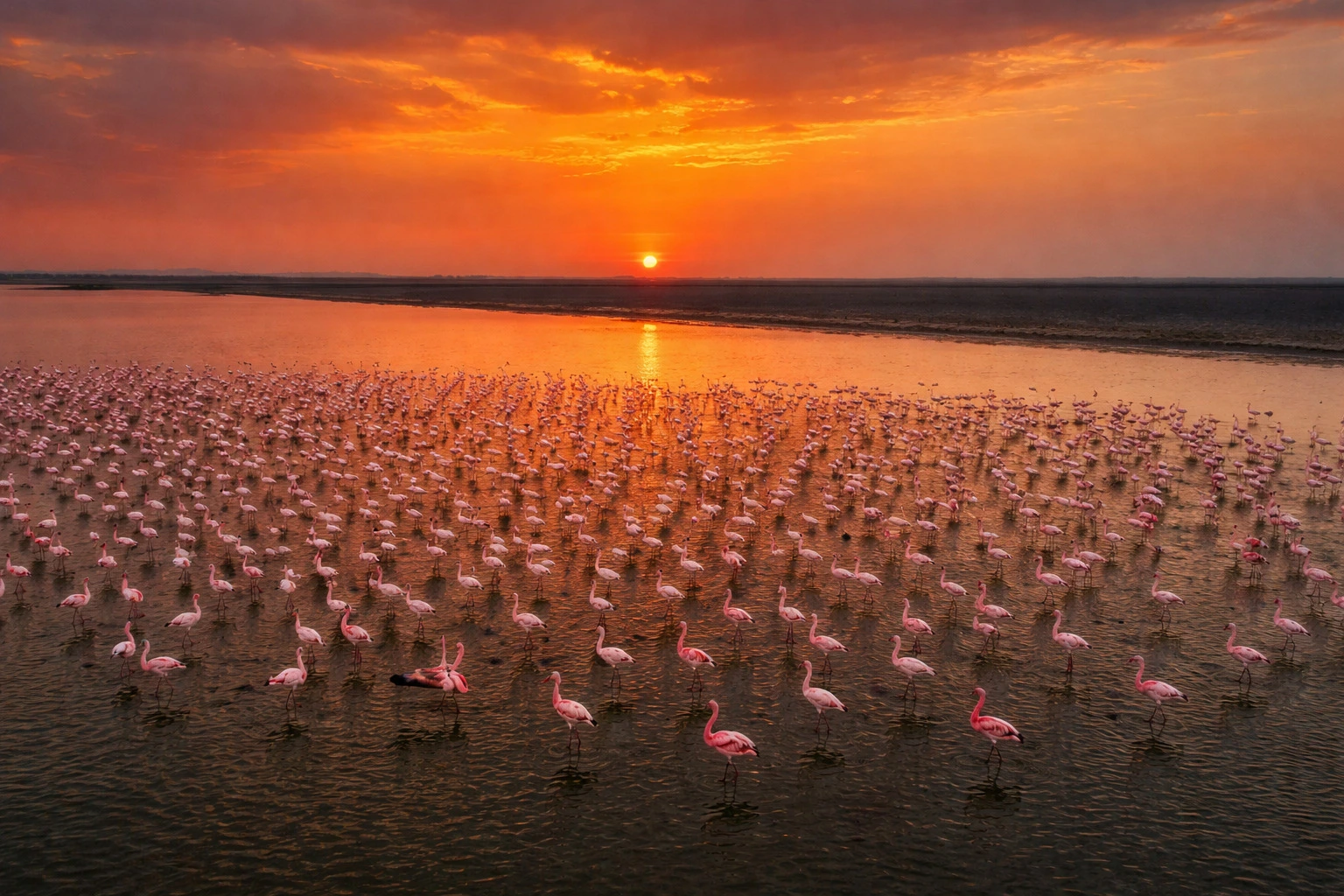
At sunrise, the white crust of Rajasthan’s desert begins to glow faintly pink. This is not a trick of light, but the arrival of nearly 2.5 lakh flamingos at Sambhar Salt Lake, a rare and powerful reminder that even fragile landscapes can still support life on a massive scale. For a few winter months each year, this vast salt lake transforms into one of the most important seasonal homes for flamingos in the Indian subcontinent.
Located in Rajasthan, Sambhar Salt Lake is India’s largest inland saltwater lake, spread across roughly 230 square kilometers. During winter, its shallow waters, open plains, and high salinity create ideal conditions for flamingos to gather in extraordinary numbers. The sight of thousands of birds feeding together against the stark desert backdrop is both visually striking and ecologically significant.
A Journey Across Continents
The flamingos that arrive at Sambhar are not local residents. They travel thousands of kilometers from regions such as Central Asia, Iran, Afghanistan, and parts of northern Eurasia. These long migratory journeys follow ancient routes shaped by climate, water availability, and survival needs. As wetlands and lakes in their breeding regions freeze during winter, the birds move south in search of food-rich, ice-free habitats.
Sambhar Salt Lake offers exactly what they need. Its shallow saline water supports algae and brine shrimp, the primary food sources for flamingos. Most birds begin arriving between November and December. Their numbers steadily rise, reaching a peak during January and February, when the lake hosts one of the largest flamingo gatherings in northern India. By March or early April, rising temperatures and changing water chemistry signal the time for departure.
Why Sambhar Can Support Lakhs of Flamingos
The scale and chemistry of Sambhar Salt Lake make this phenomenon possible. In years with good monsoon rainfall, the lake expands, creating vast feeding zones spread across multiple shallow basins. This allows large flocks to disperse while feeding, reducing competition for food.
The lake’s extreme salinity supports microscopic algae and diatoms that flourish in such conditions. These organisms not only form the base of the food chain but are also responsible for the flamingos’ distinctive pink coloration. Without this unique balance of salinity and water depth, Sambhar could not sustain such large numbers of birds.
The open landscape also plays a role. With fewer trees and limited cover for predators, flamingos can feed and rest in large, visible groups, relying on collective awareness for safety. This makes Sambhar an efficient and relatively secure wintering ground.
More Than a Spectacle
Surveys and field observations in strong seasons suggest that around 2.5 lakh flamingos spread across the lake. This makes Sambhar one of the most important flamingo congregation sites in northern India. Beyond its visual beauty, the gathering is an indicator of wetland health. When flamingos arrive in large numbers, it signals that the lake’s water quality and food systems are functioning well.
However, the absence or decline of flamingos in certain years has also served as a warning sign, pointing to deeper environmental stress.
Growing Threats to a Fragile Wetland
Despite its ecological importance, Sambhar Salt Lake faces increasing pressure. Illegal salt extraction has altered natural water channels, while reduced freshwater inflow from surrounding areas has affected water levels. Groundwater depletion in the region further weakens the lake’s ability to maintain its delicate salinity balance.
Industrial activity, unregulated development, and disturbance from heavy machinery disrupt feeding and resting zones. Even small changes in water depth or salinity can collapse the food web. When algae populations decline, flamingos are forced to leave, sometimes abandoning the lake entirely.
These threats do not affect flamingos alone. Sambhar supports many other migratory birds and plays a role in regional climate regulation and groundwater recharge. Damage to the lake weakens an entire ecological system.
A Warning and a Hope
The arrival of 2.5 lakh flamingos is both a celebration and a caution. It shows that Sambhar Salt Lake still has the capacity to support life on a massive scale. At the same time, it highlights how narrow the margin for survival has become.
Protecting Sambhar means protecting a living link between deserts, wetlands, and migratory routes that span continents. Conservation efforts, responsible water management, and strict control of illegal activities are essential to ensure that this pink horizon continues to return each winter.
When flamingos gather at Sambhar, they tell a story of resilience—but also of responsibility. The future of this spectacle depends on whether humans choose to protect the fragile systems that make it possible.