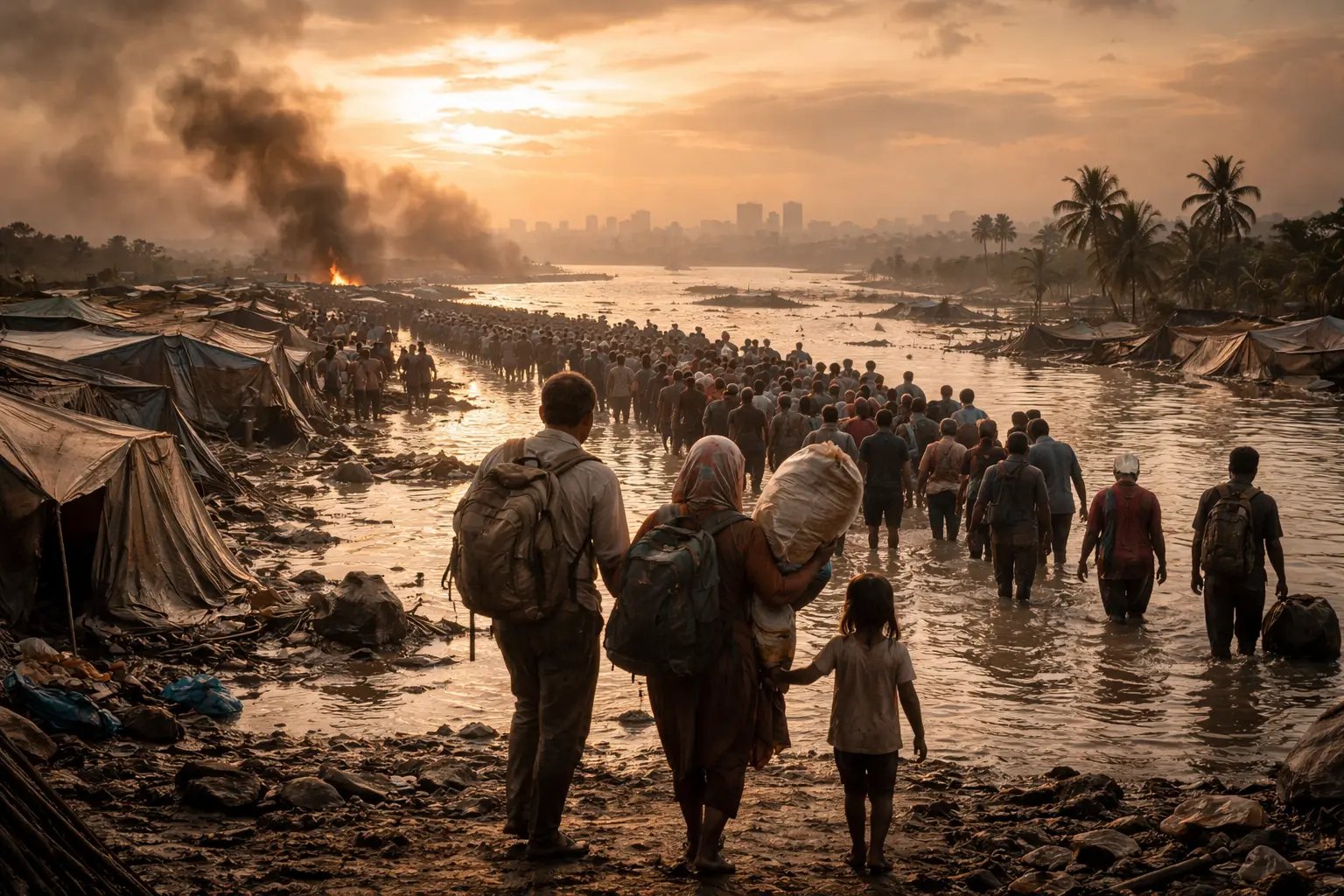
At the end of 2024, an estimated 123.2 million people worldwide were forcibly displaced — equivalent to 1 in every 67 people on Earth. Displacement has nearly doubled over the last decade.
By mid-2025, 117 million people had been displaced by war, violence and persecution. Three in four of them are living in countries facing high-to-extreme exposure to Climate refugees worldwide.
An estimated 30 million people are displaced annually due to climate-related disasters alone. In 2022, 53% of all internal displacements were driven by disasters, with 98% of those disasters linked to climate change.
Looking further ahead, the projections become even more alarming. According to the World Bank’s Groundswell report, without urgent national and global climate action, South Asia, sub-Saharan Africa, and Latin America could witness more than 140 million people move within their countries’ borders by 2050. The Institute for Economics and Peace predicts that around 1.2 billion people could be displaced by 2050 due to natural disasters and the effects of climate change.
| Metric | Figure | Source |
|---|---|---|
| Daily weather-related displacements | 70,000 per day | UNHCR 2025 |
| Internal displacements in last decade | 250 million | UNHCR No Escape II |
| Annual climate disaster displacements | 30 million/year | Concern Worldwide |
| People displaced living in climate-vulnerable countries | 3 in 4 | UNHCR 2025 |
| Projected internal climate migrants by 2050 | 140 million+ | World Bank |
| Potential displaced by 2050 (all climate factors) | 1.2 billion | IEP |
| Countries facing extreme climate hazards by 2040 | 65 (up from 3) | UNHCR 2025 |
By 2040, the number of countries facing extreme climate hazards could rise from 3 to 65. That figure alone should reframe how the world thinks about climate migration — not as a crisis affecting a handful of vulnerable nations, but as a coming reality for nearly every region on Earth.
What Is a Climate Refugee — And Why the Label Matters
The term “climate refugee” is widely used and widely contested — and understanding why reveals something important about the gap between the scale of the crisis and the world’s readiness to address it.
Under the 1951 Refugee Convention, a refugee is defined as a person fleeing persecution based on race, religion, nationality, political opinion, or membership in a particular social group. Climate displacement does not fit neatly into any of these categories. A farmer who can no longer grow food because of three consecutive failed monsoons is not being persecuted. She is being destroyed by a crisis she had almost no role in creating.
The UNHCR argues that “climate refugee” is technically inaccurate under international law, noting that many people fleeing climate effects do not leave their own country and generally do not face persecution based on climate events alone. “It is more accurate to refer to persons displaced in the context of disasters and climate change,” the UNHCR states.
This distinction, while legally precise, has devastating practical consequences. Because climate migrants fall outside the legal definition of refugee, they receive no guaranteed international protection. No legal right to resettlement. No clear responsibility assigned to host nations. No formal pathway to protection.
Because many climate migrants are not able to claim status as refugees or any other formal classification, historically they have not been granted protection under international law.
The gap between what is happening on the ground and what international frameworks are equipped to address has never been wider — and it is growing every year.
The Four Forces Driving Climate Displacement
Climate displacement is not a single phenomenon. It is the intersection of four distinct environmental pressures, each operating on its own timeline and affecting different populations in different ways.
1. Rising Sea Levels: When the Ocean Claims the Land
For communities living in low-lying coastal areas, river deltas, and small island nations, sea level rise is not a gradual inconvenience — it is an existential clock.
Saltwater intrusion into freshwater aquifers makes drinking water sources unusable. Seasonal flooding becomes permanent inundation. Agricultural land turns saline and unproductive. The moment arrives — sometimes suddenly after a cyclone, sometimes over years of incremental loss — when there is simply nothing left to stay for.
The communities facing the most immediate existential threat include the Pacific Island nations — Tuvalu, Kiribati, the Marshall Islands — whose highest points sit just meters above current sea levels. But the populations at greatest absolute scale include the Ganges-Brahmaputra delta in Bangladesh, the Mekong delta in Vietnam, the Nile delta in Egypt, and coastal cities from Jakarta to Miami that sit on land that will face regular inundation under current sea level projections.
2. Extreme Heat: When Temperatures Make Survival Impossible
There is a physiological threshold beyond which the human body cannot cool itself, regardless of shade, hydration, or rest. This threshold — a combination of temperature and humidity called the wet-bulb temperature — is being approached and occasionally exceeded in parts of South Asia and the Persian Gulf with increasing frequency.
For subsistence farmers, outdoor laborers, and the elderly without access to air conditioning, these events are not uncomfortable. They are life-threatening. When heat makes outdoor work impossible for weeks at a time, livelihoods disappear. When elderly residents die during heatwaves, communities lose their social fabric. When the same extreme events recur year after year with greater intensity, migration becomes not a choice but a survival calculation.
Nearly all current refugee settlements will face an unprecedented rise in hazardous heat. By 2050, the hottest fifteen refugee camps in the world — located in Gambia, Eritrea, Ethiopia, Senegal and Mali — are projected to face nearly 200 days or more of hazardous heat stress per year. Many of these locations are likely to become uninhabitable due to the deadly combination of extreme heat and high humidity.
This means that communities already displaced by conflict and arriving in refugee camps are being delivered into new climate emergencies — with no escape route and no legal framework to protect them.
3. Drought and Agricultural Collapse: When the Land Stops Producing
For subsistence farming communities — which constitute a significant portion of the population in sub-Saharan Africa, South Asia, and parts of Latin America — a failed harvest is not an economic setback. It is a food security emergency that can cascade into displacement within a single growing season.
In parts of the Sahel, communities report that climate-linked livelihood losses are driving recruitment into armed groups, showing how environmental stress can fuel cycles of conflict and displacement.
This connection — between drought, food insecurity, economic desperation, and violence — is one of the most important and least understood pathways through which climate change generates displacement. The displacement is not always directly caused by the climate event. It is caused by the conflict, the poverty, and the social breakdown that the climate event triggers.
75 per cent of land in Africa is deteriorating, with over half of refugee settlements in high-stress areas. This is shrinking access to food, water and income.
4. Repeated Disasters: The Cycle That Breaks Resilience
A single natural disaster — a flood, a cyclone, a wildfire — is survivable for most communities with sufficient recovery time and support. What is breaking communities across the globe is not single events but repeated ones: the same flood for the third year in a row, the second cyclone in eighteen months, the fourth consecutive drought.
Each event destroys assets — homes, livestock, savings, tools — that took years to accumulate. Each recovery consumes whatever buffer the community had built. After enough cycles, there is nothing left to rebuild from, no resilience remaining, and no rational reason to stay.
In 2022, Pakistan saw one third of its territory submerged by flooding, displacing 8 million people, including thousands of Afghan refugees already displaced by conflict.
The story of Bahadur Khan, a 60-year-old Afghan refugee living in Pakistan’s Khyber Pakhtunkhwa province, captures this compounding reality. He had been displaced three times in his life — first during Afghanistan’s civil war in the 1990s, then in 2010 when floods destroyed his home, and again in 2022 when the flood waters broke through a nearby embankment. “Our house was inundated within minutes. We had no other option but to leave at once.”
Who Climate Refugees Are — And Who They Are Not
The image most people carry of a climate refugee — a person from a Pacific island watching their home disappear beneath rising seas — is real but incomplete. It captures the most dramatic cases while missing the far larger and less visible population.
The majority of people displaced by climate change never cross an international border. They migrate internally — from rural villages to overcrowded cities, from coastal lowlands to highland areas, from drought-affected regions to areas with more reliable water. Most people who are forced to flee never cross an international border, remaining displaced within their own countries.
This internal displacement is largely invisible to international media and humanitarian systems designed around cross-border refugee flows. A farmer in Bangladesh who moves from a flooded coastal district to an overcrowded Dhaka slum does not appear in refugee statistics. He receives no resettlement support, no legal protection, no formal assistance. He simply becomes one more person in an overwhelmed urban system, competing for housing, work, and water with millions of others in similar circumstances.
71 per cent of the world’s refugees reside in low- and middle-income countries. The Least Developed Countries provide asylum to 25 per cent of the total.
This geography of displacement is deeply inequitable. The populations generating the vast majority of greenhouse gas emissions — wealthy industrialized nations — are hosting a fraction of displaced people. The countries least responsible for climate change are absorbing the greatest burden.
The Legal Gap: A Protection System Built for a Different World
The international refugee protection system was constructed in 1951, in the aftermath of World War II, to address a specific and historically bounded crisis: the displacement of European populations by conflict and political persecution.
That framework — codified in the 1951 Refugee Convention and its 1967 Protocol — remains the legal foundation of international refugee protection today. It was never designed for climate displacement. It does not address it. And as climate migration scales to dimensions that dwarf 20th-century refugee crises, the gap between what the system can do and what the scale of displacement demands is becoming one of the defining legal and political challenges of the century.
Some countries have begun to respond. In 2022, Argentina created a special visa for persons displaced by natural disasters. Finland is exploring the option to accept refugees on climate grounds. Australia is introducing a scheme that will make it easier for Pacific Islanders to move there for seasonal work.
These are meaningful steps — but they are marginal responses to a structural problem. A special visa here, a bilateral arrangement there, does not constitute a global protection framework adequate to the scale of what is coming.
The absence of legal recognition has consequences that compound over time. Without legal status, climate migrants cannot work legally in host countries. Their children cannot access education. They cannot access healthcare. They are invisible to the systems that could support them — which means they are also invisible to the political processes that could reform those systems.
The Funding Gap: Climate Finance Is Not Reaching Those Who Need It Most
Even where legal frameworks are beginning to evolve, the funding gap remains enormous.
Fragile and conflict-affected countries hosting refugees receive only a quarter of the climate finance they need, while the vast majority of global climate funding never reaches displaced communities or their hosts.
This is a systemic failure. The communities facing the most severe and immediate climate displacement impacts — in the Sahel, in low-lying coastal Bangladesh, in the Pacific islands, in drought-stricken Horn of Africa — are receiving the smallest fraction of the climate adaptation funding that has been pledged by wealthier nations.
The pledges themselves have been consistently underfulfilled. The $100 billion annual climate finance commitment made by developed nations at COP15 in 2009 — already considered inadequate by 2023 standards — was not consistently delivered for over a decade. Loss and damage funding, formally agreed at COP27, remains at a fraction of what independent assessments estimate is needed.
Meanwhile, in parts of flood-affected Chad, newly arrived refugees fleeing the war in neighboring Sudan receive fewer than 10 litres of water a day — far below emergency standards.
The distance between the language of international climate commitments and the reality experienced by people on the frontlines of climate displacement is not a small gap. It is a chasm.
The Security Dimension: Why Climate Migration Is a Geopolitical Issue
Climate displacement does not occur in a vacuum. It interacts with existing political tensions, resource competitions, and historical grievances in ways that can rapidly transform environmental crises into security emergencies.
The Sahel region provides perhaps the starkest contemporary example. A combination of prolonged drought, land degradation, and population growth has driven desperate competition for diminishing agricultural land across Mali, Niger, Burkina Faso, and Chad. This resource stress has fueled recruitment into armed groups, accelerated cycles of communal violence between farmers and herders, and undermined the governance capacity of states already struggling with fragility.
While conflict remains the primary driver of displacement, climate change can aggravate an already devastating reality. Its impacts disproportionately affect the world’s most vulnerable populations — including refugees, internally displaced people and the communities hosting them.
The pathway from climate stress to conflict to displacement to regional instability is not theoretical. It is documented, repeating, and accelerating. Security analysts increasingly recognize that climate change is a threat multiplier — an amplifier of existing vulnerabilities that turns manageable tensions into unmanageable crises.
What Justice Requires: The Responsibility Question
The ethical dimension of climate displacement cannot be separated from its practical one.
The populations bearing the greatest burden of climate displacement are overwhelmingly those who have contributed least to the greenhouse gas emissions driving climate change. Sub-Saharan Africa generates approximately 4% of global CO2 emissions. The entire continent of Africa is responsible for less than 4% of cumulative historical emissions. Yet African communities face some of the most severe and immediate climate displacement pressures on Earth.
Bangladesh — a country of 170 million people living largely at or near sea level, whose entire economic and social structure has been built on a river delta that climate change is threatening — generates a fraction of a percent of global emissions.
The principle that those most responsible for a crisis bear the greatest obligation to address it is not radical. It is the foundation of tort law in every legal system on Earth. Applied to climate displacement, it generates a clear imperative: wealthy, high-emitting nations have an obligation — not merely a charitable option — to fund adaptation, support climate migrants, and reform legal frameworks to provide protection.
This is the argument behind the loss and damage framework agreed at COP27 and expanded at COP28. It is the argument behind calls for climate reparations. And it is the argument that will increasingly define international climate negotiations as displacement scales to dimensions that make the current humanitarian architecture visibly inadequate.
What Must Happen: The Three-Track Response
Researchers, humanitarian organizations, and policy experts are broadly aligned on what an adequate response requires — even if political will to deliver it remains far short of what is needed.
Track 1 — Rapid emissions reduction: The most effective intervention for climate displacement is preventing the climate change that causes it. Every fraction of a degree of warming avoided translates directly into millions of fewer displaced people. The difference between 1.5°C and 2°C of warming is not marginal — it is the difference between a manageable crisis and a civilizational one.
Track 2 — Adaptation investment: For communities already on the frontlines, reducing emissions is no longer sufficient. They need seawalls and drought-resistant crops. Early warning systems and climate-resilient housing. Livelihood diversification and water storage infrastructure. Investment in adaptation is investment in stability — keeping communities in place rather than forcing displacement that then requires far more expensive humanitarian response.
Track 3 — Legal and institutional reform: The 1951 Refugee Convention cannot remain the sole framework for international displacement protection when the largest drivers of displacement are environmental rather than political. New legal pathways, expanded definitions, and clear burden-sharing mechanisms between nations are essential — not aspirational.
Countries hosting refugees are providing a global social good, while the costs and responsibilities they shoulder grow heavier due to climate change. Urgent action is required to scale up accessible financing and support that will enable displaced and host communities to develop local solutions to the most pressing climate challenges they face.
Frequently Asked Questions
Q: How many people are currently displaced by climate change?
An estimated 30 million people are displaced annually due to climate-related disasters. In 2022, 53% of all internal displacements were driven by disasters, with 98% of those disasters linked to climate change. Looking at the broader picture, over the past ten years, weather-related disasters have caused approximately 250 million internal displacements — equivalent to 70,000 every day.
Q: Are climate refugees legally protected under international law?
Currently, no. The 1951 Refugee Convention does not recognize climate displacement as a basis for refugee status. Because many climate migrants are not able to claim formal classification, they have historically not been granted protection under international law. Some individual countries are beginning to create specific pathways, but no comprehensive international framework yet exists.
Q: Which regions face the greatest risk of climate displacement?
South Asia, sub-Saharan Africa, and small island states face the most severe immediate risks. The World Bank projects that without urgent action, South Asia, sub-Saharan Africa, and Latin America could see more than 140 million internal climate migrants by 2050. By 2040, the number of countries facing extreme climate hazards could rise from 3 to 65.
Q: What is the difference between a climate refugee and a climate migrant?
The distinction is largely legal and terminological. “Climate refugee” implies legal status and protection under refugee law — which does not currently extend to climate displacement. “Climate migrant” or “person displaced in the context of climate change” are the terms preferred by UNHCR as more legally precise. In practice, both describe people whose movement has been caused primarily by climate-related environmental changes rather than political persecution.
Q: What can wealthier countries do to address climate displacement?
Three actions have the greatest impact: reducing domestic greenhouse gas emissions to slow the climate change driving displacement; funding adaptation programs in vulnerable communities to help people stay in place; and reforming international legal frameworks to provide protection pathways for climate-displaced people. Fragile and conflict-affected countries hosting refugees currently receive only a quarter of the climate finance they need. Closing this funding gap is among the most direct and actionable interventions available.