Today, approximately 415,000 elephants remain across 37 countries in sub-Saharan Africa — a number that sounds substantial until you understand the trajectory behind it. Africa may have held over 20 million elephants before European colonization. As recently as the 1970s, the population stood near one million. What has happened since is not a sudden collapse. It is something scientists now describe in more chilling terms: a slow-moving extinction crisis — one that the latest research confirms is both deeper and more widespread than previously understood.
A landmark 2024 study published in the Proceedings of the National Academy of Sciences — the most comprehensive assessment of African elephant populations ever conducted — analyzed 53 years of survey data from 475 sites across 37 countries. Its conclusion was stark: forest elephant populations have declined on average by 90% since 1964. Savanna elephant populations have fallen by 70%. Combined, the average decline across both species is 77%.
These are not projections or models. They are measurements of what has already happened.
Two Species, Two Conservation Emergencies
One of the most consequential shifts in elephant conservation science has been the formal recognition that Africa’s elephants are not one species but two — and that their situations, while both dire, differ significantly.
African Forest Elephant (Loxodonta cyclotis): Critically Endangered
The African forest elephant, smaller and more elusive than its savanna cousin, inhabits the dense rainforests of Central and West Africa. It is now classified as Critically Endangered on the IUCN Red List — one category above extinction in the wild.
The number of African forest elephants has fallen by more than 86% over a period of 31 years. The primary drivers are illegal ivory poaching and the near-impossibility of monitoring and protecting animals in dense, remote forest terrain.
The geographic distribution tells its own story. Most of the forest elephants researchers have found — about 96% of them — are in Central Africa. Gabon alone holds two-thirds of the population at approximately 95,000, followed by the Republic of Congo with 19%. Just 3% of the forest elephant population was found in West Africa, where expanding agriculture and extensive poaching have greatly reduced numbers.
There is cautious recent progress. Between 2016 and 2023, the rate of forest elephant decline slowed to 0.7% per year, compared to an alarming 7% annual loss between 2002 and 2011. This is meaningful — but it is deceleration of a crisis, not reversal of one.
African Savanna Elephant (Loxodonta africana): Endangered
The savanna elephant, more numerous and more studied, is classified as Endangered. The population of African savanna elephants decreased by at least 60% over the last 50 years.
The Great Elephant Census — the first continent-wide standardized aerial survey ever conducted — found a savanna elephant population of approximately 352,271 individuals across 18 countries. Elephant populations in survey areas with historical data decreased by an estimated 144,000 from 2007 to 2014, and populations were shrinking by 8% per year continent-wide, primarily due to poaching.
The picture is not uniform. Elephants are thriving in parts of southern Africa, particularly in Botswana, where populations have been protected and sustainably managed. But these localized successes sit within a broader continental decline that the aggregate data makes impossible to minimize.
The Numbers That Define the Crisis
Before examining causes, the scale of what has already been lost deserves to stand on its own.
| Metric | Data Point | Source |
|---|---|---|
| Forest elephant decline (1964–2016) | 90% average | PNAS, 2024 |
| Savanna elephant decline (1964–2016) | 70% average | PNAS, 2024 |
| Combined species average decline | 77% | PNAS, 2024 |
| Survey sites analyzed | 475 sites, 37 countries | PNAS, 2024 |
| Current estimated population | ~415,000 | WWF / IUCN |
| Estimated pre-colonial population | 20+ million | Douglas-Hamilton, 1987 |
| Elephants lost per day to poaching (peak) | ~47 per day | WWF |
| Carcass ratio across Africa | 11.9% | Great Elephant Census |
| Shrink rate at peak poaching | 8% per year | Great Elephant Census |
A carcass ratio above 8% indicates a population that cannot replace itself. Africa’s overall ratio of 11.9% confirmed what population models had been suggesting: the continent’s elephants were dying faster than they were being born.
In Cameroon, the carcass ratio reached 83%. In Mozambique, 32%. These figures represent not just population loss but functional collapse in specific regions.
Cause 1: Illegal Ivory Trade — A Persistent Criminal Network
The international ivory trade ban, introduced in 1989 under CITES (the Convention on International Trade in Endangered Species), was one of the most significant wildlife policy interventions in history. It worked — elephant populations began recovering through the 1990s.
Then came the poaching resurgence.
Both species have suffered sharp declines since 2008 due to a significant increase in poaching, which peaked in 2011 but continues to threaten populations. The trigger was rising demand in Asian markets, particularly China, where ivory became a luxury status symbol among a rapidly growing middle class.
In the previous decade, around 17,000 African elephants were illegally killed each year for their ivory — an average of 47 a day. Although there is an international ivory trade ban, huge quantities of ivory are smuggled to Asia by organised international criminal networks.
The enforcement landscape has several structural weaknesses that organized crime exploits systematically:
Legal market contamination: China, Hong Kong, and Thailand all have large illegal and legal ivory markets, where legal markets are used as a cover to launder illegal ivory and also stimulate demand. In 2018, China banned the ivory trade — leading to a marked decline in Chinese demand — but some of this market has been displaced to neighboring countries such as Vietnam and Cambodia.
Targeting of large-tusked individuals: Poachers systematically target older elephants with the largest tusks. This removes the most genetically valuable and reproductively experienced animals from populations — disproportionately damaging long-term recovery capacity.
Funding instability for rangers: Limited ranger funding restricts surveillance capacity in remote areas, particularly in politically unstable regions where governance gaps are widest.
Findings from the University of York show that the regions with the highest poaching rates are West and Central Africa, with West Africa currently having the smallest elephant population.
According to Julian Blanc, a researcher in the Wildlife Management Unit of UN Environment in Nairobi, the biggest threat to the elephant population in the long term is the ever-expanding need for development, making habitat destruction and fragmentation a serious structural threat.
Cause 2: Habitat Fragmentation — The Invisible Barrier
Poaching kills individual elephants. Habitat fragmentation kills populations.
When migration corridors are blocked by roads, agricultural expansion, or settlement, elephant populations become isolated. The consequences accumulate across generations:
Genetic diversity loss: Isolated populations cannot exchange genes. Inbreeding increases. Disease resistance drops. Fertility declines. The population becomes functionally committed to extinction even if poaching stops entirely.
Reproductive failure: Elephant societies are matriarchal and deeply knowledge-dependent. Older female elephants carry generational memory of water sources, migration routes, and food locations. When infrastructure development disrupts these routes, entire herds lose access to resources their ancestors navigated reliably.
Increased human-elephant conflict: When natural corridors force elephants into contact with agricultural land, the results are damaging for both sides. Elephants raid crops; farmers retaliate, sometimes lethally. The survival rate of sub-adult male elephants is particularly lower because animals in this age group are more susceptible to being killed by humans in retaliation for lost human lives, physical injury, and crop loss.
Scientific modeling from the Greater Virunga Landscape in Central Africa demonstrates the compounding effect: loss of habitat and water resources can be critical to the long-term survival of elephant populations, and with elephants dependent on large landscapes, transboundary cooperation becomes vital for long-term survival and regional sustainability.
Cause 3: Climate Change — The Multiplier Nobody Can Ignore
Climate change does not operate as a standalone threat to African elephants. It operates as a threat multiplier — intensifying every other pressure simultaneously.
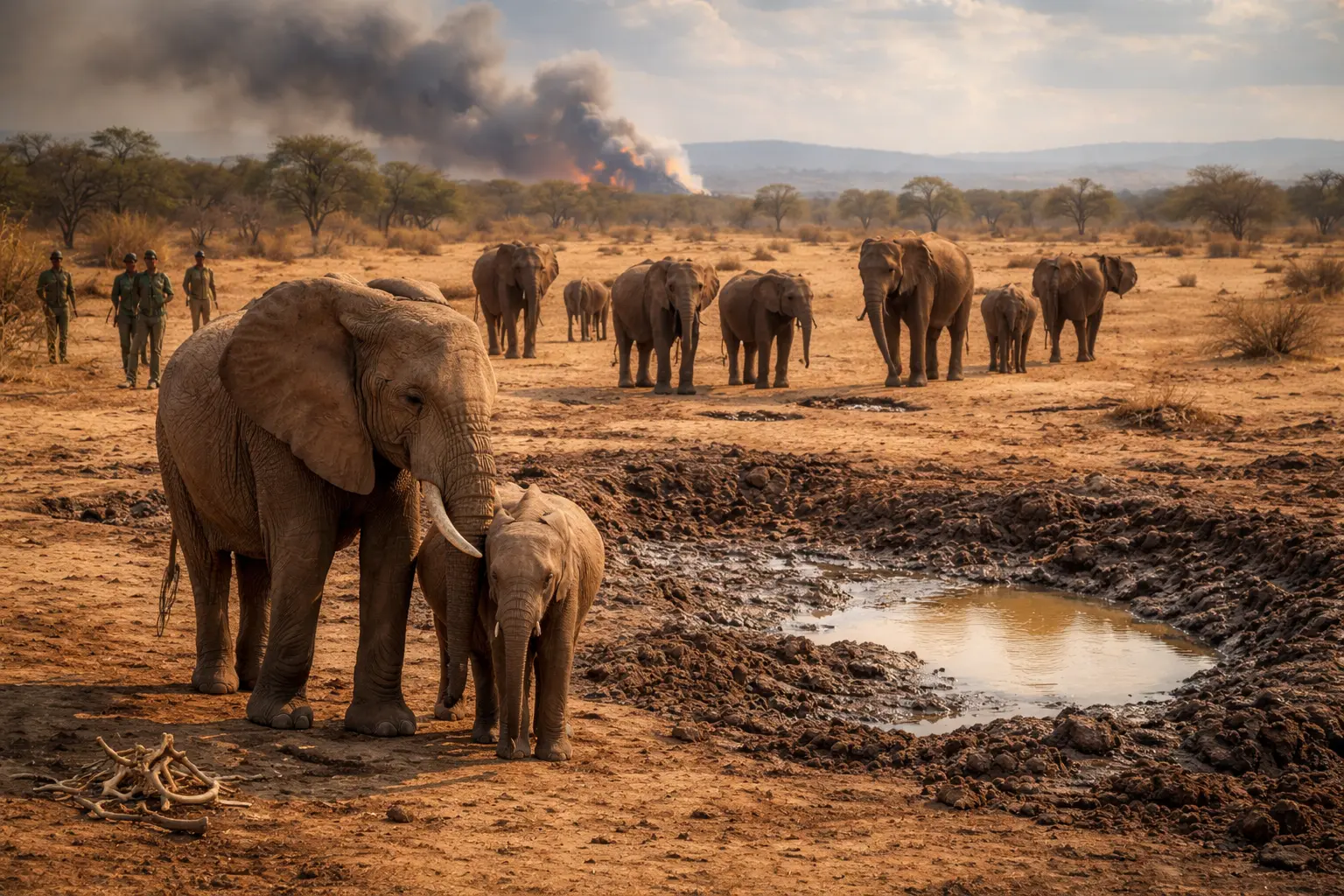
Elephants need to drink around 250 litres of water a day. As the climate changes, temperatures in Africa are rising and droughts are becoming more frequent, which has a direct effect on elephant populations as resources become scarcer in prolonged and harsher periods of little to no rain.
The consequences of water stress cascade through elephant biology and behavior:
Extended travel distances: During drought, herds travel further to reach water — exhausting adults, endangering calves, and bringing elephants into closer contact with human settlements.
Calf mortality: Young elephants are disproportionately vulnerable during droughts. Calves cannot regulate body temperature as effectively as adults and require significantly more water relative to their body weight.
Vegetation collapse: Satellite data shows declining vegetation productivity in multiple elephant habitats. When food availability drops, nutritional stress reduces fertility rates and increases calf mortality — exactly when populations most need to be growing.
Compounded conflict: Climate-driven herd movement toward human settlements generates the same human-elephant conflict that habitat fragmentation creates — but from a different direction and one that is harder to mitigate with conventional conservation tools.
The dynamic impacts of climate and habitat changes on African elephant population demography are significant. Water availability and its distribution within the landscape will be critical to the survival of elephants amidst the effects of climate change.
Researchers are increasingly explicit: climate adaptation planning must now be integrated directly into wildlife protection strategies. Conservation approaches designed for stable climatic conditions are becoming structurally inadequate.
The Ecological Stakes: What Disappears With the Elephants
African elephants are what ecologists call a keystone species — an animal whose ecological impact is disproportionate to its population size. Removing elephants from an ecosystem does not simply leave a gap. It triggers cascading changes that reshape entire landscapes.
Forest regeneration: Elephants disperse seeds across distances that other animals cannot match. Some tree species — particularly large-seeded tropical trees — depend almost entirely on elephants for seed dispersal. Without elephants moving through a landscape, those tree species cannot regenerate. Forests simplify. Biodiversity contracts.
Water access for other species: Elephants dig water holes during dry seasons using their tusks and feet. These excavations create water access points used by dozens of other species that could not otherwise survive dry periods in the same landscape.
Grassland maintenance: Elephants push over trees, open forest clearings, and maintain grassland structure that supports the entire savanna food web — from grass-eating herbivores to the predators that follow them.
Carbon sequestration: Research published in Nature Geoscience found that forest elephants, through their role in maintaining large-seeded tree species (which tend to store more carbon), contribute meaningfully to the carbon storage capacity of Central African forests. A significant decline in forest elephant populations could reduce the carbon storage capacity of the Congo Basin — with implications for global climate.
The loss of elephants is not simply a biodiversity tragedy. It is an ecological restructuring with consequences that ripple outward in ways that affect human communities, agricultural systems, and carbon cycles simultaneously.
Where Conservation Is Working — And What It Teaches Us
The continent-wide picture of decline contains important exceptions — populations that have stabilized or grown. Understanding these successes is as scientifically valuable as understanding the failures.
Botswana has maintained the largest savanna elephant population in Africa through consistent government commitment to anti-poaching enforcement, community-based conservation programs, and sustainable management of human-wildlife boundaries. The country demonstrates that population recovery is possible when political will is sustained.
Gabon has invested heavily in protecting forest elephants. In 2016, Gabon’s national parks agency created a 240-strong special forces unit to tackle poaching and other wildlife crimes in national parks. The government is also working to install 1,800 mobile fences and provide elephant insurance to compensate villagers for crop losses.
Kenya and Tanzania have shown that community-based conservation — sharing wildlife tourism revenue with local communities — reduces poaching incentives and builds local investment in elephant protection. The Tanzanian government has acknowledged that working closely with local communities has hugely helped the country curb poaching and illegal trading.
The common thread in these successes: conservation that addresses local human needs alongside wildlife protection, rather than treating them as opposing priorities.
The Technology Closing the Enforcement Gap
Conservation technology has advanced significantly in the past decade, partially compensating for ranger funding shortfalls.
Drone surveillance: Unmanned aerial vehicles now patrol remote areas that ranger teams cannot cover on foot, detecting poaching activity before it results in kills.
Satellite tracking: GPS collars on key elephants allow real-time monitoring of herd movements, providing early warning when herds approach high-conflict zones or when movement patterns suggest distress.
AI-powered acoustic monitoring: Systems that detect the sound of gunshots in real time and alert ranger stations have been deployed in several protected areas, dramatically reducing response times.
eDNA monitoring: Environmental DNA analysis from water sources can detect elephant presence and population health indicators without direct animal contact — enabling monitoring in areas too remote or dangerous for conventional surveys.
Cross-border data sharing: Digital platforms now allow conservation agencies across multiple countries to share real-time intelligence on poaching networks, trafficking routes, and suspected ivory shipments.
These tools have measurably improved enforcement capacity. But they require sustained funding — and funding for wildlife conservation in Africa remains chronically inadequate relative to the scale of the challenge.
What 2026 Research Tells Us About the Decade Ahead
The 2026 conservation assessments that prompted renewed global attention to Africa’s elephant crisis carry a specific warning: the next ten years will be decisive.
Several converging factors make this window critical:
Climate tipping points: Several elephant habitats in East and Southern Africa are approaching thresholds beyond which vegetation recovery becomes very slow. If those thresholds are crossed, even a cessation of poaching may not be sufficient to sustain populations.
Infrastructure expansion: Major infrastructure projects across Central and West Africa — roads, mining corridors, hydroelectric projects — will fragment additional habitat in the coming decade. The decisions being made now about routing and mitigation will determine whether key corridors survive.
Ivory demand dynamics: The decline in Chinese demand following China’s 2018 ban has not been fully replaced, but markets in Southeast Asia are growing. Whether international enforcement keeps pace with shifting demand will significantly affect poaching levels.
Funding sustainability: Many current conservation programs depend on international donor funding that is subject to shifting political priorities. Building sustainable local funding mechanisms — through tourism revenue sharing, carbon credit schemes, and community conservation enterprises — is a critical and underfunded priority.
As CSU Professor George Wittemyer noted: “This paper shows the scale of the declines and how widespread they are across the continent. It shines a light on how quickly even something as big and noticeable as elephants can just disappear.”
Frequently Asked Questions
Q: How many African elephants are left in the wild in 2026?
Current estimates place the total African elephant population at approximately 415,000 individuals across both species combined. African savanna elephants number roughly 350,000 to 400,000, while African forest elephants — critically endangered — number approximately 100,000 to 150,000, with around 95,000 in Gabon alone. These figures represent a fraction of historical populations that likely exceeded 20 million before European colonization.
Q: Which species of African elephant is more endangered?
The African forest elephant is classified as Critically Endangered on the IUCN Red List — a more severe category than the African savanna elephant, which is classified as Endangered. Forest elephants have experienced average population declines of over 86% in 31 years, driven primarily by ivory poaching in remote Central and West African forests where enforcement is most difficult.
Q: Is elephant poaching getting better or worse?
The situation is mixed. Poaching peaked around 2011 and has declined since, partly due to China’s 2018 ivory trade ban. The rate of forest elephant decline slowed from 7% annually between 2002–2011 to 0.7% annually between 2016–2023. However, poaching remains significant, ivory demand is shifting to new markets in Southeast Asia, and enforcement gaps in politically unstable regions remain serious. The decline has slowed, not stopped.
Q: What happens to African ecosystems if elephants go extinct?
The consequences would be ecologically catastrophic. Elephants are keystone species that maintain vegetation structure, disperse seeds for large-seeded trees, dig water holes used by dozens of other species, and prevent woodland encroachment on grasslands. Research suggests their loss would trigger trophic cascades — chain reactions through food webs — that would restructure entire ecosystems, reduce biodiversity, and potentially reduce the carbon storage capacity of Central African forests.
Q: What can individuals do to help protect African elephants?
Avoid purchasing ivory or products containing ivory in any form. Support conservation organizations with documented field impact — WWF, Save the Elephants, Wildlife Conservation Society, African Wildlife Foundation, and the Elephant Crisis Fund are among the most effective. Choose eco-tourism operators that share revenue with local communities. Advocate for stronger international wildlife trafficking enforcement. Contact elected representatives about funding international conservation programs.