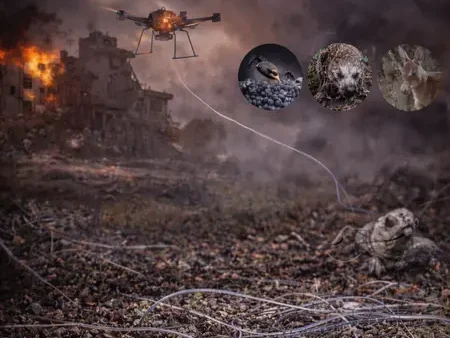
While missiles and drones dominate the headlines of the Russia-Ukraine war, a more insidious and silent threat is being woven into the very fabric of the battlefield environment. This threat comes from a specialized piece of technology: the FPV (First-Person View) Drone Optical Fiber Kit. Designed for tactical advantage, its lasting legacy is becoming an ecological nightmare for the region’s helpless biodiversity. Specifically, the abandoned drone fiber optics harming wildlife has emerged as a critical issue that demands attention.
The Technology: Precision Control at a Physical Cost
One of the grave implications of this technology is that the abandoned drone fiber optics harming wildlife, creating a significant threat to various species.
To understand the problem, we must first understand the tool. Standard radio-controlled drones have limited range and are vulnerable to electronic jamming. The fiber optic solution overcomes this by tethering the drone to its operator with an incredibly thin, durable cable.
How It Works: As the drone flies, it unspools this hair-thin optical fiber behind it. Control signals and live video feed travel through this cable via light pulses within the glass or specialized plastic core, which has a higher refractive index than its cladding. This makes the connection immune to interference and allows for ultra-long-range, real-time control over distances.
The Intentional Design: The materials—high-purity silica glass or advanced polymers like HDPE—are chosen for signal clarity, tensile strength, and durability. They are not chosen for environmental friendliness. Their purpose is to survive a mission, not to decompose after it.
The Pervasive Problem: An Indestructible Web Left Behind
The critical failure occurs at mission’s end. The drone is often recovered or destroyed, but the kilometers of deployed fiber optic cable are almost always abandoned. It is logistically impossible to retrieve a single, near-invisible strand tangled across hectares of war-torn terrain—fields, forests, wetlands, and rubble.
This creates two fundamental issues:
Permanent Physical Pollution: The cable is non-biodegradable. Unlike organic matter, it does not break down naturally within any meaningful timeframe. Estimates suggest these polymers could persist in the environment for centuries. They also cannot be practically “extracted.” The cable becomes a permanent, synthetic addition to the soil and vegetation—a pervasive, invisible layer of technological litter.
A Multi-Faceted Threat to Biodiversity: This abandoned web acts as a silent, widespread agent of ecological harm. Its impact is not a single event but a continuous, slow-motion disaster for local fauna.
How This “Silent Web” Harms Wildlife: A Detailed Breakdown
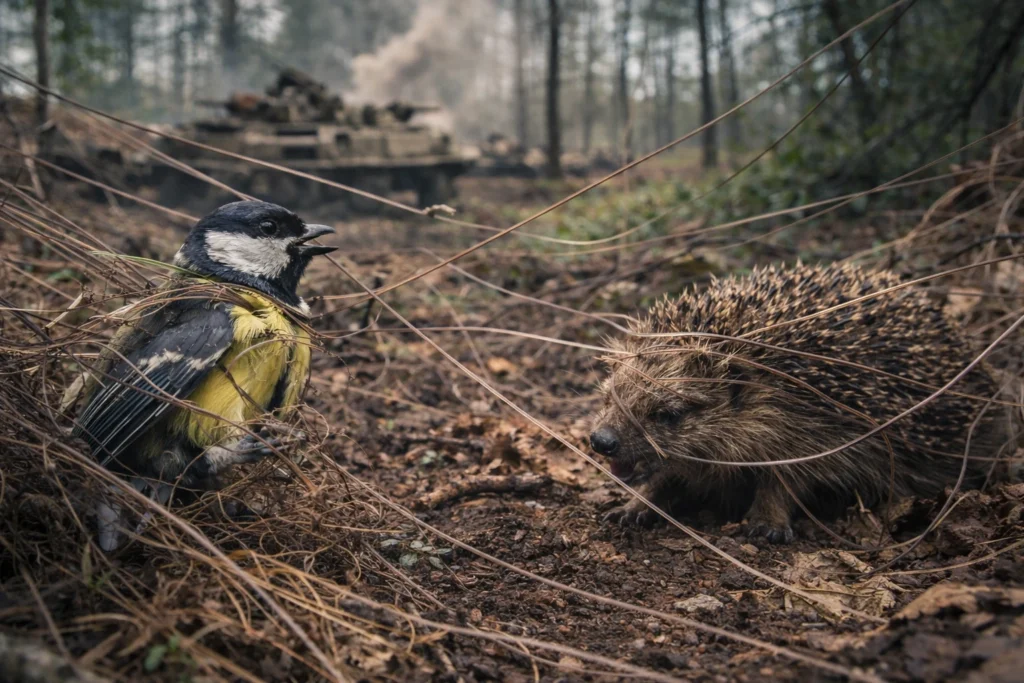
The abandoned battlefield does not cease to be an ecosystem. Birds return to nest, mammals forage, insects pollinate, and amphibians breed—all now in an environment laced with lethal filaments.
Lethal Entanglement & “The Slow Death”:
Birds: Nesting birds collect the shiny, thread-like fibers, weaving them into their nests. This can trap and choke hatchlings. In flight, birds, especially low-flying species like quail or pheasants, can become entangled in strands stretched between trees or bushes, leading to injury, wing damage, and starvation.
Small Mammals: Hedgehogs, voles, mice, and even young foxes or hares can become ensnared while moving through undergrowth. The strong, thin cable can loop around limbs or necks, causing deep wounds, infections, amputations, or a slow death from immobility and dehydration.
Larger Animals: While less likely to become fully entangled, deer or wild boar can suffer deep, cutting wounds on their legs or snouts from encountering taut strands.
Habitat Fragmentation & Behavioral Disruption:
The chaotic web of cables creates a network of micro-barriers. For small creatures, a field crisscrossed with these lines is no longer a continuous habitat but a perilous obstacle course. This disrupts foraging routes, access to shelter, and migration pathways for insects, reptiles, and amphibians.
Ingestion and Poisoning:
As the cable degrades under UV light and weathering, it breaks into microplastics. These particles contaminate the soil and water. Earthworms, insects, and filter-feeding organisms ingest them, introducing plastics and potential chemical leachates into the food chain, ultimately affecting larger animals and birds of prey.
The “Invisible Exclusion Zone” Effect:
The cumulative impact transforms a natural area into a zone of chronic danger. The user’s analogy is starkly accurate: while not radioactive, the area becomes hostile and uninhabitable for its native species in a new way. Animals did not evolve to navigate a landscape strewn with synthetic, strangling threads. Their instinctual behaviors become fatal liabilities.
Conclusion: A High-Tech Legacy of Primitive Suffering
The use of FPV fiber-optic drones represents a grim paradox: a hyper-advanced tool creating a primitive, cruel form of environmental contamination. The conflict highlights a severe accountability gap in military technology development. The focus is solely on tactical efficacy, with zero consideration for post-mission environmental cleanup or ecological impact.
The wildlife of Ukraine—already victims of habitat destruction, noise, and chemical pollution—now faces this additional, lingering threat. They are the unwitting, non-combatant casualties of a technological arms race. This “silent web” is more than just communication cable; it is a symbol of how modern warfare outsources its lasting costs to the natural world. Recognizing this specific, detailed mechanism of harm is the first step toward demanding that environmental consequences be a mandatory calculation in the design and deployment of all future military technology.