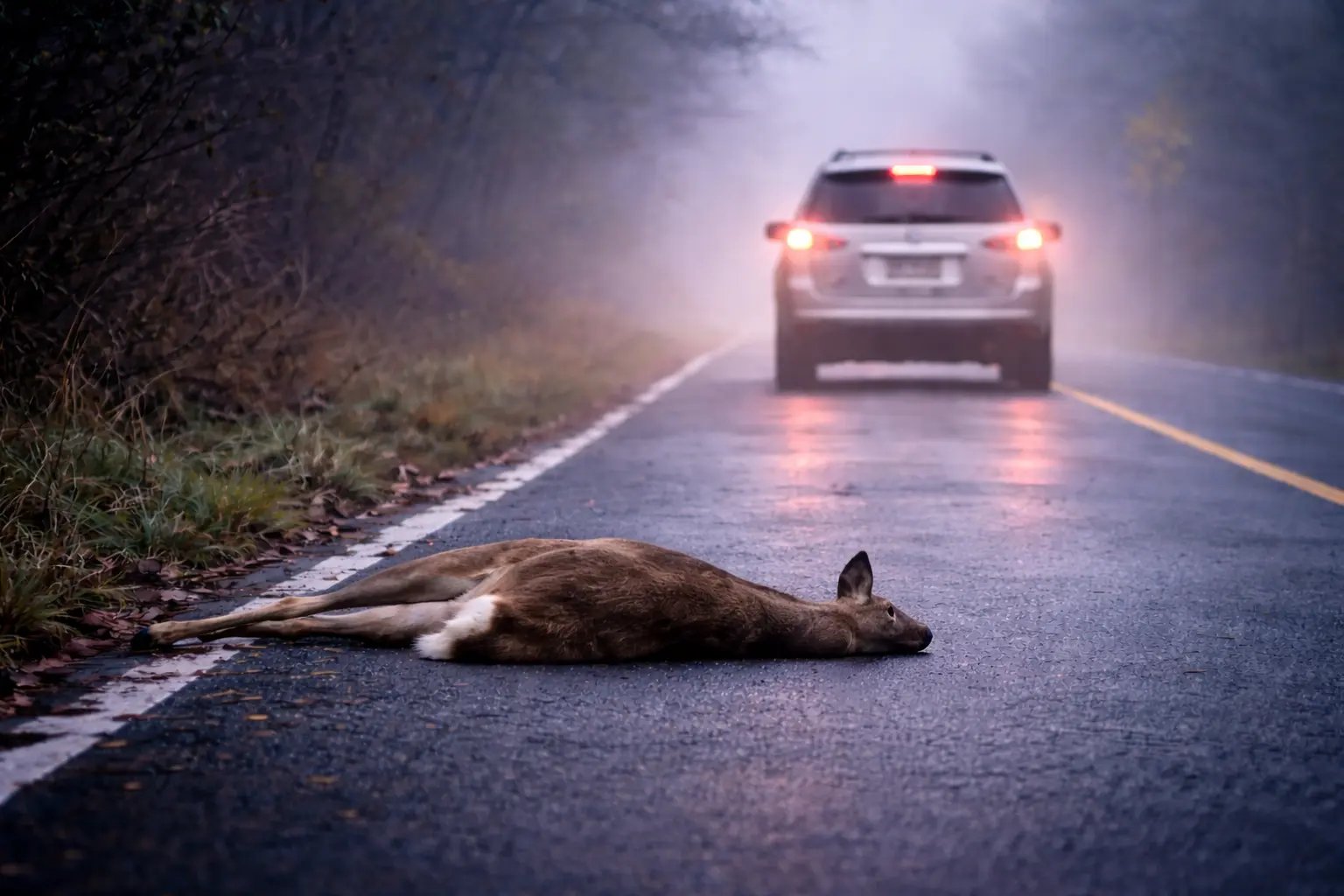
Wildlife road accidents are killing thousands of animals every single day — and most of the world isn’t even counting. As highways cut through ancient forests, animals following migration trails older than the roads themselves are paying with their lives.
The Scale of the Problem Nobody Is Measuring
Here is the uncomfortable truth about wildlife road mortality: we do not actually know how bad it is.
In the United States, estimates suggest between 1 million and 2 million large animals are killed on roads annually. That figure covers only large mammals — deer, elk, bear. The actual number, including reptiles, amphibians, birds, and small mammals, is likely 10 to 20 times higher.
In India, the situation is even murkier. There is no centralized national database. No mandatory legal requirement to report hitting an animal. No standardized survey system.
What we do know comes in fragments — a state forest department’s annual report here, an NGO’s local survey there. The Wildlife Institute of India estimates that India’s roads kill thousands of wild animals annually, including critically endangered species. But the true scale remains, in their own words, “largely unknown.”
This is not just a data problem. When you cannot measure a crisis, you cannot fund solutions for it.
Countries that began measuring — the Netherlands, Australia, Canada — discovered the problem was catastrophic. They then built systems to fix it. India and much of the developing world are still in the dark.
Why Animals Keep Walking Into Traffic — And Why It Is Not Their Fault
The most common human reaction to a roadkill is a shrug: “Why didn’t it just run away?“
The answer reveals how little we understand about the animals we share this planet with.
Roads Were Built Over Their Home, Not the Other Way Around
The deer trail that crosses your highway did not appear last week. In many cases, it has existed for hundreds or thousands of years — a path worn into the earth by generations of animals following the same water source, the same fruiting trees, the same seasonal migration route.
When a road is built across that trail, the road is the intruder. The animal is simply going home.
The Freeze Response Is Survival Biology, Not Stupidity
When a prey animal like a deer or antelope encounters a sudden, bright, approaching threat, its nervous system does something counterintuitive: it stops.
This is not confusion. It is an ancient survival mechanism. In nature, freezing can make you invisible to a predator. It buys a fraction of a second to assess — is this real? Which direction is safety?
That fraction of a second is precisely what a vehicle at 80 km/h does not allow. By the time the deer’s brain decides to move, the vehicle is already there.
Predators face a different problem. When a leopard or wolf crosses a road, its instinct is to move fast and stay low. On a multi-lane highway, fast and low is exactly the wrong strategy — the animal may clear one lane and be struck from the opposite direction.
Hunger and Thirst Override Fear
An animal that is starving or desperately thirsty will cross terrain it would otherwise avoid. This is why road mortality spikes in two predictable seasons:
Winter/dry season: Food scarcity forces animals to range further. In fog and darkness, they cross roads they would normally avoid in daylight.
Breeding season: Male animals — tigers, leopards, deer, wolves — travel extraordinary distances seeking mates. Territorial instinct temporarily overrides road-avoidance behavior.
This is not recklessness. It is survival. And the road happens to be in the way.
The Species Paying the Highest Price
Large Mammals: The Most Visible Deaths
Elephants, tigers, leopards, and bears make headlines when they die on roads — partly because of their size, partly because of their conservation status. India’s NH 37 through Kaziranga National Park has killed multiple tigers and rhinos. The Pench-Kanha corridor in Madhya Pradesh is a documented death zone for leopards.
But large mammal deaths are only the tip of the iceberg.
The Invisible Casualties
Consider what lives on and near Indian roads that no one counts:
Reptiles — monitor lizards, pythons, cobras, and star tortoises move slowly, are nearly invisible at night, and are struck continuously. Studies in some road sections have found reptile roadkill density of one animal every 2–3 kilometers.
Amphibians — frogs and toads migrate and masse during monsoon. A single road through wetland habitat can kill hundreds in a single night. Their deaths are almost never recorded.
Birds — owls, nightjars, and raptors hunt along road edges where small animals congregate. They fly low across roads and are struck by vehicles regularly. In Europe, barn owl populations near busy roads have declined significantly.
Small mammals — mongoose, civets, hares, hedgehogs, jungle cats. Fast-moving but small, they are essentially invisible to drivers until after impact.
The cumulative loss of these “small” animals quietly devastates ecosystems in ways that take decades to become visible.
What Happens to an Ecosystem When Roads Cut Through It
The death of individual animals is tragic. The ecosystem-level consequences are catastrophic — and they unfold in slow motion, which is why they rarely feel urgent.
The Predator-Prey Imbalance
Remove a leopard from a forest corridor — whether through poaching, disease, or road mortality — and the local deer and wild boar population surges. Within two to three seasons, overgrazing begins. Seedling regeneration drops. Tree diversity declines. Ground-nesting birds lose cover. The entire understory shifts.
This chain reaction, called a trophic cascade, has been documented globally wherever apex predators are removed. Road mortality is now recognized as one of the leading triggers.
Genetic Isolation: The Silent Extinction
A road does not have to kill animals directly to destroy a population. It simply has to stop them from crossing.
When a highway divides a forest, the populations on either side slowly become genetically isolated. No new genes enter. Inbreeding increases. Disease resistance drops. Fertility declines. Over three to five generations, the population becomes functionally extinct — alive, but unable to sustain itself.
Conservation biologists call this an extinction debt: the population looks fine today, but is already committed to disappearing. The road just set the timer.
Seed Dispersal and Forest Regeneration
Many forest animals are seed dispersers. The civet cat eats coffee berries and deposits seeds kilometers from the parent tree. The elephant processes and deposits hundreds of seed species daily, some of which cannot germinate without passing through an elephant’s digestive system.
Kill or fragment these disperser populations and forest regeneration slows — sometimes stops entirely in certain species. Roads are not just killing animals. They are preventing forests from reproducing.
Why the Data Gap Is the Biggest Obstacle to Change
It is almost impossible to advocate for a problem you cannot quantify.
When a conservation group approaches a state government about road mortality, the government’s first response is usually: “Show us the data.” Without a mandatory reporting system, there is no data. Without data, there is no budget. Without budget, there are no solutions.
This is not hypothetical. Compare two cases:
Banff National Park, Canada: Systematic roadkill monitoring began in the 1980s. Data showed catastrophic mortality in certain corridors. Government invested in wildlife overpasses and underpasses. Roadkill in monitored corridors dropped by over 80%. The crossings paid for themselves in reduced vehicle-collision insurance costs within 10 years.
NH 766, Karnataka, India: One of the most ecologically sensitive highways in the country, passing through the Nagarhole-Bandipur corridor. No mandatory reporting. No systematic monitoring. No wildlife crossings. Anecdotal reports from forest staff suggest significant mortality — but “anecdotal” is not enough to unlock government funding.
The difference is data. Nothing more, nothing less.
Solutions That Actually Work
The good news — and there is genuine good news — is that we already know how to fix this. The technology and the evidence exist. What is missing is the will to implement.
Wildlife Crossings: Proven Across Three Continents
Wildlife overpasses and underpasses are the single most effective intervention for road mortality. When properly designed — wide enough to feel natural, connected to dense vegetation on both ends, monitored with cameras — they work dramatically well.
India’s first major wildlife underpass in the Pench Tiger Reserve was documented using camera traps within weeks of opening. Tigers, leopards, deer, and smaller mammals were crossing. The design worked.
The investment cost is typically 0.5% to 1% of highway construction cost — a fraction of the ecological value of the wildlife it protects.
Smart Warning Systems
Sensor-based warning systems detect animal movement near roads and trigger flashing warning lights or vibrations that alert both drivers and approaching animals. These have been piloted in Rajasthan’s Sariska Tiger Reserve and parts of Uttarakhand with measurable impact on driver behavior.
They are not perfect. But they are affordable, scalable, and deployable within months.
Mandatory Reporting: The Foundation Everything Else Needs
Until India creates a legal requirement to report wildlife-vehicle collisions — similar to the mandatory reporting that exists for human accidents — the data gap will persist. No data, no policy. No policy, no change.
This is a legislative change that costs almost nothing. It simply requires political will.
The Role of Citizens: What You Can Do Right Now
While driving in forest zones:
- Reduce speed to 40 km/h at “Wildlife Crossing” signs — treat them as seriously as school zone signs
- If an animal is in your path: slow down calmly, dim headlights briefly, stay in your lane
- Never swerve at highway speed — it risks your life and rarely saves the animal
- If you hit an animal or see one injured: park safely, call India’s wildlife helpline 1926, document the location
Beyond the road:
- Download the WII Roadkill app and log every incident you see — your data matters
- Support organizations doing road ecology work: Nature Conservation Foundation, Wildlife SOS, WWF India
- Write to your local representative about wildlife crossings in your region’s highway projects
The Bigger Picture: Roads, Development, and the Choice We Are Making
India is currently building roads at one of the fastest rates in its history. The Bharatmala Pariyojana project plans over 34,000 km of new highways. The Northeast alone will see massive connectivity expansion through some of the most biodiverse terrain on earth.
None of this development is inherently wrong. Roads are lifelines for remote communities, drivers of economic growth, enablers of emergency services.
But roads that are planned without accounting for wildlife corridors are not just ecologically destructive — they are economically short-sighted. The cost of retrofitting wildlife crossings into an existing highway is three to five times higher than including them during original construction.
Countries that integrated road ecology into their infrastructure planning in the 1990s and 2000s — the Netherlands, Austria, France — now have functioning corridor networks that have reversed local extinction trends. They built the road and protected the wildlife. It was not a choice between development and nature. It was a question of design.
That choice is still available to India. But the window is narrowing with every kilometer of unplanned highway that cuts through a forest corridor.
Frequently Asked Questions
Q: What should I do immediately if I accidentally hit an animal while driving?
Stop your vehicle safely away from traffic. Do not attempt to handle or move an injured wild animal — even small animals can cause serious injury when frightened. Call India’s wildlife emergency helpline at 1926 or contact the nearest forest beat office. Document the exact GPS location if possible.
Q: Is hitting a wild animal on the road a legal offense in India?
Under the Wildlife Protection Act, 1972, killing a protected species — even accidentally — can carry legal implications. However, the law distinguishes between intentional killing and unavoidable accidents. Reporting the incident immediately and cooperating with authorities is strongly advisable.
Q: Which are the most dangerous highways for wildlife in India?
Based on documented reports and forest department data: NH 37 through Kaziranga (Assam), NH 766 through Nagarhole-Bandipur (Karnataka), NH 44 through Pench-Kanha (Madhya Pradesh), and NH 7 through the Satpura landscape are among the highest-risk corridors.
Q: Do wildlife crossings actually work, or are they just expensive infrastructure?
The evidence from multiple countries is clear — properly designed wildlife crossings work. Studies from Banff National Park showed roadkill reductions of over 80% in monitored zones. India’s own Pench corridor data showed crossing usage within weeks of installation.
Q: How can ordinary citizens help address this problem?
Report wildlife casualties using the WII Roadkill app or by calling 1926. Reduce speed in wildlife zones. Share verified information about road ecology. Support organizations like Nature Conservation Foundation, Wildlife SOS, and WWF-India. Most importantly: treat wildlife crossing signs with the same seriousness as school zone signs.