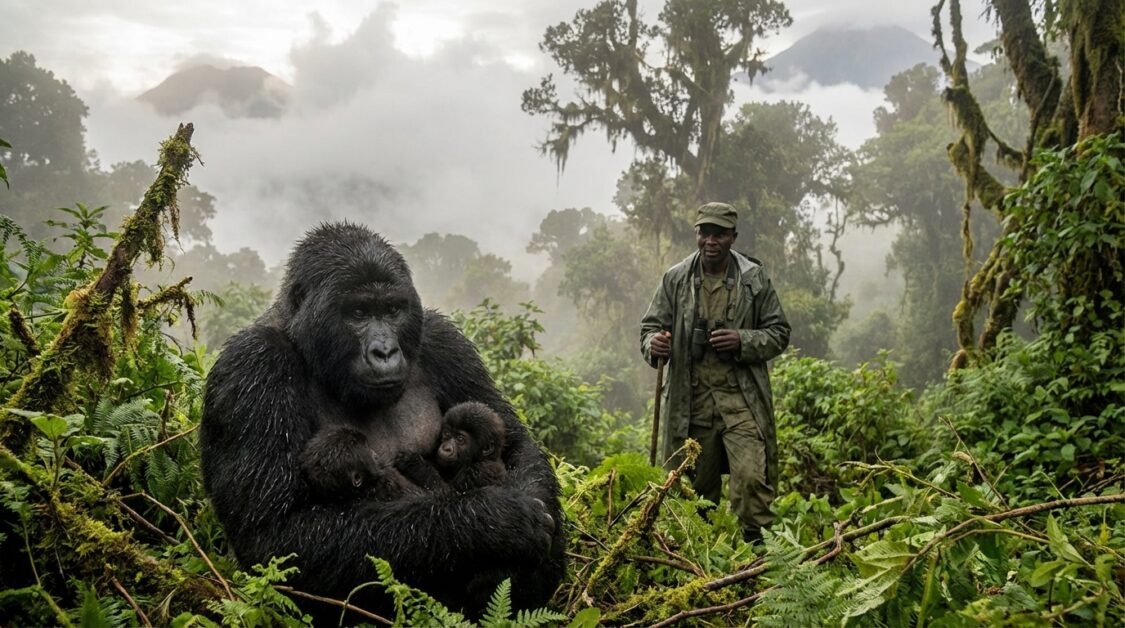
On January 3, 2026, in a rainforest surrounded by active volcanoes in the eastern Democratic Republic of Congo, a female mountain gorilla gave birth to twins.
Twin births in mountain gorillas occur in less than one percent of all pregnancies. The mother — a member of the Bageni family, the largest gorilla group in the park — held both infants close. The community trackers who watch over this family sent back the news by radio. At the Virunga National Park headquarters, the team felt something they had not felt in a long time: joy.
By March 2026, a second set of twins had been born in the park — also a boy and a girl, into the Baraka family. Nine gorilla births had been recorded in Virunga in the first three months of 2026 alone. The species that numbered only 254 individuals in the wild in 1981 had, against all odds, crossed the threshold of 1,000.
“Despite the challenges, life triumphs,” the Congolese Institute for the Conservation of Nature posted on social media.
The challenges the institute was referring to are extraordinary. Half of Virunga National Park — Africa’s oldest protected area, a UNESCO World Heritage Site, the last stronghold of the mountain gorilla — is currently occupied by the M23 rebel group, allegedly backed by Rwanda. Eight rangers have been assassinated in the line of duty. Patrol posts at the gorilla sectors of Bukima, Gikeri, and Mikeno have been destroyed. The park’s administrative headquarters in Rumangabo has fallen under rebel control. And in early 2025, the United States — historically the largest conservation donor to the Congo Basin — cut $23 million in funding to Virunga overnight.
The mountain gorilla is surviving in a war zone with shrinking resources and growing threats. This is the full story of how that is possible — and how long it can last.
Virunga in Numbers: 2026
- 1,050 — total mountain gorillas remaining in the wild worldwide — the entire global population
- 350+ — mountain gorillas living in Virunga National Park — roughly one third of all wild mountain gorillas
- 50%+ — of Virunga National Park currently under M23 rebel control, including the entire southern sector (National Geographic, 2025)
- 240+ — Virunga park rangers killed in the last two decades — one of the highest ranger mortality rates on Earth
- 50% — decline in general wildlife populations in Virunga since the M23 resurgence intensified in 2021
- 35% — of Virunga’s territory inaccessible to conservationists due to rebel occupation as of March 2026
- $23 million — in USAID funding to Virunga since 2019 — frozen by the Trump administration in early 2025
- 50 tonnes/month — chocolate produced at the Virunga Chocolate Factory — employing widows and children of fallen rangers
- 9 — gorilla births recorded in Virunga in first three months of 2026 alone — including two sets of twins
Part 1: Virunga — Africa’s Oldest Park, the World’s Most Dangerous Conservation Job
Virunga National Park was established in 1925 — first as Albert National Park, under Belgian colonial rule — making it the oldest national park in Africa. It stretches 7,800 square kilometres across the eastern Democratic Republic of Congo, running north to south for approximately 300 kilometres along the borders with Uganda and Rwanda. It includes two of Africa’s most active volcanoes — Mount Nyiragongo and Nyamuragira — dense equatorial rainforest, open savanna, glacier-capped mountains in the Rwenzori range, and the wetlands and hippo-filled waters of Lake Edward.
More than 3,000 plant and animal species have been recorded in Virunga, over 300 of them endemic to the Albertine Rift — found nowhere else on Earth. It is one of the most biodiverse landscapes on the planet. Its mountain gorillas are its most famous residents, but Virunga also holds significant populations of African forest elephants, hippopotamuses, African buffalo, chimpanzees, golden monkeys, lions, leopards, and hundreds of bird species.
It is also one of the most dangerous places on Earth to do conservation work.
More than 240 Virunga rangers have died in the past two decades defending the park from armed groups, poachers, and illegal resource extractors. The Congolese Institute for Nature Conservation (ICCN), which manages the park, traditionally names newborn gorillas after fallen rangers — a practice that says something about how constant and how deep the loss has been. The park has had directors shot in ambushes. It has had patrol posts destroyed and vehicles stolen by rebels. It has had entire sectors go unmonitored for months at a time because it was too dangerous to enter them.
And yet the gorillas are still there. Growing, slowly, year by year, birth by birth — including twin births in the first days of January 2026, while rebel fighters controlled the southern half of the park.
The Gorilla’s Journey: From 254 to 1,050
In 1981, a comprehensive survey found only 254 mountain gorillas left in the wild. The species was on a trajectory toward extinction within a generation. Habitat loss, poaching, civil war, and disease had reduced one of the world’s most intelligent animals to a remnant population clinging to survival in a few forested volcanic mountains.
What happened over the next 40 years is one of conservation’s most remarkable stories. Through the sustained, dangerous, and expensive work of rangers, veterinarians, trackers, and conservation organisations — working through genocides, civil wars, rebel occupations, and multiple rounds of international funding crises — the population grew. By 2018, it had crossed 1,000 individuals for the first time. The IUCN reclassified the mountain gorilla from Critically Endangered to Endangered — the only great ape to have improved its conservation status in recent decades.
As of 2026, approximately 1,050 mountain gorillas exist in the wild. They live in two populations: one in the Virunga Massif spanning DRC, Rwanda, and Uganda; the other in Uganda’s Bwindi Impenetrable Forest. Virunga National Park holds roughly one third of all wild mountain gorillas. They are not safe. They have never been safe. But they are more numerous today than at any point since serious monitoring began — because humans have chosen, repeatedly and at great personal cost, to protect them.
Part 2: The War Inside the Park — M23, Armed Groups, and a Century of Conflict
To understand what is happening in Virunga in 2026, you need to understand that the park has never known true peace. Its entire existence has been shaped by the political and military turmoil of central Africa. The 1994 Rwandan Genocide sent four million refugees across the border into DRC — many of them into or near the park itself. The Congo Wars of the 1990s and 2000s killed an estimated five to ten million people and militarised the forests of eastern DRC in ways that have never been fully undone.
Over 120 armed groups are currently estimated to be active in eastern DRC. The most powerful, the most well-equipped, and the most significant threat to Virunga is M23 — the March 23 Movement — a rebel force that is broadly understood to operate with Rwandan military support, though Rwanda denies this.
M23’s Occupation of Virunga: What It Looks Like on the Ground
M23 first appeared in 2012, taking territory in eastern DRC including areas adjacent to and inside Virunga. It was suppressed in 2013, re-emerged in 2017, and resurgent again — more powerfully than before — in 2022. By 2025, M23 controlled the city of Goma, the regional capital of North Kivu, and had extended its reach across large swathes of eastern DRC.
Inside Virunga, the consequences have been specific and severe. As of 2025, M23 controls more than 50 percent of the park, including the entire southern sector — where the most significant mountain gorilla habitat lies. Patrol posts at Bukima, Gikeri, and Mikeno — the three most critical gorilla monitoring stations in the park — have been destroyed. Some of the park’s vehicles and equipment have been stolen and repurposed by M23 for military operations.
The park’s administrative headquarters at Rumangabo, which houses the gorilla orphanage and the central coordination infrastructure for all conservation operations, fell under M23 control. Park director Emmanuel de Merode — a Belgian national who has devoted his career to Virunga and who survived an assassination attempt by ambush while on patrol — was prevented by M23 from using the small surveillance plane that allows him to coordinate operations across the park’s remote terrain.
The Virunga Foundation’s public-private partnership with the Congolese government, which has managed the park since 2008, now faces an unprecedented question: how do you manage a UNESCO World Heritage Site when its de facto ruler is a rebel group that is not party to any international conservation agreement?
How M23 Profits From Virunga’s Destruction
M23’s presence in Virunga is not simply a military occupation. It is an economic extraction operation. Research by academics at the University of Antwerp’s Institute of Development Policy documented the financial mechanisms in detail.
| Revenue Source | Amount per Transaction | Ecological Impact |
| Charcoal kiln taxation inside Virunga | $10–$30 per kiln | Massive old-growth deforestation for charcoal production |
| Roadblock taxation on charcoal trucks | $320–$700 per truck | Accelerates charcoal trade, increases deforestation pressure |
| Land sold to displaced people in park | $30 per hectare | Illegal farming inside protected gorilla habitat |
| Firewood access near refugee camps | ~$0.35 per roadblock | 8 million IDPs relying on park timber for survival fuel |
| Bushmeat trade facilitation | Percentage of sales | Poaching of gorillas, elephants, hippos for food and profit |
Source: University of Antwerp Institute of Development Policy, Mongabay analysis, 2025
The charcoal trade is particularly devastating. The felling of old-growth trees for charcoal not only strips the habitat of endangered mountain gorillas — it also accelerates carbon emissions from a region that the Congo Basin rainforest, the second-largest tropical rainforest on Earth, is supposed to absorb. Kahuzi-Biega National Park, south of Virunga, lost over 1,170 hectares of forest cover within its charcoal production zones in 2023 alone — more than double the historical average.
Behind the charcoal trade is the most heartbreaking human reality: approximately 8 million internally displaced persons living in camps on the outskirts of the park. These are people who have lost their homes, their livelihoods, and their safety to a war that began decades before most of them were born. They need firewood to cook. They need land to grow food. They need income to survive. The park is the closest available resource. They are not the enemy of the gorillas. They are the most visible human victims of the same war.
The Rangers: 240 Deaths in 20 Years
The Virunga rangers are, by any measure, among the bravest conservation workers on earth. They earn approximately $250 per month. They patrol with weapons in a genuine active conflict zone where they are targeted by armed groups who view them as obstacles to illegal resource extraction. They track gorillas through terrain that armed groups use as operational bases and ambush points. They dismantle traps set by poachers who are sometimes armed and sometimes working under the protection of militias.
In the past two decades, 240 of them have been killed. The deaths come in many forms. Alain Mukiranya, an assistant to Maiko National Park’s director, described rangers cut off from supply flights, from communication, from reinforcement — reduced to maintaining their posts on willpower and the knowledge that if they leave, the gorillas will be unprotected.
In July 2025, pilot Claude Nguo and ranger Daniel Kakule were killed when their surveillance aircraft crashed near Ishasha during an aerial protection mission. They had been flying to ensure the safety of ground teams. Both left behind young families.
Eight rangers were assassinated in an armed attack on a convoy near Rumangabo. Deputy park manager Rodrigue Katembo Mugaruka described the aftermath: “Some families requested that their loved ones leave their posts, and several rangers abandoned their work.” Morale is low. The fear is constant.
And yet the remaining rangers continue. Every day. Because if they stop, the gorillas are alone.
“You must justify why you are on this earth. Gorillas justify why I am here. They are my life. So if it is about dying, I will die for the gorillas.” — André Bauma, Head Gorilla Caregiver, Virunga National Park
Part 3: The American Betrayal — How a USAID Freeze Nearly Broke Virunga
For more than 25 years, the United States government was one of the most significant funders of conservation in the Congo Basin. Through USAID’s Central Africa Regional Program for the Environment and other channels, Washington sent hundreds of millions of dollars to support national parks, wildlife rangers, forest monitoring, and community conservation programmes across DRC, Congo Republic, Cameroon, and Gabon.
Since 2019 alone, USAID and the US Department of State provided more than $23 million to Virunga National Park — funding ranger salaries, aerial surveillance, veterinary care for gorillas, community development programmes, and the remote sensing technology that allows conservationists to monitor forest loss in real time.
In early 2025, the Trump administration froze all US foreign aid. The plug was pulled overnight. No warning. No transition plan. No alternative funding secured. Just silence.
What the Cut Actually Means on the Ground
Matthew Hansen, a remote-sensing scientist at the University of Maryland who had been working with Congo Basin authorities to map forests so they could receive payments for keeping them intact, described the impact with stark simplicity: “We just had the plug pulled on us, and we don’t have a plan right now.”
In Virunga specifically, the freeze forced the park to reduce ranger field patrols. Fewer patrols mean fewer trap removals. Fewer trap removals mean more gorillas caught. Fewer patrols mean less deterrence of poachers and illegal loggers. More importantly, ranger salary arrears create exactly the conditions under which rangers abandon their posts — as some already had after the assassinations near Rumangabo.
In Kenya, USAID was expected to provide nearly $13 million this year for conservation projects. Dickson Kaelo, head of the Kenya Wildlife Conservancies Association, told Mongabay that without this funding, communities that have been sustained by conservation tourism revenues would shift back to agricultural land use — meaning wildlife habitats would be converted to farms.
A federal judge ordered the administration to restore paused foreign aid in February 2025. The ruling’s implementation remained unclear. Conservation organizations were left, as one Mongabay source described it, in a financial and logistical vacuum.
Many organisations declined to speak publicly about the funding freeze, citing fear of retribution from the US government and uncertainty about the future of their grants. The silence itself was revealing.
“If you take away support for civil society, government, and the environment, it’s not going to be good at all.” — Matthew Hansen, University of Maryland
The Virunga Response: Chocolate, Hydroelectricity, and Self-Sufficiency
The Virunga Foundation had been anticipating this kind of crisis for years — not specifically from the United States, but from the general vulnerability of a conservation operation dependent on external donors in an active conflict zone. Their response, developed over more than a decade, is one of the most creative approaches to conservation funding anywhere in the world.
Recognising that the widows and children of fallen rangers were among the most economically vulnerable people in the region, the park’s management team established a chocolate factory — working with renowned Belgian chocolatier Dominique Persoone — to employ them directly in a sustainable enterprise. The Virunga Chocolate Factory now produces 50 tonnes of chocolate per month from locally grown cocoa, with plans for a 100-fold increase. The factory provides income, dignity, and a financial stake in the park’s continued existence for the families most affected by its dangers.
The park has also built hydroelectric plants using the rivers and altitude differentials of its volcanic landscape, providing clean electricity to surrounding communities. This electricity replaces charcoal as the primary energy source for homes and businesses near the park — directly reducing the economic pressure on the park’s forests. Communities with electricity have less reason to cut trees.
These initiatives do not replace government and international funding. They complement it. But they represent an understanding that conservation in a conflict zone cannot depend entirely on the goodwill of distant governments whose priorities change with elections.
Part 4: How the Gorillas Are Surviving — The Science of Survival Under Fire
The most extraordinary fact about Virunga in 2026 is not the war, the rebels, or the funding cuts. It is that the gorillas are having babies.
Nine births in the first three months of 2026. Two sets of twins — the rarest of gorilla births — within three months of each other. The Baraka family at 19 members. The Bageni family at 59 — the largest gorilla group in the park’s history. The Rugendo family at 20 individuals.
How is this possible?
The 110 Community Trackers: Conservation’s Frontline
When M23’s resurgence in 2024 made it impossible for uniformed rangers to operate in parts of the park, the Virunga Foundation established an emergency network of 110 community trackers — local residents living in or near gorilla habitat areas who agreed to monitor and protect the gorilla families on a daily basis.
These community trackers are not rangers. They are not armed. They are community members with intimate knowledge of the landscape and the gorilla families who have lived near them for generations. They report gorilla locations, health status, and any human intrusion via radio networks. They provide the early warning that allows veterinary teams to respond when a gorilla is found in a trap — as young Fazili was, on March 11, 2025, found caught in a poacher’s snare and receiving emergency treatment within hours of discovery.
The community tracker model recognises something that pure ranger-based conservation often misses: the people who live closest to wildlife are its most effective monitors. When they have a stake in the outcome — when their employment, their community’s reputation, and their relationship with the conservation organisation depends on the gorillas’ survival — they become its most committed defenders.
Gorilla Families Adapting to War
The gorillas themselves are not passive subjects of conservation. They are highly intelligent social animals who, over decades of living near humans, have developed their own adaptations to the instability of their environment. Virunga park officials reported that a gorilla family from the DRC had taken refuge in Rwanda — crossing an international border to escape areas of intense conflict, demonstrating the species’ capacity to respond to environmental change.
Mountain gorillas are not territorial in the aggressive sense. They move in response to food availability, seasonal changes, and threats. In years of high conflict, some families shift toward areas with more consistent monitoring and less armed group activity. In years when specific sectors of the park are safer, families return. The population’s continued growth suggests that the animals are, to some degree, navigating the conflict successfully — finding safety within a landscape that offers both extreme danger and, in certain sectors, genuine protection.
Disease: The Invisible Threat
Mountain gorillas share approximately 98.4 percent of their DNA with humans. This means they are susceptible to virtually every human respiratory disease — colds, flu, tuberculosis, measles, Ebola. A gorilla family that encounters a sick human — a ranger, a poacher, a tourist, a displaced community member — can contract and spread disease through the entire group.
The displacement of 8 million people near Virunga, many living in overcrowded camps with inadequate healthcare, combined with reduced ranger patrol presence and increased illegal human entry into the park, represents a genuine disease transmission risk that is difficult to quantify but impossible to ignore. The COVID-19 pandemic demonstrated how quickly human respiratory diseases can reach great ape populations — multiple gorilla groups in Africa tested positive during the pandemic years.
Veterinary monitoring — the kind made possible by the community tracker network and by helicopter access to remote gorilla families — is the primary defence against this risk. It is also the kind of work most directly undermined by funding cuts and ranger mortality.
Part 5: Three Crises Converging — Why 2026 Is the Most Critical Year
Virunga has survived war before. It has survived funding cuts before. It has survived poaching surges and ranger losses before. What makes 2026 different is that all three threats have intensified simultaneously, and the international safety nets that have historically absorbed the worst of these shocks are weakened or absent.
Crisis 1: M23 Consolidation
M23 captured Goma in 2025 and has consolidated control over large parts of North Kivu. Unlike previous rebel occupations that were temporary or contested, M23’s current position is more stable — making the planning horizon for conservation operations inside occupied zones more uncertain. The M23-controlled areas of Virunga now have an established economic extraction infrastructure: charcoal taxation, land sales, and bushmeat trade routes. This infrastructure creates vested interests in continued occupation. Reversing it requires not just military victory over M23 but dismantling the economic ecosystem that has grown around it.
Crisis 2: USAID Funding Freeze
The $23 million in US funding to Virunga represented approximately a third of the park’s operating budget. Its abrupt removal, combined with the broader freeze of USAID funding that has affected conservation projects in nine African countries and dozens of nations across Latin America and Asia, removes the international financial backstop that has allowed Virunga to maintain operations during conflict cycles. The Virunga Foundation’s self-financing initiatives — chocolate, hydroelectricity, sustainable agriculture — are significant but cannot fully replace institutional government funding in the short term.
Crisis 3: 8 Million Displaced People
The humanitarian crisis created by the DRC conflict has displaced 8 million people — more than the populations of Singapore or Switzerland. The majority of these people are in the eastern DRC, surrounding the parks. They need food, shelter, water, and fuel. The forests of Virunga and Kahuzi-Biega are the most accessible source of many of these resources. Even with the best intentions, the pressure of 8 million survival-driven human beings against a park boundary is a conservation challenge of an entirely different scale from anything the park has previously faced.
Conclusion: Life Triumphs — But for How Long?
Somewhere in the Mikeno sector of Virunga National Park, in a forest that is half occupied by rebel soldiers and fully mapped by community trackers, a mother mountain gorilla is nursing two infants. They were born on a day when gunfire could be heard in the distance, when their mother’s family group — 19 individuals, the Baraka family — moved carefully through terrain that humans with weapons also move through.
The infants will spend the next four years completely dependent on their mother. They will learn to walk in this forest, to climb these volcanic slopes, to recognise the faces of the trackers who come to count them every day. They will grow up as members of a species that should by all rights be extinct — and is not, because a decision was made, decades ago, to fight for them.
That fight is under extraordinary pressure in 2026. M23 controls half the park. Eight rangers were assassinated. Two pilots died in a surveillance crash. America cut $23 million in funding overnight. The charcoal trade is stripping the forest. Eight million displaced people are pressing against the boundaries.
And nine gorillas were born in the first three months of 2026.
The Congolese Institute for the Conservation of Nature was right: despite the challenges, life triumphs. But life triumphing is not the same as life being safe. The gorilla population has grown because humans have chosen to protect it — at extraordinary cost, through extraordinary obstacles. That choice must continue to be made, year after year, by rangers, trackers, donors, and governments.