These are not statistics. These are events that happened — documented, photographed, verified — in 2024, 2025, and the first months of 2026. And they represent something larger and more frightening than any single animal’s death.
Across three African countries — Sudan, Kenya, and Zimbabwe — the same forces are converging: climate change driving unprecedented droughts, human hunger growing desperate enough to threaten conservation, and wildlife caught in the middle of a crisis they did not create and cannot escape.
This is that story. Told honestly, with real data, and with the detail it deserves.
The Scale of the Crisis: Numbers That Demand Attention
- 24.6 million people — facing acute hunger in Sudan — nearly half the entire population (WFP, 2025)
- 200 elephants — shot by Zimbabwe government to feed its drought-stricken citizens (September 2024)
- 3.3 million people — pushed into acute food insecurity in Kenya as of March 2026 — a 52% increase in one year (IPC/CARE Kenya)
- 62 people killed — by wildlife in Zimbabwe in 2025 — a 27% rise from 2024, driven by desperate animals searching for food and water
- 64% below average — rainfall in Kenya’s north-east in February 2026 — driving animals and humans toward the same shrinking water sources (NDMA, 2026)
Part 1: Sudan — When War Kills More Than People
Sudan’s crisis begins with a war, but its consequences reach far beyond the battlefield. Since April 2023, a brutal conflict between the Sudanese Armed Forces (SAF) and the Rapid Support Forces (RSF) has displaced over 12 million people — making it the world’s largest displacement crisis — and pushed nearly half the country’s population into acute hunger.
But there is a dimension to Sudan’s collapse that rarely makes international headlines: what war does to the animals, the land, and the ecosystems that remain after the fighting passes through.
The Farmland Destroyed — and What That Means for Wildlife
Sudan’s pastoralist communities — the people who herd camels, cattle, goats, and sheep across the country’s semi-arid rangelands — have always shared their landscape with wild animals. The boundary between livestock grazing land and wildlife territory in Sudan was never rigid. Giraffes, gazelles, leopards, and hyenas moved through the same corridors as herds of cattle.
The war has demolished this balance. A March 2026 investigation by Yale University’s Humanitarian Research Lab, reported by The Guardian, documented how the RSF systematically attacked 41 farming communities in North Darfur between March and June 2024. The attacks were not random. They appeared designed to destroy agricultural infrastructure before the siege of El Fasher — targeting livestock enclosures, farm equipment, and the farmers themselves. Legal experts told The Guardian that this pattern constituted the use of starvation as a method of warfare.
When farming communities flee or are destroyed, livestock dies or is looted. And when livestock disappears, the ecological buffer between desperate humans and wild animals evaporates. People who have no food will hunt. Wildlife corridors that were once maintained by communities now go unprotected. Poaching — already a threat in Sudan’s wildlife areas — becomes survival strategy rather than crime.
Sudan’s Wildlife Before the War: What Is Being Lost
Sudan was never a country with East Africa’s famous megafauna, but it held significant biodiversity. The Dinder National Park, a UNESCO Biosphere Reserve on the Ethiopian border, sheltered lions, leopards, cheetahs, Nile crocodiles, roan antelope, and tiang. The Radom National Park in South Darfur — one of the least explored protected areas in Africa — was home to elephants, giraffes, and African wild dogs.
Since the war began, both parks have been effectively inaccessible to conservation staff. There is no monitoring. There is no anti-poaching. There are no wildlife surveys. What is happening inside Sudan’s protected areas right now is, in the most literal sense, unknown. The silence from these parks is itself a warning.
The broader ecological damage is more visible. Sudan’s agricultural land — the source of food for the country and the ecological foundation that kept people in their communities rather than pouring into wildlife areas — has experienced two consecutive failed farming seasons. Food prices have risen over 100 percent above 2024 levels in some regions. People who cannot buy food must find it elsewhere. In a country where wild animals still exist, that pressure flows directly to them.
“Sudan is experiencing the most extreme hunger crisis globally. Without immediate humanitarian intervention, hundreds of thousands could perish.” — UN Human Rights Experts, April 2025
The Indirect Casualty: Conservation Infrastructure
Sudan had been developing its conservation capacity in the years before the war. International NGOs, government wildlife departments, and community conservancies were beginning to build the kind of institutional foundation that supports wildlife recovery elsewhere in Africa. All of that has now been disrupted or destroyed.
Park rangers have been displaced. Wildlife vehicles have been commandeered. The radio networks and monitoring systems that track animal movements and detect poaching have gone silent. Rebuilding this infrastructure — which typically takes years even in stable conditions — will require not just peace but sustained investment that no one is currently promising.
The animals of Sudan’s protected areas cannot wait for that rebuilding to happen. They are living, unprotected, in what is now a war zone.
Part 2: Kenya — The Drought That Never Ends
Kenya presents a different kind of crisis — not a war, but a slow-motion ecological collapse driven by climate change. The story of Kenya’s wildlife and drought in 2025 and 2026 is the story of what happens when the rains stop coming, year after year, until the land simply runs out of ways to recover.
February 2026
In the first week of February 2026, photographs from Wajir and Turkana counties in northeastern Kenya spread rapidly across social media and international news platforms. They showed emaciated camels collapsing in dust. Cattle lying dead in fields, their bones visible through thinning skin. A giraffe’s carcass being dragged from a dried-up reservoir by Kenya Wildlife Service rangers — the animal had become stuck in the mud at the bottom of the empty waterhole, too weak from starvation to free itself, and had died there.
By February 9, 2026, the Associated Press confirmed what local communities had been reporting for months: drought conditions had pushed over 2 million people in northeastern Kenya into acute hunger. The UN and international aid organizations confirmed the scale of the crisis. Normally, the AP noted, animals die first. And animals were dying — in large numbers, across large areas.
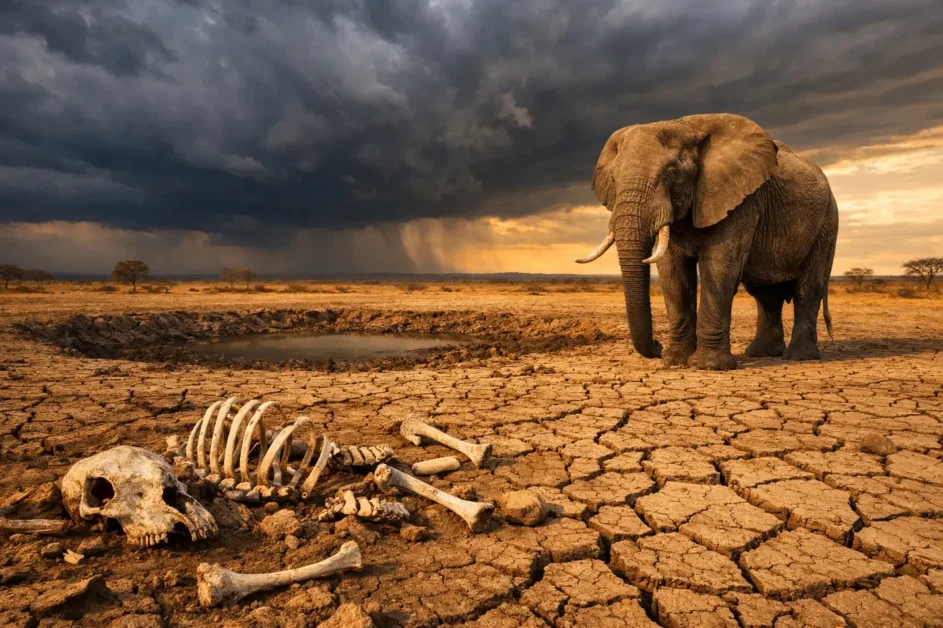
The situation in Kenya’s northeast is the product of multiple consecutive failed rainy seasons. Climate scientists tracking the Horn of Africa have recorded four consecutive below-average wet seasons since 2020. In February 2026, rainfall in Garissa County was 64 percent below average. In January 2026, it was 69 percent below average. The land, the livestock, and the wildlife have had no meaningful recovery period between droughts.
How Drought Kills Kenya’s Wildlife: The Chain Reaction
The mechanism by which drought destroys wildlife is not simple starvation. It is a chain of consequences, each one making the next more likely and more devastating.
- Water disappears first. Seasonal rivers stop flowing. Waterholes dry up. Animals migrate toward the few remaining water sources — often the same sources that humans and livestock depend on.
- Food collapses next. Grasses dry and die. Browsing species like giraffes and elephants find the trees they depend on depleted by competition. Carnivores find their prey weakening and dispersing, which disrupts established hunting patterns.
- Disease follows. Animals weakened by dehydration and malnutrition become vulnerable to infections they would normally resist. Anthrax outbreaks, common in drought years, kill dozens of animals at a time.
- Human-wildlife conflict intensifies. Desperate animals push into farms and settlements searching for food and water. Farmers, equally desperate, retaliate. Elephants in Samburu in 2022 were shot by Kenya Wildlife Service rangers after they killed a woman while searching for water — a direct consequence of drought-driven range collapse.
- Carrion feeders crash. As National Geographic documented in Wajir County, the indirect victims of drought include vultures, marabou storks, and other scavengers whose populations plummeted because poison set out to target problem predators killed them too.
The Numbers From Kenya’s Previous Drought Cycle
The drought of 2020 to 2023 — which the current 2025-2026 drought is already echoing in severity — left a documented wildlife toll that Kenya’s conservation community is still reckoning with.
| Species | Confirmed Deaths (2022 drought alone) | Additional Impact |
| Elephants | 200+ | Many orphaned calves rescued at Reteti Sanctuary |
| Common Zebras | Nearly 400 | Found dead across Samburu and northern counties |
| Wildebeest | 500+ | Mortality concentrated near dried waterholes |
| Grevy’s Zebra (endangered) | Significant losses | IFAW supported Grevy’s Zebra Trust emergency response |
| Giraffes | Multiple documented | Wajir giraffe died trapped in empty reservoir mud |
| Migratory birds | Widespread starvation | European Roller remains found across dry northern Kenya |
Source: Kenya Wildlife Service, VOA Learning English, National Geographic, IFAW (2022-2023)
As of March 2026, CARE Kenya’s assessment shows the situation is now worse than the 2022 peak. The IPC confirmed that 3.3 million Kenyans are in high levels of acute food insecurity — a 52 percent increase in a single year. The 400,000 people in Dadaab refugee camp, one of the world’s largest, have had their food rations cut to the lowest level in the camp’s 35-year history.
When people have this little food, wildlife has no protection. Hungry communities in areas without effective law enforcement will hunt what they can find. The pressure on Kenya’s wildlife areas — already fragmented and shrinking — compounds with each failed rainy season.
The Hirola: Kenya’s Most Endangered Antelope — and the Drought’s Quiet Victim
Among Kenya’s most critical conservation stories is the hirola — an antelope found only in northeastern Kenya and a small part of Somalia. With only 200 to 250 individuals remaining in the wild, the hirola is one of the world’s most endangered bovids. It exists almost entirely in the same drought-affected northeastern counties where the current crisis is most severe. Drought, disease, predation, and competition with livestock are the primary threats the IUCN lists for this species — all of which intensify dramatically in crisis years like 2026.
The hirola does not attract international headlines. It has no Instagram following. But it is living through exactly the conditions most likely to deliver the final blow to a critically endangered species with no room left for error.
Part 3: Zimbabwe — When a Government Shoots Its Own Elephants
Of the three countries in this story, Zimbabwe presents the most morally complex situation. Sudan’s wildlife crisis is a consequence of war. Kenya’s is a consequence of climate change acting on a region with limited resources. Zimbabwe’s is a consequence of a government making an agonizing choice between the survival of its people and the survival of its most iconic animals — and deciding, in September 2024, to shoot 200 elephants.
The Decision and the Debate
In September 2024, Zimbabwe’s Parks and Wildlife Management Authority spokesperson Tinashe Farawo announced that the government was authorizing the culling of 200 elephants. The justification was stark: nearly half of Zimbabwe’s population faced the risk of acute hunger following the worst drought in four decades, driven by the El Niño climate pattern. The elephant meat, officials said, would be distributed to the communities most in need.
Zimbabwe is home to more than 84,000 elephants — the second-largest population in the world after Botswana. Environment Minister Sithembiso Nyoni told parliamentarians that Zimbabwe had more than double its ecological carrying capacity of 45,000 elephants. The overpopulation, she said, was causing resource scarcity that was itself driving human-wildlife conflict.
The response from conservation organizations was immediate and deeply divided.
Those who opposed the cull — including the Sheldrick Wildlife Trust and numerous international animal welfare organizations — argued several points. First, that a cull kills indiscriminately, disrupting the complex family structures and social hierarchies that elephant herds depend on. Second, that traumatizing surviving elephants by killing their family members makes them more dangerous and aggressive toward humans, worsening the very conflict the cull was meant to reduce. Third, that killing 200 elephants when 24 million people need food is, as one Zimbabwean conservationist put it, ‘an insult’ — a distraction from the scale of aid that the situation actually required.
Those who understood the government’s position — primarily conservationists based in Zimbabwe who work with these specific ecosystems — acknowledged that in fragmented habitats where natural migration is impossible, population management sometimes requires human intervention. They argued that translocation — moving elephants to other protected areas — would be more humane and more ecologically sound than culling, but that Zimbabwe lacked the resources to fund it.
“Nature has long maintained balance among wildlife populations. When species begin to edge toward overpopulation, drought leads to natural die-offs. The old and weak succumb, while the strong survive. A cull, by contrast, kills indiscriminately.” — Sheldrick Wildlife Trust, 2025
The cull went ahead. In 2025, Zimbabwe repeated it, with plans announced for further culls. A dangerous precedent — feared by conservationists when the first cull was authorized — had been set.
The Hwange Horror: Elephants Dying in Their Own Park
While the cull debate played out in government offices and international media, a different and even more viscerally painful story was unfolding in Hwange National Park — Zimbabwe’s largest national park and one of the most important elephant sanctuaries in Africa.
Animal Survival International, working with the Presidential Elephants Research Trust in a 7,413-acre area bordering Hwange, documented conditions in late 2024 that the organization described as catastrophic. Teams found elephants clustered beneath skeletal trees in temperatures reaching 40°C, seeking shade that the bare branches could barely provide. In dried-up waterholes, they found the remains of animals who had died waiting for relief.
The most devastating observation was this: mother elephants were dying of exhaustion and thirst, their milk drying up before they died. Their calves — which need their mothers’ milk for up to four years — were left beside the bodies, starving, not understanding what had happened.
“In dried-up waterholes, we found the remains of animals who died waiting for relief that never came. Elephant mothers’ milk had dried up as they died, leaving their calves to starve.” — Animal Survival International, 2024
The rainy season that arrived in late December 2024 brought some temporary relief. But as of 2025, Zimbabwe’s rainy season is almost two months shorter than it was historically — a direct consequence of climate change. The respite was brief. The drought returned.
Human-Wildlife Conflict in Zimbabwe: 62 Killed in 2025
The drought’s effect on Zimbabwe’s wildlife is not only about animals dying of thirst. It is also about animals and humans being pushed into increasingly desperate competition for the same shrinking resources — with lethal consequences on both sides.
In January 2026, Zimbabwe Parks and Wildlife Management Authority reported that 62 people were killed and 81 injured in wildlife attacks across Zimbabwe in 2025. This was a 27 percent increase from 2024, when 49 people were killed. The trend is accelerating. A January 2026 academic analysis published in the journal Phys.org found that fatal human-wildlife encounters in Zimbabwe had risen fourfold between 2016 and 2022 alone.
The geography of the deaths tells its own story. More than 80 percent occurred in just three districts: Kariba, Binga, and Hwange — all located along Zimbabwe’s northern and western frontier, close to Lake Kariba and the country’s largest protected areas. These are places where people must go to water sources that crocodiles also inhabit, where walking to fields means crossing elephant corridors, and where fishing means entering rivers that hippos and crocodiles share.
Climate change intensifies every element of this conflict. In drought years, elephants move further and more desperately in search of water and forage, increasing their presence in communal lands. Crocodiles, pushed into smaller water bodies as rivers shrink, encounter humans more frequently at the remaining waterholes. The animals are not becoming more aggressive — they are becoming more desperate. And so are the people who share their landscape.
| District | Primary Threat Animal | Why Most Affected |
| Kariba | Crocodiles (50%+ of deaths) | Large water body, fishing communities, poor water access |
| Binga | Elephants & Crocodiles | Border with protected areas, high elephant movement |
| Hwange | Elephants | Adjacent to Hwange NP, Africa’s 2nd largest elephant pop. |
Source: Phys.org academic analysis, January 2026; ZimParks, January 2026
The Thread That Connects All Three: Climate Change and Human Decisions
Sudan, Kenya, and Zimbabwe are different countries facing different immediate crises. One has war. One has drought without war. One has drought combined with wildlife overpopulation in fragmented habitats. But they share the same underlying driver: a climate system that is becoming less predictable, less forgiving, and less capable of sustaining the ecological relationships that both wildlife and human communities depend on.
The rainfall that Kenyan pastoralists need to keep their livestock alive is the same rainfall that refills the waterholes that elephants need to survive. The farmland in Sudan that the RSF destroyed was also the buffer zone that kept hungry humans from entering wildlife areas. The carrying capacity of Zimbabwe’s parks is being calculated using rainfall averages that no longer apply in a warming world.
Every drought that is made more severe by climate change, every conflict that destroys agricultural buffers, every failed rainy season that drives animals and humans toward the same water — these are not separate problems. They are the same problem, manifesting differently in different places at different speeds.
The UN Environment Programme’s Elizabeth Mrema said it plainly during the Zimbabwe elephant cull controversy: the reality is an unprecedented increase in droughts. The question is not whether this will continue. It will. The question is whether the international community — and the governments of the countries most affected — will respond at the scale the crisis demands.
What Can Actually Help: Evidence-Based Responses
1. Emergency Water Provisioning for Wildlife
In Zimbabwe, Animal Survival International is working with the Presidential Elephants Research Trust to equip existing boreholes with solar-powered pumps, creating reliable water sources at critical locations bordering Hwange during dry seasons. This approach — simple, scalable, and proven — can prevent mass mortality events in specific, high-value wildlife areas. In Kenya, Reteti Elephant Sanctuary has demonstrated that emergency nutritional support for orphaned calves can save animals that would otherwise die. These interventions are not enough on their own, but they save individual lives while longer-term solutions are built.
2. Translocation Over Culling
Zimbabwe’s elephant overpopulation problem has a humane solution: translocation to other protected areas in the region. The Kavango Zambezi Transfrontier Conservation Area — spanning Zimbabwe, Botswana, Zambia, Zimbabwe, and Namibia — covers 520,000 square kilometres and could absorb elephant populations from overstocked parks. The barrier is cost: translocation is expensive, requires specialized equipment, and needs international funding to work at scale. The alternative — repeated culls — damages elephant social structures, increases human-elephant conflict through traumatized survivors, and sets conservation precedents that undermine decades of protection.
3. Community-Based Conservation Tied to Food Security
Al Jazeera’s reporting from South Sudan identified the key insight that applies across all three countries: when communities are food secure, they protect wildlife. When they are not, they hunt it. Conservation that is disconnected from the food security of the communities living beside protected areas will always be undermined in times of crisis. Programmes that pay communities directly for wildlife protection — through wildlife conservancy fees, tourism revenue sharing, or direct conservation payments — have been shown to work in Kenya’s community conservancies. Scaling these programmes, and linking them to drought-resilience support, is the most durable long-term solution.
4. International Funding for African Wildlife in Crisis
The WFP needs $700 million to continue Sudan operations through June 2026. CARE Kenya is calling for emergency funding increases for the 3.3 million people in crisis in northern Kenya. These are human crises that demand human response. But wildlife conservation in these same areas cannot be treated as a luxury to be addressed after the human crisis passes — because by the time the human crisis passes, the wildlife may already be gone. Integrated funding that treats human food security and wildlife conservation as interconnected — which they genuinely are — is the approach that evidence supports.
Conclusion: Africa’s Animals Cannot Wait
In a dried-up waterhole in Wajir County, Kenya, a giraffe’s body lay in the mud. It had arrived seeking water that was no longer there, and been too weak from starvation to leave. No one came to help it in time.
In Hwange, Zimbabwe, an elephant calf stood beside its dead mother for two days. Its mother had died of thirst in 40-degree heat. The calf had no way of knowing that the drought that killed her was made worse by decisions made in cities on the other side of the world.
In Sudan, the wildlife of Dinder and Radom National Parks lives in an information blackout. No one is monitoring them. No one is protecting them. What is happening to them right now, no one can say.
These animals — and the ecosystems they represent — are not incidental casualties of Africa’s human crises. They are living indicators of the health of the land. When the land is healthy enough to support elephants, lions, giraffes, and zebras, it is also healthy enough to support human communities. When it is not, both suffer.
The droughts in Kenya and Zimbabwe will return. Sudan’s war will eventually end. But the wildlife that survives — or disappears — during these crises will determine what Africa’s ecosystems look like for generations. The window to act is open. It will not stay open forever.