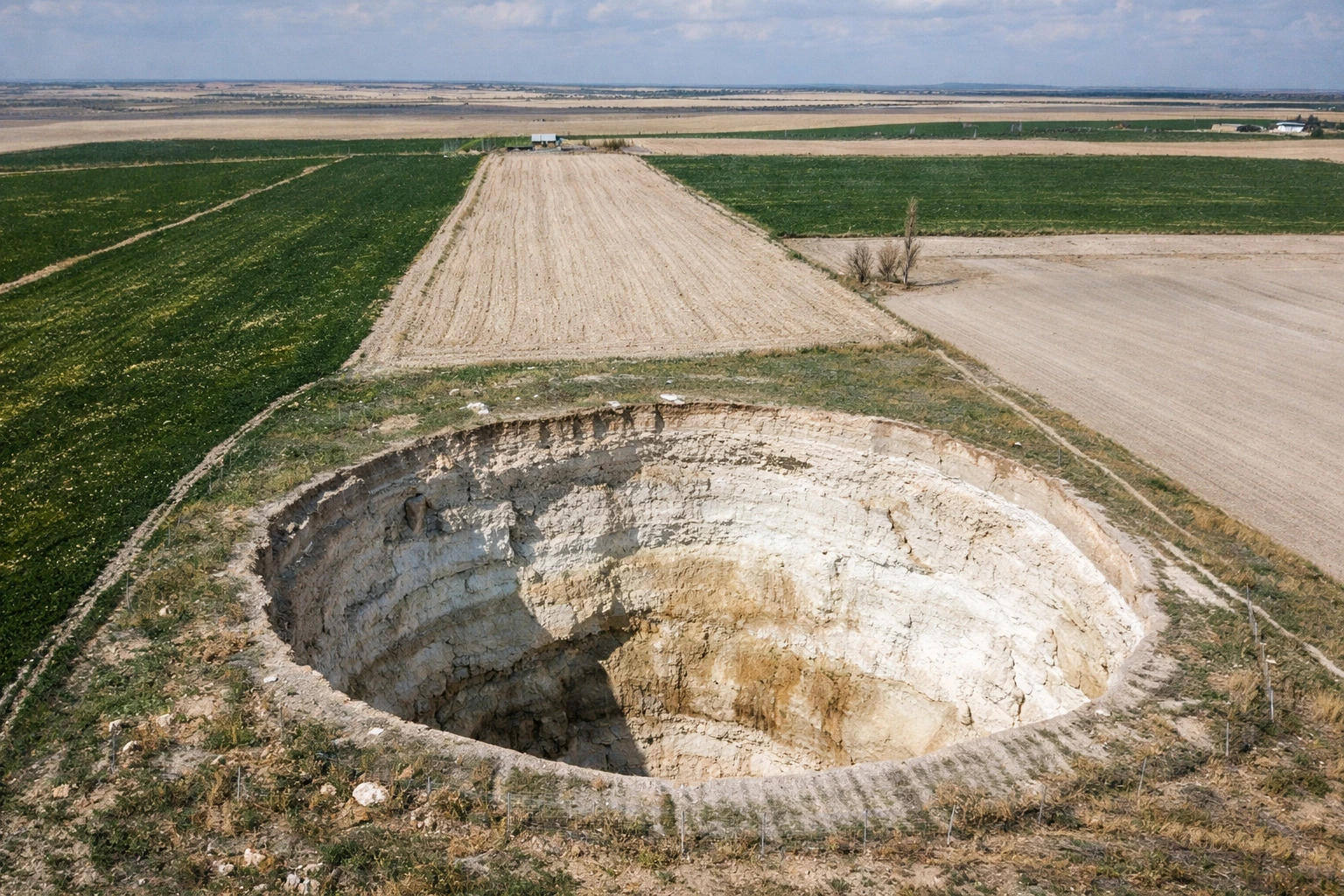
Across the wide agricultural plains of Central Turkey, a quiet but profound environmental transformation is unfolding beneath the soil. What once appeared to be stable, productive farmland is increasingly giving way to sudden sinkholes—deep, circular collapses known locally as Obruk. These craters are not just geological curiosities; they are a visible manifestation of a fragile balance between land, water, and human survival that has finally snapped.
In regions such as the Konya Plain, Turkey’s “breadbasket,” the land is telling a story of extreme pressure and depletion. This is where the quiet crisis of groundwater mismanagement meets the sudden violence of geological collapse.
The Anatomy of a Collapse: Why the Ground Fails
To understand Turkey’s sinkhole crisis, we must look at the unique geology of the region. The Konya Plain sits on a foundation of Karst topography—a landscape formed from soluble rocks such as limestone, gypsum, and dolomite.
The Role of Groundwater Support
For thousands of years, underground aquifers (natural water tanks) filled the hollow spaces in this limestone. This water provided “hydrostatic pressure,” essentially acting as a pillar that supported the weight of the soil above.
- The Depletion: When humans pump out groundwater for intensive farming, that support disappears.
- The Void: The once water-filled cavities become hollow air pockets.
- The Gravity Snap: When the weight of the dry topsoil becomes too heavy for the hollow limestone ceiling to hold, the ground collapses instantly, often creating craters up to 50 meters deep.
Agriculture vs. Aquifers: A Dangerous Dependence
The primary driver of this crisis is the unsustainable extraction of groundwater. Central Turkey’s agriculture has long relied on deep-well irrigation to support thirsty crops like sugar beets and corn in an otherwise semi-arid climate.
Beyond Natural Recharge Rates
Groundwater systems develop over millennia, maintaining a delicate equilibrium. However, modern farming has accelerated extraction far beyond natural recharge rates.
- Unpredictable Rainfall: As climate patterns shift, rainfall and snowmelt—the primary sources of aquifer refill—have declined significantly.
- The Illegal Well Crisis: Estimates suggest there are thousands of unlicensed wells in the region. Each well acts as a straw, sucking the life out of the earth faster than nature can replenish it.
The “Slow-Moving” Disaster: Land Subsidence
While sinkholes are sudden, they are often preceded by Land Subsidence—a gradual sinking of the earth’s surface.
- Satellite Evidence: Modern monitoring tools and InSAR (Interferometric Synthetic Aperture Radar) data have revealed that parts of central Turkey are sinking by several centimeters every year.
- The Invisible Threat: This suggests that even in areas where sinkholes haven’t appeared yet, the entire geological structure is weakening. A field that appears normal today is scientifically “primed” for a collapse tomorrow.
The Human Side: Cultivating Fear
For the farming communities of Konya, the impact is deeply personal and psychological. Fields that have been cultivated for generations can become unusable overnight.
- Economic Ruin: Machinery, expensive irrigation systems, and entire harvests can be lost in seconds.
- A Loss of Trust: Farmers speak of a growing unease—a feeling that the land beneath their feet is no longer a stable partner. Each planting season carries a silent question: Will the soil hold?
- Infrastructure Risk: As sinkholes move closer to residential areas and highways, they threaten not just livelihoods, but human life itself.
Environmental & Biodiversity Consequences
The appearance of sinkholes disrupts more than just human activity; it alters the entire local ecosystem.
- Drainage Disruption: Sinkholes alter natural drainage patterns, sometimes draining local wetlands into deep underground chasms.
- Aquifer Contamination: These open craters act as direct funnels for surface pollutants, fertilizers, and pesticides to enter the deep groundwater, contaminating the very water farmers rely on.
- Soil Fertility Loss: The loss of topsoil and the disruption of underground water flows mean that once-productive land may never recover its original fertility.
The Sinkhole Crisis Dashboard
| Factor | Impact on Konya Plain | Long-term Risk |
| Number of Sinkholes | From a few dozen to over 2,500+ | Exponential growth if extraction continues |
| Groundwater Level | Dropping 1-2 meters annually | Permanent depletion of ancient aquifers |
| Soil Composition | Karst/Limestone heavy | Highly susceptible to sudden collapse |
| Economic Role | Produces 10% of Turkey’s grain | National food security threat |
| Climate Influence | Prolonged droughts & heatwaves | Reduced natural recharge of water |
The Global Warning: A Lesson Written in Dust
Turkey’s experience is a “canary in the coal mine” for other agricultural regions globally. From the Central Valley in California to parts of North India, agricultural areas dependent on groundwater are experiencing declining water tables.
- The Tipping Point: Natural systems have limits. When those limits are ignored for short-term profit, the response is often sudden, irreversible, and catastrophic.
- Food Security: As central Turkey plays a vital role in national food output, the loss of this land creates a ripple effect of rising food prices and economic instability.
Sustainable Solutions: Rethinking the Relationship with Water
Addressing the crisis requires more than just filling in holes with soil—which scientists warn is a useless, temporary fix.
- Crop Substitution: Moving away from water-intensive crops (like sugar beets) toward drought-resistant varieties.
- Strict Well Regulation: Mapping and regulating all illegal wells to stabilize the water table.
- Advanced Irrigation: Implementing drip irrigation systems that reduce water waste by up to 50%.
- Artificial Recharge: Researching ways to divert excess surface water during rainy seasons into underground aquifers to “re-pressurize” the limestone cavities.
Conclusion: A Renewed Respect for the Foundation
Beneath Turkey’s golden wheat fields lies a lesson with global relevance. The growing number of sinkholes is not merely a geological curiosity—it is a warning written into the land itself. It tells us that our modern civilization is built on a foundation that requires responsibility, restraint, and a deep respect for natural limits. Responding to the sinkhole crisis is not just about saving a farm; it is about ensuring that the ground remains stable for the generations yet to come.